
SOCELI Hanging Glass Bottle Car Air Freshener (10ml): What It Is and How It Freshens the Air While Decorating Your Car Interior
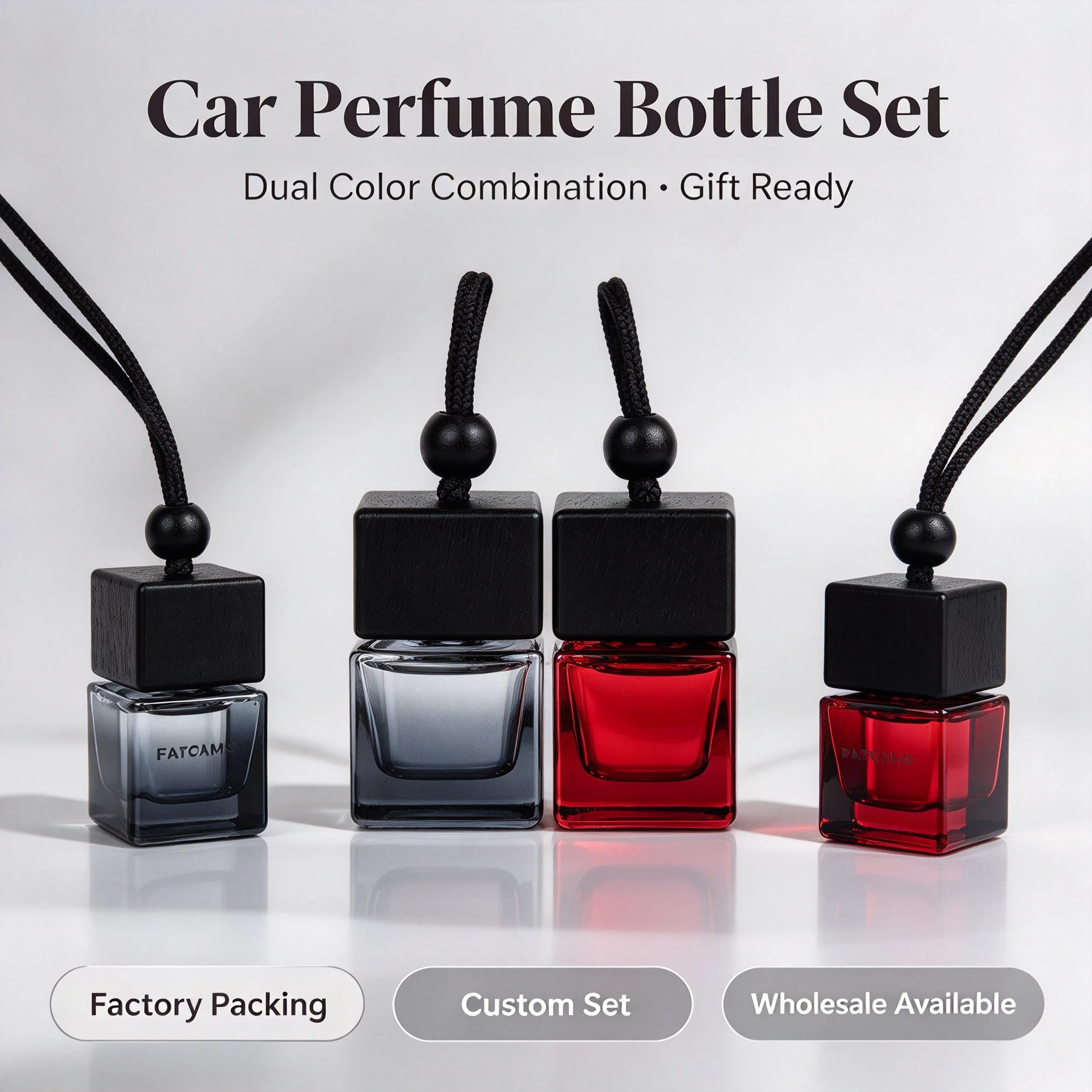
The SOCELI Hanging Glass Bottle Car Air Freshener (10ml, model T188) is a product whose core function is air freshening, while also serving as a visual accent inside the car. Its basic construction is straightforward: a square glass bottle body, a natural wood cap, a 10ml capacity, and a hanging design that secures it to the rearview mirror or another hanging point inside the car. To understand this product, the key is to look at what each of these three elements changes.
What the 10ml glass bottle body combined with a natural wood cap means inside a car
10ml is the capacity limit of this product. It determines the refill rhythm and usage cycle of a single bottle, and it also allows the bottle to be made relatively compact, so that when hung it does not noticeably obstruct the driver's line of sight. For buyers and distributors, 10ml is a convenient specification unit for creating combination packs and for displaying products in sets.
The combination of a glass bottle body and a natural wood cap affects the look and feel in the special environment of a car interior. The glass itself offers light transmission and a sense of weight, and its square outline has clean lines, making it look more like a small object than a consumable when placed inside the car;The wooden cap creates a material contrast among the mostly plastic interior trim parts, giving it a visual quality closer to that of home or gift products. It should be noted that glass means attention must be paid to shipping protection and secure suspension — this is a confirmation item at the packaging and structural level, not an issue of product positioning.
How the hanging design turns an air freshener from a functional part into a decorative piece
The hanging form solves the question of "where to place it." If a car air freshener relies on an air vent clip or placement on the center console, its position is limited by the vehicle's structure and it can easily be crowded out by other items. The hanging method places the product in the visual open space below the rearview mirror, avoiding the air vents and cup holders while keeping the bottle in a position that both the driver and passengers will naturally see.
The result of this position choice is: the air freshener is no longer just a "part that emits fragrance," but a continuously visible hanging decoration within the car's interior space. The material combination of the glass bottle body and the wooden cap only truly comes into its own in this position — they are seen, not just smelled. This is also why this product places the "air freshening functional carrier" and "refined in-car decorative element" in the same sentence: the function is carried by the essential oil, while the decorative quality is jointly carried by the bottle material and the hanging position.
It should be noted that specific information such as fragrance options, scent longevity, and safety certifications is not covered in this section; before purchasing or listing, you should confirm the documentation for the corresponding batch with the SOCELI team.
What supports the "premium" judgment: how to understand high-concentration pure oil-based essential oils, ultra-long scent retention, and international safety standard certifications
Judging the premium positioning of this glass hanging car fragrance cannot rely on the bottle alone. What truly affects repeat purchases and customer complaints is the combination of the fragrance carrier, scent retention performance, and safety standards.
What is the relationship between high-concentration plant-extracted pure oil-based essential oils and ultra-long-lasting scent retention?
High-concentration plant-extracted pure oil-based essential oils are one of the capability foundations for ultra-long-lasting scent retention: there are more effective fragrance substances per unit volume, providing stronger support for the duration of scent release. However, "ultra-long-lasting fragrance" is a capability description at the user-experience level; the actual duration depends on in-vehicle temperature, ventilation conditions, and frequency of use, and is not a uniform promise across vehicle models or climates. If your sales channels involve high-temperature or prolonged sun-exposure scenarios, it is recommended to first confirm with the SOCELI team the performance claims under such conditions before deciding whether to promote it as a key selling point.
What certification to international safety standards and a health-and-safety formula mean for purchasing decisions
The value of these two items to purchasing lies in what they allow you to communicate to your next-level customers. Three points need to be distinguished: whether the certification covers the finished product, the formula, or the raw materials;whether the applicable market aligns with your target market;and whether the certificates can be provided along with bulk orders. A health-and-safety formula helps reduce the risk of disputes over use in enclosed vehicle spaces and lowers after-sales explanation costs at the retail level.
The current materials do not list specific certification names and numbers. It is recommended to request a certificate list and applicable market information from the SOCELI team during the sampling or quotation stage, and then determine whether compliance requirements are met.
In addition, integrated in-house factory control and rapid sampling services support product consistency and customization efficiency respectively, and can serve as reference points when evaluating supply chain stability.
Which scenarios are suitable and which are not recommended: the fit boundaries for automotive decoration, home use, and brand OEM/ODM
To give the conclusion first: scenarios with clear objectives, well-defined users, and stable expectations for in-car or home decoration and air freshening are suitable for selection;Scenarios with unclear objectives, insufficient information, or frequently changing expectations are not recommended for rushing to add customization complexity.
Automotive decoration and home use: how the same hanging car freshener can be used across scenarios
Automotive decoration is a directly implementable scenario: hung inside the vehicle, it serves both visual decoration and air freshening. For home use, it can serve as an air freshening and decorative carrier for small spaces. Both scenarios share the same hanging form, and the criteria are the same — whether the space is suitable for hanging and whether the expectation is mainly for localized accents.
Brand OEM/ODM and retail purchasing: when it is suitable to choose it, and when it is not worth adding complexity
Brand OEM/ODM is suitable for clients with a clear fragrance direction, refined label craftsmanship requirements, and expectations for rapid sampling. If you need a rich fragrance library and sampling support, we can discuss and confirm further. Not recommended situations: extreme uniform requirements on scent longevity without providing operating conditions, needing a complex certification combination that has not yet been confirmed, or only needing a one-time simple fragrance without the need for glass texture and custom labels — in these cases, choosing a simpler solution is more reasonable.
Finally, there is the trade-off: adaptability and clarity of subsequent maintenance take priority over simply driving down costs. When the main problem can be clearly solved, the current solution is sufficient.
How to read the parameters and selection conclusions: how the 10ml capacity, glass bottle body, and certification standards affect the final decision
How the 10ml capacity and glass/wood materials affect usage and purchasing decisions
A 10ml capacity is a relatively restrained size for a hanging car fragrance diffuser. For buyers, it first determinesthe per-unit usage cycle and restocking rhythm: with a small capacity, the evaporation cycle per bottle is relatively short, so end-customer repurchase frequency is higher, making it suitable for retail small-pack, gift, or trial-size routes;but if your channel's selling point is "one purchase lasts a long time," 10ml needs to rely on fragrance concentration and evaporation structure to support the perceived duration. This point cannot be concluded from the capacity figure alone; you should confirm with your team the actual scent retention performance and recommended replacement cycle.
A glass bottle body with a natural wood cap affectspositioning and shippingTwo lines. Glass brings texture and a perceptible "non-plastic" premium feel, making it suitable for mid-to-high-end retail displays and brand gift boxes;The trade-off is that weight and breakage risk are higher than plastic, so when purchasing you should confirm the packaging protection plan and the proportion of logistics costs at the same time. Wooden caps, on the other hand, involve batch color variation and odor absorption of natural materials; if you are building a brand line with a unified visual identity, you need to confirm the color consistency standard for the wooden caps.
How to make the final choice: an actionable set of conclusion boundaries and a next-step consultation checklist
Situations where it is suitable: you want a car fragrance with a premium feel, suitable for hanging display, with a moderate capacity that encourages repeat purchases, and you can accept the packaging and logistics requirements that come with glass material.
Situations where it is unsuitable, or where added complexity is unnecessary: If your core requirements are an extremely low logistics breakage rate, an ultra-long per-bottle usage cycle, or your target market has a clear preference for plastic/lightweight materials, then the additional packaging and shipping investment for glass and wood may not be worthwhile — in that case, you should first confirm whether there is a more suitable material or capacity option rather than forcing this one.
Certification scope needs to be confirmed separately: The product materials mention "certified to international safety standards," but do not list the specific standard names or the applicable markets. Whether the certification covers your target market depends on the standards and regions corresponding to the specific certificates, and cannot be assumed to be universally applicable. When inquiring, please directly request the certificate name, issuing body, and applicable market scope, then determine whether it meets your compliance requirements.
Please prepare these items before inquiring: target market and sales channels, whether OEM/ODM and logo customization are needed, expected purchase volume and packaging format, expectations for fragrance longevity and scent type, logistics method, and allocation of breakage liability. By asking with these conditions in hand, the team can provide a matching combination of capacity, material, and certification, rather than giving you a generic quote.
Frequently Asked Questions
How long does 10ml last? The duration of use is affected by fragrance concentration, in-car temperature, and the volatilization structure; the available materials do not specify a uniform duration. It is recommended to confirm the recommended replacement cycle for the target fragrance with the team, and then design the usage instructions on the retail packaging accordingly.
Is the glass bottle body prone to breaking in a bumpy in-car environment? This depends on the bottle wall thickness and the hanging structure; the existing materials do not provide impact resistance data. Before purchasing, the packaging protection plan should be confirmed, and the handling policy for shipping damage should be understood.
Can "Certified to International Safety Standards" be used directly in my target market? Not necessarily. You need to confirm the specific standards and applicable regions covered by the certificate, then compare them item by item against the market access requirements of your target market.
Will wooden bottle caps have color differences or odors? Batch variation is a natural characteristic of raw wood; the specific consistency criteria need to be confirmed with our team;If your brand has high requirements for visual consistency, we recommend requesting physical samples for evaluation first.
Learn more
If you are evaluating product selection or customization options for car aromatherapy, you can organize your target market, sales channels, expected purchase volume, fragrance direction, and packaging format, and send them to the SOCELI team.We will use this information to help match capacity, materials, and certification combinations, and provide sampling and quotation support.