
What are the core risks in transporting liquid car air fresheners?Why are leakage and damage the primary challenges?
The transportation risks of liquid car air fresheners essentially stem from the conflict between the physical properties of the liquid and the transportation environment. Understanding this conflict helps buyers establish correct packaging evaluation criteria during the product selection stage.
Challenges posed by the physical properties of liquid air fresheners to packaging
Liquid air fresheners are fundamentally different from solid air freshener pastes or sheets. Their core carrier is liquid, and liquids possess two characteristics that impose high demands on packaging:Incompressibilityandpermeability。
- Incompressibility: When the packaging is squeezed or dropped, liquid cannot cushion the impact like a solid, and pressure is transmitted directly to the joint between the cap and the bottle body.If the sealing structure has insufficient design margin, the impact may cause the cap to pop off or the threads to strip.
- permeability: Aroma diffuser liquids typically contain volatile solvents, which have small molecules and strong permeability.Ordinary plastic bottles or low-quality sealing rings may slowly leak under temperature changes or prolonged storage—not all at once, but gradually seeping along the bottle mouth threads or label edges, contaminating the outer packaging by the time it reaches the end customer.
In addition, for liquid aromatherapy, thelarger the content volume, the greater the destructive power of a single leakTaking the SOCELI liquid car fragrance 120g as an example, once a leak occurs, not only is the product itself scrapped, but it may also contaminate other goods in the same box, causing collateral losses.
The test of the transport environment on sealing performance
Transport is not a constant temperature and pressure environment. Liquid fragrance must face multiple tests in the logistics chain:
- Severe temperature changes: During summer land transport or cross-border transport, the temperature inside the container can rise significantly, causing the liquid in the bottle to expand and the air pressure to increase, exerting continuous positive pressure on the sealing structure.If the packaging design does not reserve thermal expansion allowance, the probability of leakage will increase accordingly.
- Air pressure fluctuations: During air transport, the air pressure in the cargo hold decreases, and the pressure difference between the inside and outside of the bottle increases, which may 'suck out' the liquid or cause the cap to loosen.This is also why liquid products often require an additional leak-proof inner cap or sealing film during air transport.
- Stacking and Compression: During transport, packaging boxes are stacked, and the bottom layers bear the weight of those above.If the bottle's structural strength is insufficient, deformation may occur, which can compromise the fit of the sealing surfaces.
What kind of packaging design can effectively prevent leakage? Buyers can focus on three key aspects: first, whether the sealing structure employs double sealing (such as an inner plug plus an outer cap, or aluminum foil sealing plus a screw cap);second, whether the bottle material has sufficient rigidity to resist deformation under stacking and compression—SOCELI uses eco-friendly PP material, which is superior to ordinary PET or HDPE in impact resistance and temperature tolerance, but whether it meets specific transport route requirements needs to be verified through practical testing;third, whether the sealing ring material is resistant to oil and solvents; ordinary rubber rings may swell or age when in contact with aromatherapy solvents, which can actually accelerate leakage.
It should be noted thatno packaging can more reliably prevent leakage. The truly effective approach is to clarify the transportation route (whether it involves air freight, extreme temperature differences, or long-distance sea shipping), and then have the supplier provide corresponding packaging verification solutions based on these conditions.
How can transportation losses be reduced through packaging and logistics selection?
The transportation loss of liquid car air fresheners is essentially not just a matter of "whether the packaging is thick enough," but the combined result of three factors: the sealing performance of the inner packaging, the compression resistance of the outer packaging, and the choice of logistics method. For liquid air fresheners like the SOCELI TS101, which have a 120g capacity and are made of eco-friendly PP material, the weight per bottle is not large, but the liquid nature means that during transportation, they face bothleakageandand bottle body compression and ruptureThere are two types of risks, and the selection strategy should also revolve around these two points.
Collaborative protection strategy for inner and outer packaging
The core task of inner packaging issealing, while the core task of outer packaging iscompression resistance and cushioning, both of which are indispensable.
At the inner packaging level, three details need to be confirmed:
- Bottle mouth sealing method: The mouth of liquid fragrance bottles typically uses a double structure of an inner stopper and an outer cap.When purchasing, confirm with the supplier whether gluing or heat sealing processes are available, as these offer a higher level of sealing reliability than simple screw caps, especially suitable for long-distance sea shipping or high-temperature environments.
- Individual sealed bags for each bottle: Each bottle is individually wrapped in a leak-proof bag (PE or aluminum foil bag), so even if the cap loosens due to vibration during transport, it will not contaminate other products in the same box.This cost is extremely low, but it greatly impacts the experience of distributors when distributing the entire box.
- Protection of the visible jar body: The visible design of TS101 allows users to directly see the remaining amount, but the transparent jar body also means scratches are more noticeable.In the inner packaging, it is recommended to add a thin layer of pearl cotton spacer between the jar body and the lid to prevent friction between them during transportation.
For the outer packaging, the key is not "the thicker, the better," buta reasonable structure.:
- It is recommended to usefive-layer corrugated cartonsrather than three layers. For a single 120g aromatherapy jar, a full carton of 12 jars weighs approximately 1.5–2kg, and the compressive strength of five-layer corrugated board is sufficient to withstand routine express sorting.
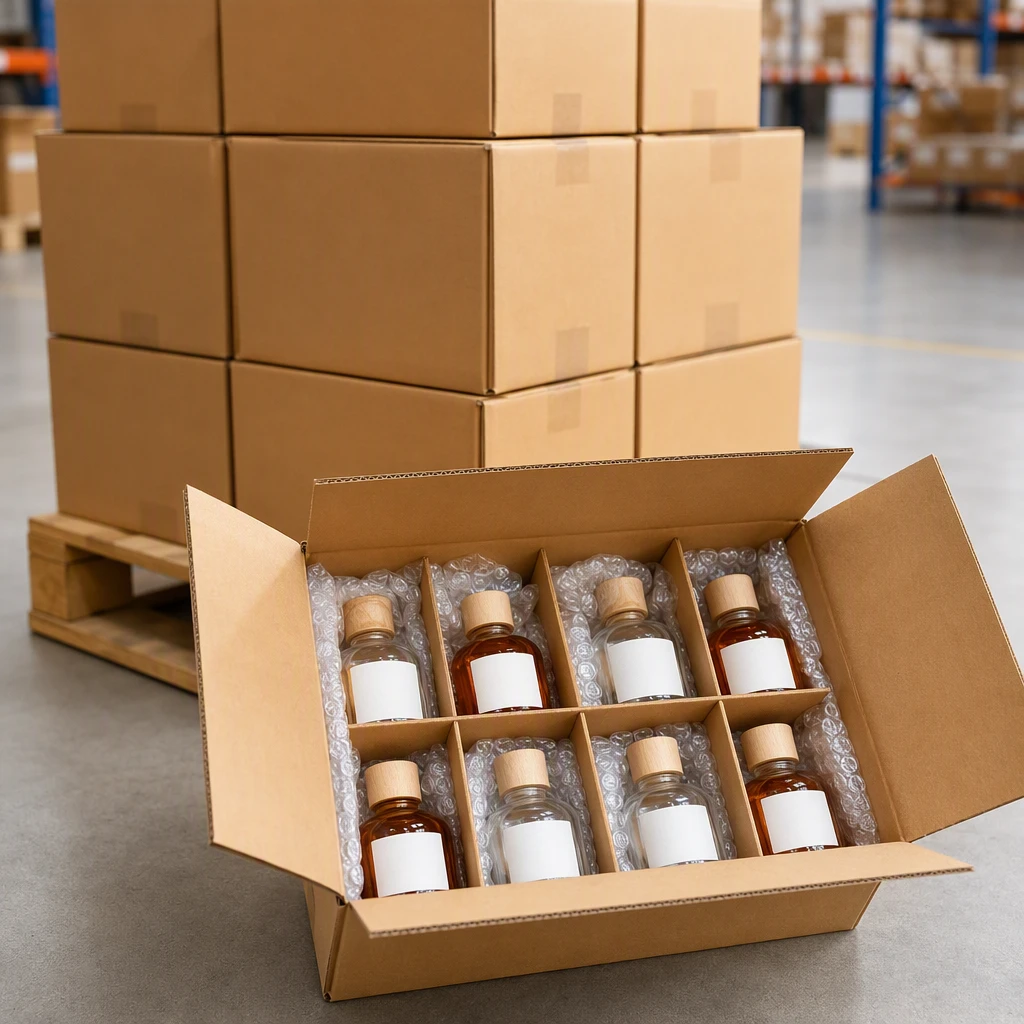
- Between jars, useHoneycomb paper grid or EPE pearl cotton dividers, to prevent direct contact between bottles.This is more effective than overall foam filling, because the grid restricts the displacement space of the bottles.
- Control the filling rate inside the box to above 90%.When the filling is insufficient, transportation bumps will cause the bottles to repeatedly collide inside the box, which is one of the main causes of damage.
Impact of different logistics methods on car fragrance transportation
The choice of logistics method depends on whether your shipping scenario isbrand owner directly shipping to distributorsOrdistributors/retailers shipping to end customers, the risk points and cost structures are completely different.
| Logistics method | Applicable scenario | Main risks | Packaging response |
| Express delivery (SF Express / ZTO, YTO, STO, Yunda) | Sample shipping, small batch orders, retail direct shipping | Rough sorting, multiple individual handling steps | Each bottle needs individual bubble wrap + outer carton with five-layer corrugated board |
| Less-than-truckload logistics | Bulk shipping to distributors | Multiple transshipment and loading/unloading, potential for cargo compression | Must use pallets + stretch film for securing, internal grid dividers cannot be omitted |
| Ocean freight full container load / less than container load | Cross-border bulk shipping | Long transit time, large temperature and humidity fluctuations, stacking pressure | Moisture-proof bags or desiccants are required, and the outer carton must undergo stacking tests |
For liquid aromatherapy,express delivery is not the safest option—although it is the fastest, the tossing and stacking pressure during sorting are the most uncontrollable. If your orders are mainly full cartons (12 bottles or more), the overall damage rate of less-than-truckload (LTL) logistics with palletized transport is usually lower than that of scattered express delivery. However, the minimum shipment threshold and transit time disadvantages of LTL also need to be considered.
The choice of logistics method for liquid aromatherapy is primarily determined by the 'number of handling cycles'.The more handling cycles, the higher the packaging requirements. For samples and small batch orders shipped by courier, it is better to spend a bit more on packaging than to skip individual bottle protection.For bulk orders, prioritize logistics methods that reduce intermediate handling.
Items to confirm with the SOCELI team next
Before finalizing the packaging plan, several specific questions will directly affect the selection results. It is recommended to communicate with the current website team to confirm:
- Whether packaging customization services are availableIncluding inner liners, sealing bags, outer box printing, etc., and the minimum order quantity for customization.
- Are there existing transportation test data: such as results of drop tests, stacking tests, and simulated transport vibration tests.If test reports are already available, you can directly determine the outer box material and structure based on them, avoiding over-packaging that increases costs.
- Compensation policies for damage under different logistics methods: Confirm the division of responsibility for cargo damage, as this will affect your decision between express delivery and less-than-truckload (LTL) shipping.
Key trade-off summary: If you mainly ship small batches of samples and retail orders, allocate your budget to individual bottle protection and choose express delivery for logistics;if you supply in bulk to distributors, allocate your budget to outer box structure and palletization, and choose LTL shipping for logistics, which is more cost-effective. In both scenarios, the inner bottle sealing process is a non-negotiable bottom line, because leakage is harder to handle than breakage—breakage is visible, but leakage may only be discovered when it reaches the end customer.
How can you quickly inspect the product for integrity upon receipt?
Car air fresheners are liquid products, and the biggest risk during transportation is not collision, but leakage and deformation of the bottle due to pressure. Spending five minutes on a targeted inspection at the time of signing can help you clearly define the boundary of responsibility and avoid disputes with the logistics provider or supplier later.
Key Points for Inspecting Appearance and Packaging
First check the outer packaging, then the product itself—do not reverse the order.
Outer packaging layer:
- Check whether the carton has obvious dents, water stains, or damp marks—water stains often indicate that the internal liquid has already leaked.
- Shake the carton and listen for any abnormal rattling sounds—under normal packaging, the product should be tightly secured by the fixing material and should not shift significantly.
- Check whether the sealing tape is intact and whether there are any signs of secondary pasting.
Product body:
- Check the can body (made of eco-friendly PP material) for any visible cracks or deformation, focusing on the bottom of the can and the seams at the mouth of the can.
- The advantage of the transparent can body design is that the remaining amount is directly visible—confirm through the can wall whether the liquid level is within the normal range. If the liquid level is noticeably low, it indicates that leakage may have occurred during transportation.
- Check whether the bottle cap or sealing sticker is intact, and whether there are any signs of looseness, lifting, or re-pressing.
Sampling inspection methods for functionality and safety
For bulk purchases, there is no need to open and inspect each item individually, but it is recommended to conduct sampling inspection on 5%-10% of the received quantity, with at least 3 samples.
Sampling inspection actions:
- Place the aromatherapy upright and let it sit for 10 minutes, observing whether there are any traces of liquid seepage around the rim of the can.
- Gently tilt the can to about 45 degrees and then return it to upright, checking whether there is any liquid seepage at the seal—this action simulates the shaking scenario during vehicle driving.
- Open the lid and take a sniff to confirm whether the fragrance type and smell are normal, and whether there is any rancid sour odor or chemical irritation.
- After tightening the lid, invert the can for 5 seconds and observe whether there is any dripping.
Key points to note: A slight escape of fragrance does not equal leakage. The sealing structure of liquid aromatherapy allows slight permeation of fragrance molecules, which is a normal phenomenon. A true leak is visible liquid seepage or a noticeable drop in the liquid level.
What to do after discovering cargo damage
The order in which you handle the problem directly affects your claim efficiency:
- Take photos as evidence: The damaged outer packaging, the defective product area, and the logistics waybill must all be clearly captured in the same frame.
- Note the anomaly on the logistics waybill: Mark "outer packaging damaged/product suspected leak" in front of the courier before signing to receive the goods—if you report the issue after signing, it becomes significantly harder to provide evidence.
- Keep the original packaging: Do not rush to discard the carton and filling materials. The supplier or logistics team may need to inspect the original condition.
- Contact the SOCELI team: Provide the product batch number (on the can body or outer carton) and photos, and indicate whether it is a single-item issue or a batch issue.
For bulk purchases, if random inspection reveals more than 10% of products have leakage or appearance issues, it is recommended to pause unpacking and keep the entire batch in its original state while contacting the supplier to confirm the resolution plan. Minor defects on a single item can usually be resolved by sending a replacement, but batch issues require re-evaluating whether the packaging plan for that batch is suitable for the current shipping route.
Key trade-off reminder: Spending five extra minutes on inspection upon receipt saves future communication costs. For liquid products, the core evidence for determining liability for cargo damage is the condition record at the time of signing—if this step is done thoroughly, it provides a basis for either replacement or claims later.
How does SOCELI ensure delivery quality through integrated management?Is it suitable for your procurement scenario?
For bulk procurement of car air fresheners, the risks in the delivery process often deserve more attention than the product itself—liquid consumables may leak during transportation, packaging may be damaged, and batch-to-batch scent differences can affect acceptance. SOCELI's approach is to keep the production process in its own hands: its own factory handles the entire process from raw material blending to filling and packaging, rather than outsourcing to multiple contract manufacturers. This means that every batch you receive comes from the same set of process standards and quality inspection procedures, making it easier to maintain consistency in fragrance concentration and scent duration across batches.
For the buyer, the direct value of this integrated management istraceability。 If a batch has scent deviations or packaging issues, SOCELI can quickly identify whether the problem lies in raw materials, filling, or packaging materials, rather than coordinating back and forth between suppliers. At the same time, having our own factory also makes the sampling and customization process more streamlined—when the brand needs to adjust the fragrance or label, the communication chain is shorter, and the conversion loss from sample confirmation to mass production is also lower.
Support of Integrated Factory Management for Logistics Quality
The support of integrated management for logistics quality is mainly reflected in three aspects:Filling processUnified control of liquid volume and sealing process to reduce the probability of leakage during transportation;Packaging processAdopting standardized operations to reduce packaging defects caused by manual operation differences;Pre-shipment inspection processConduct sampling inspections according to uniform standards to prevent problematic batches from entering the logistics chain. For specifications with a 120g capacity and 90-day battery life, it is recommended to require shockproof packaging for bulk shipments and to conduct sampling inspections upon arrival.
Under what circumstances is choosing SOCELI a more prudent decision?
Scenarios suitable for choosing SOCELI:
- You have a clear SKU plan: With confirmed fragrance types, single-bottle capacity (e.g., 120g), and packaging style, SOCELI's OEM/ODM capabilities can directly align with your specification requirements.
- You need to verify product safety: If the product claims to be certified by international safety standards, buyers can request test reports as a basis for inspection, making it suitable for brands or channels with strict compliance requirements.
- Your sales cycle is longer: With 90-day endurance and a visual canister design, it is suitable for car owner gifts or long-term in-car consumables, requiring no frequent restocking.
Scenarios that are not suitable or require caution:
- You are still in the exploration stage with frequently changing needs: If the target customer group, fragrance preferences, and pricing range are not yet determined, it is recommended to first obtain samples for small-scale testing, rather than placing bulk orders directly.The advantages of integrated management are more evident in large batches; small-scale trials may not reflect cost benefits.
- Your core demand is extreme low price: Having our own factory means that quality control costs are included in the price. If you only compare prices without considering craftsmanship and quality control, there may be cheaper loose suppliers in the market, but delivery risks are correspondingly higher.
Recommended path when requirements are unclear: Don't rush to finalize specifications. First, ask the SOCELI team two questions—first, whether they can provide 2-3 samples of different fragrance types for internal testing of scent longevity and odor acceptability;second, the minimum order quantity for bulk orders and the corresponding unit price tiers, which determine whether your initial purchase quantity is economical. After sample testing passes, move on to the customization stage—confirm label craftsmanship, packaging format, and fragrance lock-in, and only then proceed to mass production.
Key trade-off summary: SOCELI's integrated management is suitable for buyers with clear goals and a focus on delivery consistency. If your requirements are still changing rapidly, first validate with samples, then decide whether to enter bulk cooperation.
Frequently Asked Questions
Q1: What is SOCELI's sample application process? Contact the SOCELI team directly to explain your needs scenario (such as brand customization or retail purchase). Typically, you need to provide the usage environment and expected purchase quantity. The team will recommend fragrance types and arrange sample shipment accordingly. Samples may require covering shipping costs, and the sample fee can be deducted after bulk ordering.
Q2: How can batch quality consistency be confirmed during bulk procurement? SOCELI's own factory produces uniformly. You can request batch quality inspection reports before shipment, focusing on verifying fragrance concentration and filling volume. If you have concerns about a particular batch, you can negotiate for sample inspection.
Q3: For OEM customization, to what extent can fragrance and packaging be modified? Fragrance can be selected from 18+ existing fragrance library options, or adjustments can be made based on existing formulas;In terms of packaging, label process customization is supported, but the can structure and capacity (120g) are usually based on existing molds, and significant changes may involve mold opening costs.
Q4: Is the product prone to leakage during transportation? The product uses an eco-friendly PP material can, and under normal logistics conditions, sealing performance is guaranteed. However, high temperatures or rough handling during transportation may still affect liquid stability. It is recommended to require shockproof packaging for bulk shipments and to conduct spot checks upon arrival.
Q5: If the first batch of orders does not sell as expected, can the fragrance be adjusted later? Yes, but please note the adjustment costs. Already produced inventory cannot be returned, and sampling and confirmation of new fragrances take time.
It is recommended to control the quantity of the first batch of orders, verify market feedback, and then reorder.
Learn More
If you are evaluating packaging solutions for liquid car air fresheners, transportation loss control, or OEM/ODM customization cooperation, you are welcome to submit your specific requirements (such as shipping routes, single batch purchase quantity, packaging customization requirements). The SOCELI team will provide corresponding packaging verification suggestions and sample support based on your scenario.
Related Products:SOCELI Liquid Car Air Freshener