How does the volatile principle of slow-release aromatherapy differ from that of traditional fragrance?
Why is traditional fragrance strong at first and then weakens?
The volatilization method of traditional fragrance (such as liquid evaporation, reed diffusers, and ordinary solid balms) is essentially passive diffusion. Fragrance molecules continuously escape from the surface of the liquid or balm at room temperature; the greater the concentration difference, the faster the volatilization.
When first opened, the fragrance concentration inside the container is highest, and the concentration difference with the air is greatest, so the scent is very strong in the first two or three days. As the fragrance continuously escapes, the concentration inside the container decreases, and the volatilization rate also slows down. In the middle and later stages, the remaining fragrance molecules are "trapped" deep within the carrier, requiring more energy to break free, further reducing the release amount.
This is why traditional fragrance loses its scent after a few days—not because the fragrance is gone, but becauseThe evaporation rate drops off a cliff.The release of the remaining fragrance is so low that the nose can barely perceive it.
Another key factor issurface area and temperature.。 Traditional aromatherapy has a fixed evaporation area; when the temperature rises, evaporation accelerates, and when the temperature drops, it almost stops. This is exactly why in a car, the scent is too strong and pungent when exposed to the sun in summer, and almost odorless in winter.
How does sustained-release technology control the release rate?
The core of sustained-release diffusion technology is to turn "passive evaporation" into "active controlled release." It does not rely on the concentration difference between fragrance and air, but instead throughporous media adsorption, microcapsule encapsulation, or polymer slow-release membranes, the fragrance molecules are "locked" inside the carrier and released slowly at a nearly constant rate.
You can think of it this way: traditional aromatherapy is an open bottle, while slow-release technology is a sealed can with a regulating valve. The evaporation rate of the bottle depends on the size of the bottle opening and the ambient temperature, but the regulating valve can ensure that the amount of fragrance released per unit time is basically the same regardless of how much remains in the can.
Specifically, the control mechanism usually has three layers:
- Adsorption layer: The fragrance is adsorbed into the micropores of porous materials (such as wood fiber or molecular sieves), and the pore size determines the ease with which fragrance molecules escape.
- Diffusion layer: The fragrance needs to penetrate a polymer film or gel barrier to reach the surface. The thickness and density of this barrier directly control the release rate.
- Concentration compensation: When the fragrance on the surface is released, the inner fragrance continuously replenishes the surface through capillary action, maintaining a stable release concentration.
This is also why sustained-release products can achieve30-day endurance—it is not "waiting for the fragrance to evaporate naturally," but "releasing it quantitatively according to plan." It won't be pungent in the first three days, nor will it be too faint to smell in the last three days. The fragrance intensity curve throughout the entire lifecycle is a gentle straight line, not a steep downhill slope.
The implication for your decision is: if you need a usage habit of "noticeable fragrance immediately upon opening, with a refill every few days," traditional aromatherapy is sufficient and cost-effective; if you care aboutthe consistency of the fragrance experience throughout the entire usage period, as well as reducing the maintenance cost of frequent replacements, then slow-release technology is the matching solution. The next step to confirm is: do you expect the fragrance retention period to be a few days or a few weeks? Is the temperature fluctuation in the car significant?
These two conditions directly determine which technology suits you.
How is the 30-day endurance achieved?Analysis of SOCELI slow-release core and refill design
How does the slow-release core extend the fragrance retention period?
The 30-day endurance of the SOCELI G111 is not about fragrance concentration, but about the release rhythm. Traditional car air fresheners (especially liquid evaporation or low-quality solid balms) often have a strong and pungent scent in the first 3-5 days, followed by a cliff-like decline, with an actual effective fragrance retention of often less than two weeks. The slow-release core approach allows the fragrance to be released slowly at a nearly constant rate, avoiding the problems of early waste and later odorlessness.
For purchasers and distributors, this difference directly relates to two decision points:
- Customer satisfaction: 30-day battery life means fleet or retail customers only need to handle a replacement action once a month, rather than complaining every two weeks that "the scent is gone".
- Consistent Experience: The slow-release technology keeps the in-car fragrance concentration within a comfortable range, avoiding extreme fluctuations such as being overwhelmed right after installation and completely scentless after a week.
It should be noted that 30 days is a reference period provided by SOCELI based on standard usage conditions (normal in-car temperature, daily ventilation). Extreme high temperatures can accelerate release and shorten battery life; in long-term sun exposure, the actual period may be shortened to 20-25 days.Conversely, if the vehicle is parked in a shaded area for a long time, the battery life may slightly exceed 30 days. For your specific usage scenario, it is recommended to confirm with the SOCELI team about your fleet's parking environment and average daily usage duration to determine whether the 30-day battery life aligns with your restocking rhythm.
How do replaceable cores reduce long-term usage costs?
Let's first do the math. Assume a traditional car fragrance costs 30 yuan per unit and lasts effectively for 10 days, so you need about 12 units a year, with an annual cost of about 360 yuan. The initial purchase cost of the SOCELI G111 is higher, but the price of replacement cartridges is usually much lower than that of the entire fragrance, and the replacement cycle is 30 days rather than 10 days.
Estimating the replacement cartridge at one-third of the price of the whole unit, you need about 12 cartridges a year, and the total cost may be 30%-50% lower than that of the traditional solution.
But there is a key premise here:The premise for the replacement cartridge to be cost-effective is that the shell is durable enough.。 The G111 uses a wooden shell and a magnetic mounting structure. Under normal use, the shell's lifespan is much longer than the cartridge replacement cycle, which is the basis for the replacement cartridge model to work. If the shell is easily damaged or lost, the advantage of the replacement cartridge will be diluted.
Scenarios suitable for the replacement cartridge solution:
- Fleet management: Multiple vehicles managed uniformly, with a monthly centralized refill of the inner cartridge, reducing procurement frequency and inventory pressure.
- Business reception vehicles: Need to maintain a stable fragrance over the long term; replacement cartridges ensure the scent does not run out.
- Retail customers: Willing to pay an initial premium for the wooden appearance and texture, but hope to control usage costs afterward.
Scenarios not suitable:
- Customers extremely budget-sensitive and only looking at the initial unit price—the initial cost of the G111 is indeed higher than ordinary vent diffusers.
- Vehicles used very infrequently (e.g., driven a few times a month)—the advantage of 30-day endurance cannot be fully realized, and the economy of replacement cartridges is not obvious.
Next step suggestion: Confirm with the SOCELI team the specific unit price of replacement inner cartridges, the minimum order quantity per purchase, and whether there is a tiered pricing for fleet bulk purchases. Once you have these numbers, plug in your actual fleet size and replacement cycle to calculate a conclusion that is more precise than 'more cost-effective'.
Which vehicle usage scenarios are suitable for slow-release fragrance diffusion technology?Which scenarios are not recommended?
The core value of slow-release fragrance diffusion technology is not 'stronger fragrance,' but 'more controllable fragrance release.' To determine whether your scenario is worth paying for it, you only need to answer one question:Over what period of time and at what intensity do you want the fragrance to persist?
Why are business reception and long-distance driving more suitable for slow-release technology?
The pain point in business reception scenarios is not 'no fragrance,' but 'the fragrance arrives too suddenly.' Traditional liquid aromatherapy or sprays can be overpowering when you first get into the car, but by the time guests are seated, the scent is often gone. This experience is a drawback in business settings. Slow-release technology absorbs essential oils into a wooden carrier, which releases them gradually at ambient temperature, keeping the in-car scent at a stable, low-to-medium concentration. Guests won't be disturbed, but they will notice that the car environment has been thoughtfully maintained.
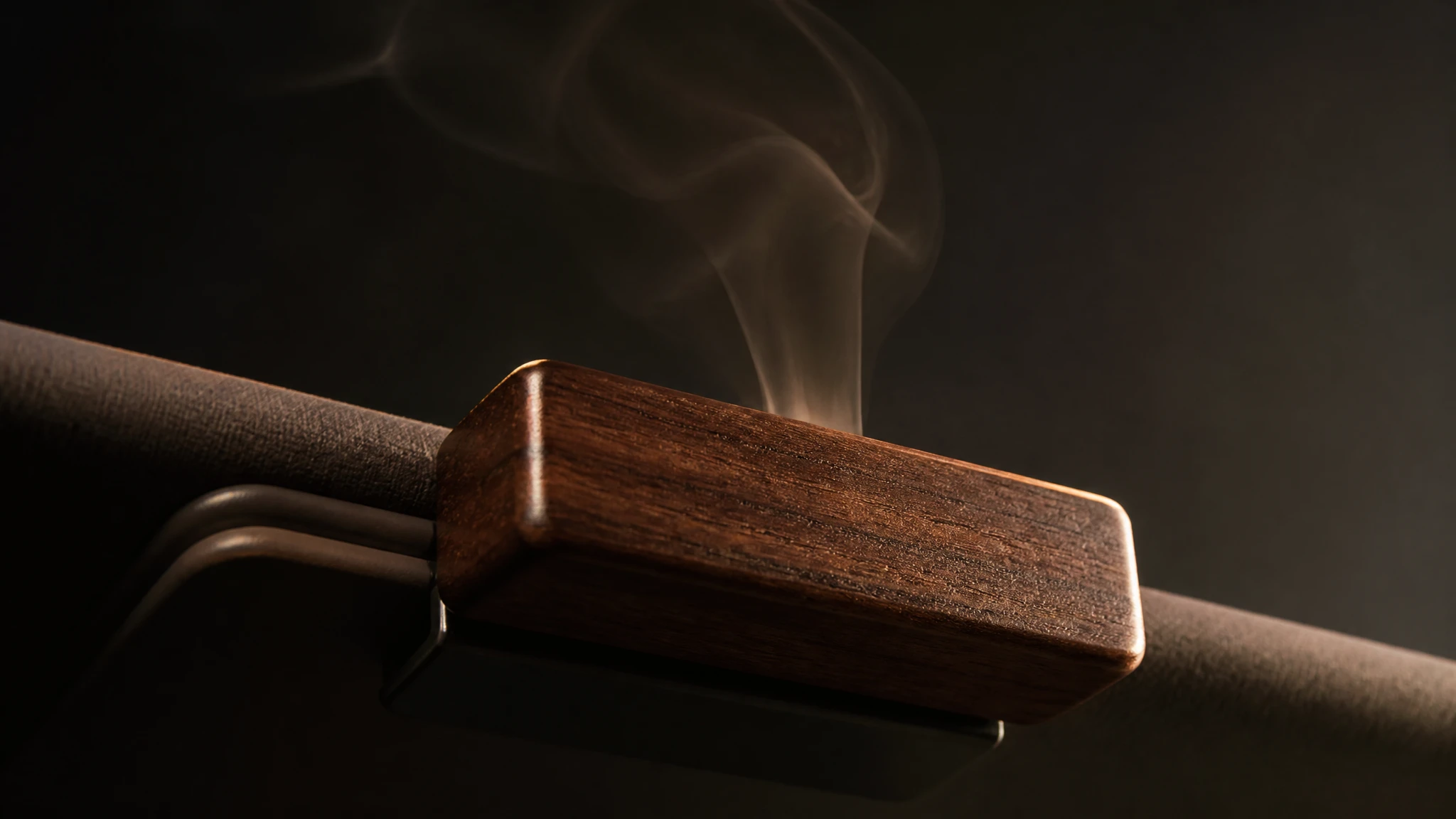
The 30-day lifespan of the SOCELI car wooden block sun visor aromatherapy also means you don't need to top up or replace the refill before each reception.
The logic for long-distance driving is more straightforward: traditional aromatherapy's evaporation rate fluctuates significantly with temperature. After summer sun exposure, the concentration spikes, then drops rapidly once the air conditioning is on, making it hard to maintain a consistent olfactory experience on long trips. Slow-release technology features a more stable release rate per unit time, and the 30-day lifespan means no mid-trip intervention is needed throughout the entire long journey. For fleet managers, this difference directly translates into lower maintenance costs—fewer replacements mean less manual labor.
When is traditional aromatherapy still sufficient?
In the following three scenarios, the advantages of slow-release technology are diluted, and traditional aromatherapy is more practical:
- Short-distance commuting (within 20 minutes one way): The time spent in the car is short, and the fragrance has just entered the stable release phase when you arrive at your destination.The traditional "strong at first, weak later" curve of aromatherapy can actually provide more obvious olfactory feedback in short trips, while the low-concentration characteristic of slow-release technology may make you feel "no scent" during short trips.
- Display scenarios that pursue "instant scent": If the goal is for passengers to smell a clear fragrance as soon as they open the door (such as new car delivery, test drives), traditional aromatherapy or sprays have higher instantaneous concentration, and the gradual release of slow-release technology cannot achieve this "first impression impact".
- Individual users who are budget-sensitive and have no requirement for fragrance persistence: The cost of slow-release technology is reflected in the carrier structure and replacement core design. If you only use the car occasionally and are not sensitive to the presence of fragrance, the one-time purchase cost of traditional aromatherapy is lower.
Key trade-offs: Sustained-release technology is paid for "long-term, stable, low-maintenance" performance. If your car usage is fragmented, you have high demands for fragrance intensity, or your budget is strictly limited, traditional aromatherapy offers better value for money. If you need "no maintenance for 30 days and consistent scent every time you get in the car," sustained-release technology truly solves the problem.
Next step to confirm: compare your actual car usage frequency and duration per trip—if each trip exceeds 30 minutes and you use the car more than 3 times a week, the endurance and stability advantages of sustained-release technology can be fully realized. If your usage is mainly short trips, we recommend confirming with the SOCELI team whether the low-concentration release curve of this product meets your olfactory expectations before deciding whether it is worth paying for sustained-release technology.
Procurement decision: Is sustained-release fragrance diffusion technology worth choosing?How to balance budget and maintenance?
The core difference between sustained-release fragrance diffusion technology and traditional aromatherapy lies not in the initial purchase price, but in the maintenance costs and experience stability during long-term use. The following provides the selection boundaries from two dimensions.
When is it more cost-effective to choose slow-release technology?
- High vehicle usage frequency and variable personnel: Scenarios such as ride-sharing and reception fleets lack dedicated maintenance. Slow-release technology reduces the replacement frequency to once a month (the SOCELI car wooden block sun visor aromatherapy lasts 30 days), avoiding the problems of traditional aromatherapy being pungent at the beginning and odorless later.
- Business scenarios with requirements for scent quality: Natural essential oil blends and slow-release fragrance can avoid the alcohol smell and scent degradation of traditional aromatherapy. The scent of reception vehicles directly affects brand experience.
- Calculate the total cost rather than the unit price: When comparing, it is recommended to calculate based on "monthly usage cost = product unit price ÷ replacement cycle".If traditional aromatherapy is replaced every 5 days and slow-release products every 30 days, and the price difference per use is within 3 times, the total cost of ownership of the slow-release solution may be lower.
When is it not worth increasing the budget?
- Very low frequency of vehicle use: When the number of monthly uses is low, the fragrance decay issue of traditional aromatherapy is not obvious, and the long-lasting advantage of slow-release technology cannot be utilized.
- Frequent need to change fragrance types: Slow-release products are usually replaced by replacing the core. If the fragrance is changed weekly, traditional aromatherapy offers greater flexibility.
- Extremely budget-sensitive with dedicated maintenance personnel: If the fleet has personnel who regularly replenish fragrance, the 'convenience' value of slow-release technology will correspondingly decrease.
Conclusion boundary: The value of slow-release technology is reflected in the maintenance cost and experience consistency during long-term use, not the initial purchase price. It is recommended to first run a complete replacement cycle (30 days) with 5-10 vehicles, record the consumption rate of refills and passenger feedback, and then decide whether to replace all. Specific selection needs to be based on the number of vehicles, usage frequency, and budget structure. You can provide working condition information to the SOCELI team to confirm the matching solution.
FAQ
Q: How does the cost of slow-release fragrance refills compare with ordinary fragrances? A: Based on SOCELI's 30-day endurance, about one refill is needed per month. When comparing, you need to multiply the replacement frequency of traditional fragrances (e.g., once a week) by the unit price to get the real monthly cost, and then compare, rather than just looking at the single price.
Q: Will the magnetic mount fall off on bumpy roads? A: The magnetic structure is mainly for easy replacement of the refill. The sun visor position does not directly participate in vehicle vibration transmission, so it will not fall off under normal driving. If off-road or extreme road conditions are involved, it is recommended to install one first and test it in practice.
Q: Is the 30-day battery life the same for all fragrances? A: Different fragrance essential oils have different volatility, so the actual battery life may vary between 25-30 days. If you have strict requirements for battery life, you need to confirm the actual test data of the specific fragrance with the SOCELI team.
Q: Will the wooden shell deform under high temperatures? A: SOCELI uses sustainable eco-friendly wood, but prolonged exposure to sunlight will accelerate wood aging. If the vehicle is parked in an open area for a long time, it is recommended to confirm the shell's temperature resistance performance with the team before purchase, or consider alternative replacement options.
Learn more
If you are evaluating a procurement plan for car air fresheners, you are welcome to submit your fleet size, usage frequency, and fragrance preferences to the SOCELI team. We will provide matching recommendations and bulk procurement solutions based on your actual operating conditions.
Related products:SOCELI Car Wooden Block Sun Visor Air Freshener