
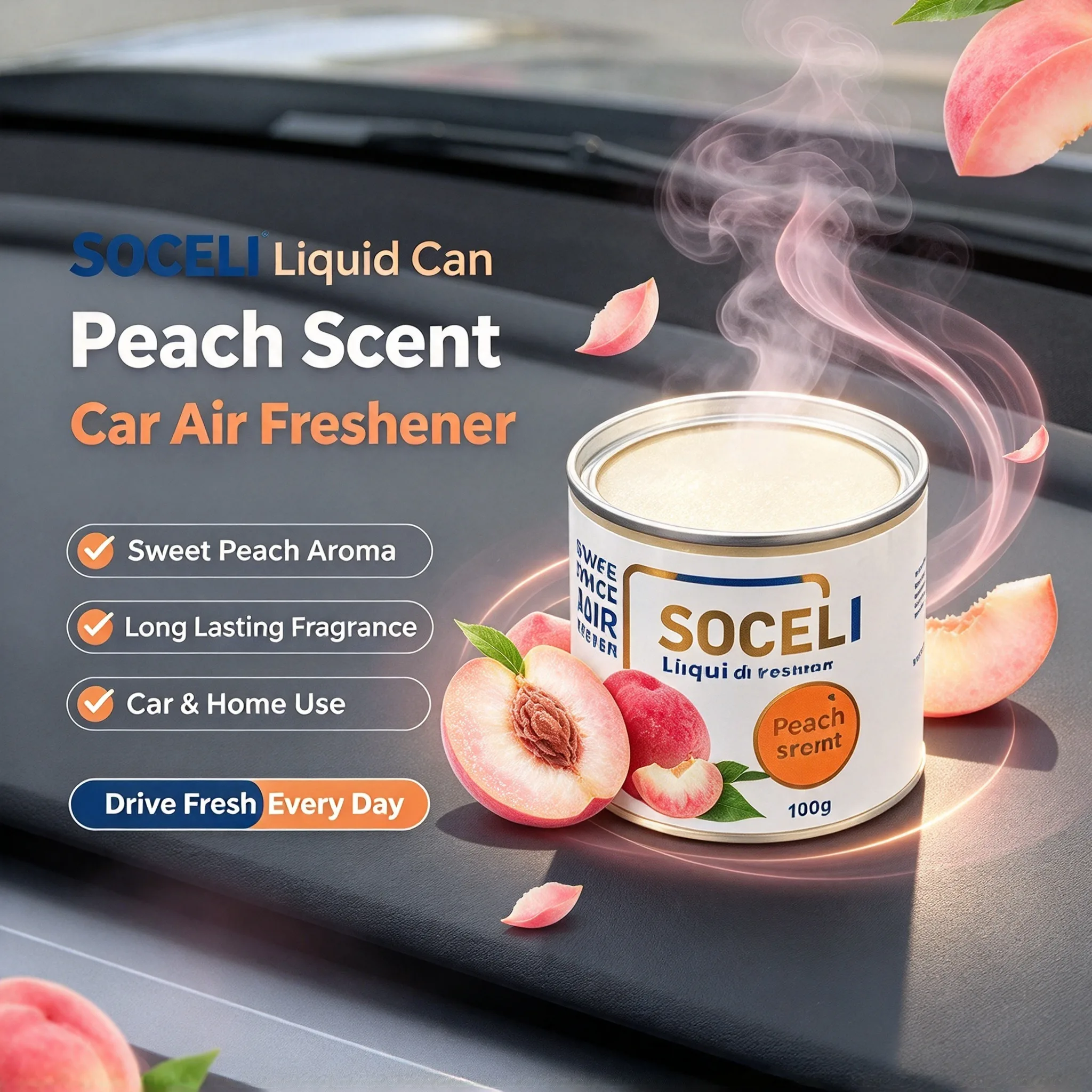
What is SOCELI liquid car fragrance?How does its operation in high-temperature environments differ from ordinary fragrances?
SOCELI liquid car fragrance (model TS101) is a car product that releases scent through natural evaporation of liquid fragrance, with a content capacity of 120g. The canister is made of eco-friendly PP material and features a visualized design, making it easy to check the remaining amount at any time. Its core difference from solid fragrance balms and fragrance sheets lies in the following: the liquid form is more sensitive to temperature changes, high temperatures accelerate the evaporation rate, and it also places higher demands on the sealing structure.
Evaporation principle and sealing structure of liquid car fragrance: why storage location requires more attention under high temperatures
Liquid fragrance relies on the natural evaporation of scent from the liquid surface into the air. The higher the ambient temperature, the faster the evaporation rate usually is, and the pace of liquid consumption may also change accordingly. Ordinary solid fragrance balms mostly soften or weaken in scent under high temperatures, whereas the liquid form also requires extra attention to whether the pressure state inside the canister and the sealing structure remain stable.
Therefore, in markets such as the Middle East and Africa where in-car temperatures are high in summer, the first lesson for liquid car fragrances is storage location: the area directly above the dashboard and under the front windshield, where heat accumulates most noticeably due to direct sunlight, should be avoided as much as possible;Shaded locations such as the glove box and the sides of the center console can reduce the heat load the liquid is exposed to. Specific suitable locations should be confirmed based on the actual sun exposure conditions of the target vehicle model.
SOCELI's eco-friendly PP material and visible jar body: how to balance sealing performance and remaining volume visibility
Buyers often ask: if the jar body is transparent so the remaining volume can be seen, will sealing performance be compromised? Visibility solves the problem of remaining volume management—fleet, hotel, and retail replenishment scenarios need to quickly determine which vehicle or which room needs a replacement. Sealing performance depends on the jar structure, the closing method, and material consistency, not on "whether the inside can be seen."
SOCELI uses an eco-friendly PP material for the jar body; PP is a common material choice for automotive and daily-use products;The visual design makes the remaining amount clear at a glance, which is especially valuable for bulk buyers and can reduce the labor cost of inspections and restocking. The specific performance of the sealing structure under high temperatures falls within the scope of what needs to be verified through actual testing. It is recommended that during the sampling stage you explain to the team the in-car temperature range and usage habits of the target market, and have the team confirm a matching solution.
Under the high temperatures of the Middle East and Africa, will SOCELI liquid car fragrance deteriorate, leak, or develop an abnormal scent?
When a car is parked under blazing sun in summer in the Middle East and Africa, the temperature near the dashboard inside the car can be noticeably higher than the outdoor air temperature. Liquid fragrance will undergo three types of changes in this environment, but this does not mean it is highly likely to deteriorate or leak. Buyers need to treat this as a selection condition rather than an after-sales issue.
Three major potential effects of high temperature on liquid fragrance: accelerated evaporation, changes in sealing pressure, and differences in scent perception
Accelerated evaporation: Rising temperatures will speed up the diffusion of the fragrance liquid. The scent may be stronger in the early stage, and the overall lifespan may be shorter than under normal temperature conditions. The SOCELI liquid car air freshener is rated for a 90-day lifespan, a figure that corresponds to normal usage conditions;under high temperatures, it should be understood as an upper-limit reference, with the actual duration affected by the parking environment, air conditioning usage frequency, and placement location.
Sealing pressure changes: the liquid expands when heated, the vapor pressure inside the can rises, placing continuous stress on the sealing structure. The eco-friendly PP can body itself has a certain degree of temperature resistance, but the stability of the cap sealing ring and fragrance outlet structure after repeated thermal expansion and contraction deserves more attention. This is not a binary question of "will it leak or not," but rather how much sealing margin remains after long-term exposure to the sun.
Differences in fragrance perception: at high temperatures, the proportion of volatile fragrance components changes, so the same scent may smell sharper, sweeter, or more monotonous in a sun-exposed car than at room temperature. This is a change in perceived conditions, not spoilage. Sample evaluation should be conducted in real high-temperature scenarios, rather than smelling the fragrance in an air-conditioned room.
Troubleshooting steps: How to reduce high-temperature risks through storage location and timing of use
Storage location: Avoid the direct sunlight area of the front windshield and the top of the dashboard; prioritize shaded positions such as the cup holder, the side of the center console, or under the seat. The visible canister makes it easy to judge the remaining amount without opening it, facilitating regular inspections by fleets or stores.
Timing of use: If the vehicle has been parked under prolonged sun exposure, open the windows to ventilate before turning on the fragrance, to avoid an overly intense one-time release of scent in a hot, enclosed state;For vehicles parked for extended periods, it is recommended to remove the car fragrance and place it in a cool, shaded area rather than leaving it in the vehicle to be continuously exposed to heat.
Pre-use inspection: Check whether the can body shows any deformation or signs of liquid seepage, whether the fragrance outlet has crystallization or blockage, and whether the scent after opening the lid matches the sample. These three checks require no tools, and distributors can include them in end-user instructions to reduce the likelihood of misjudging them as quality issues.
For buyers, the key judgment is not whether the product is "more reliable and problem-free under high temperatures," but whether the usage scenario falls within the product's design conditions. If the channel is mainly outdoor parking in the Middle East and Africa during summer, it is recommended to explain the target market's parking environment and expected endurance specifications to the SOCELI team during the sampling stage, and confirm the sealing structure and fragrance type adaptation plan under those conditions.
90-day endurance and 120g content: How to convert replenishment cycles under high temperatures to avoid stockouts for fleets or stores
The 90-day endurance is a reference value under normal temperature and moderate usage intensity, not a guaranteed value. For fleet, hotel, and retail customers, what really needs to be calculated is not "replenish once every 90 days," but rather "under the actual operating conditions of this batch of goods, how many days will it take to consume one 120g can."
The actual meaning of the endurance parameter: why 90 days is a reference value rather than a promised value
The volatilization rate of liquid aromatherapy accelerates as the temperature rises. In the Middle East and Africa during summer, when a car is exposed to the sun, the temperature inside a sealed cabin will be significantly higher than normal room temperature, and the consumption rate of the aromatherapy will accelerate accordingly, so the 90-day reference period will be shortened. The degree of shortening depends on the parking environment, the average daily duration of sun exposure, and the ventilation conditions inside the car, so a uniform conversion factor cannot be given.
What can be determined is this: for fleet vehicles parked outdoors for long periods, the replenishment rhythm must be tighter than the normal-temperature assumption, and scheduling cannot be done directly based on 90 days.
Replenishment model: how to estimate safety stock based on usage intensity and high-temperature impact
Calculate in the following order, rather than applying a fixed formula:
- Determine the average daily consumption per unit: Based on 90 days at room temperature, first calculate the baseline daily consumption (120g ÷ 90 days). This is only the starting point.
- Adjust upward according to operating conditions: Vehicles parked outdoors with long average daily sun exposure have higher daily consumption than the baseline;vehicles parked in underground garages and mainly in air-conditioned environments are close to the baseline.
- Convert to restocking cycle: 120g ÷ adjusted daily consumption = actual usable days per unit.
- Leave a safety margin: Safety stock should cover "actual usable days + replenishment transit time," rather than arriving exactly on the day it runs out.
For retail store customers, the logic is the same, but the object becomes shelf turnover: ordering frequency in hot seasons should be denser than in normal-temperature seasons to avoid stockouts or near-expiry products.
SOCELI liquid car fragrance uses a visible jar body, allowing direct observation of the remaining amount. Fleets and hotels can visually confirm at fixed inspection points (such as weekly vehicle checks and room cleaning), and trigger replenishment in advance when the remaining amount is low. If vehicles are exposed to extreme sunlight for long periods, or stores are located in areas with continuous high temperatures in summer and no air conditioning, it is recommended to provide the SOCELI team with parking conditions, average daily usage duration, and replenishment logistics cycles to confirm replenishment recommendations that are closer to reality.
Can the same SOCELI liquid car fragrance be used both in the car and at home?Which scenarios are suitable, and which require caution
Yes, it can be used for both, but expectations need to be adjusted according to space size and ventilation conditions. SOCELI liquid car air freshener comes in a 120g can body, made of eco-friendly PP material, with a visible remaining amount design, and it is not limited to being placed only in a car. What truly affects the experience is the placement location, space volume, and replacement frequency.
Suitable scenarios: long-distance driving, high-frequency use for ride-hailing vehicles, hotel guest rooms, and unified configuration for fleets
- Long-distance driving and high-frequency use for ride-hailing vehicles: The scent needs to remain continuous and stable, and the visible can body makes it easy to check the remaining amount at any time.High-frequency use will accelerate consumption. 90 days is the nominal reference value, and the actual replacement pace needs to be re-estimated according to the intensity of vehicle use.
- Hotel guest rooms and unified configuration for fleets: The focus is on scent consistency and restocking rhythm.18+ fragrance types available, making it easy to group by floor or vehicle model, but it is recommended to first confirm the stability of the same batch of fragrance types.
- Small home spaces: Just place one can in localized areas such as bathrooms and entryways;For large spaces such as living rooms, do not expect a single can to provide coverage.
- Corporate gift channel: The can body is moderate in size and the label craftsmanship is exquisite, making it suitable for combination gift boxes, but the minimum order quantity and sampling lead time need to be confirmed in advance.
Scenarios requiring caution or confirmation: locations with extreme sun exposure, areas within children's reach, and enclosed spaces with strict requirements for fragrance intensity
- Locations with extreme sun exposure: Long-term direct sunlight on the dashboard in summer may affect the liquid seal and stability. It is recommended to place it in a cup holder or near the glove box and other shaded areas. The specific temperature resistance limits need to be confirmed with the supplier.
- Areas within children's reach: When used at home, the liquid container should be placed out of children's reach to avoid tipping over or accidental opening.
- Enclosed spaces with strict requirements for fragrance concentration: For scenarios such as meeting rooms, hospital wards, and infant rooms, a small-scale trial should be conducted first before deciding whether to equip them in bulk.
Frequently Asked Questions
Can the same container be placed in a car first and then taken home for use? Yes, liquid fragrance does not become ineffective due to movement. However, the high temperature inside the car may have already affected the state of the liquid. Before moving it into a home space, it is recommended to check for leaks or abnormal odors.
Will it leak if left in a car during a Middle Eastern summer? Sealing performance and placement location together determine this. Avoiding direct sunlight is key to reducing risk. The specific temperature tolerance limits need to be confirmed with the SOCELI team.
Will using the same fragrance in hotel guest rooms be too monotonous? More than 18 fragrance types can be differentiated by area, but guest room scents should be light rather than strong. It is recommended to first choose 2–3 types for floor testing.
What should be confirmed first when purchasing for a fleet? First confirm the placement point and restocking cycle for each vehicle, then discuss price. Different placement points lead to differences in actual consumption and experience, which will directly affect subsequent repurchase decisions.
Learn more
If you are selecting products for the Middle East and Africa market, or need to configure liquid car air fresheners for fleets, hotels, or retail channels, you are welcome to provide the SOCELI team with the parking environment, average daily usage duration, and replenishment logistics cycle of the target market. Based on this, we can help confirm a sealing adaptation solution and replenishment recommendations that are closer to actual conditions.