
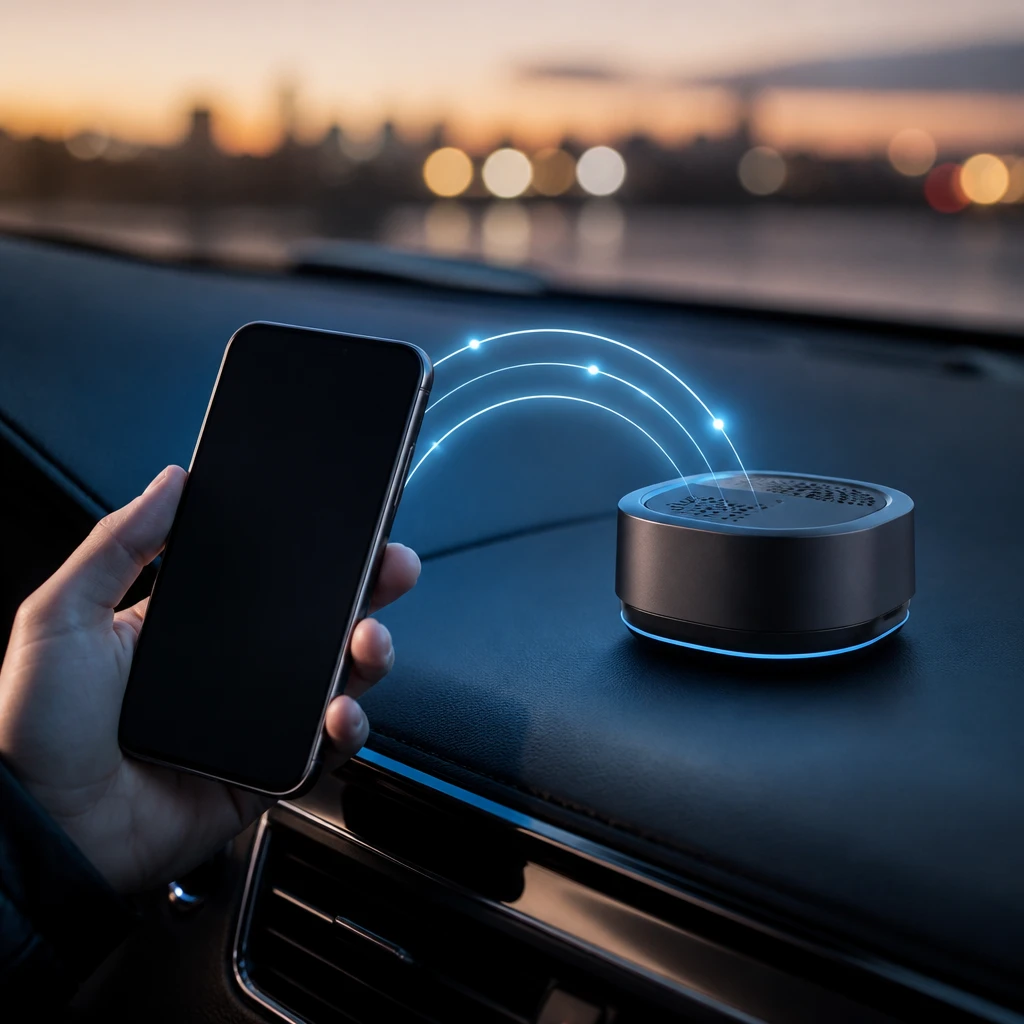
What problems does the APP linkage of car diffusers actually solve?
APP linkage on car diffusers usually solves three things:remote on/off and scheduling, concentration level adjustment, and fragrance switching records. For brand procurement and distributors, what really needs to be judged is not "whether there is an APP," but "whether your customers will actually use it."
The core value of APP linkage: remote control and personalization
First, look at the functional definition. APP linkage generally includes:
- Remote on/off: Start it in advance before getting into the car; whether after summer sun exposure or when the car is cold in winter, you'll be greeted by fragrance as soon as you enter.
- : Concentration/level adjustment: Switch according to scenarios, such as increasing it in congested traffic and lowering it during highway cruising.
- : Timing and periodic settings: Set it to run automatically during weekday morning and evening rush hours to avoid forgetting to turn it on or off.
- : Scent switching and usage records: Some solutions support switching between multiple scents and record consumption rate in the app.
: The practical value of these features lies inTurn "manual operation" into "preset automatic behavior". For brands doing OEM/ODM, APP linkage also means they cancollect user usage habit data, providing a basis for subsequent product iteration or fragrance recommendations—something traditional knob-style aromatherapy completely cannot do.
Overrated Intelligence: Analysis of Actual User Usage Frequency
But we must honestly say:During driving, users almost never open the APP to operate。 The reason is simple—taking out your phone to adjust the aromatherapy while driving is both dangerous and inconvenient. The most frequently used actions in real life are:remote start before getting in the car, andrepeatedly adjusting the gear during the first two weeks after purchase。
After that, most users settle on one gear and stop intervening frequently.
So the real value of APP integration is not in 'daily use,' but inthree specific moments:
- extreme temperature scenarios(Scorching sun / severe cold) — the experience difference with early activation is very noticeable.
- Multiple users sharing one vehicle— different drivers can quickly switch to their own preference settings.
- Brand-side user operations— push new fragrance types via the APP, collect feedback, and build a repurchase loop.
If your customers areretail end consumers, and the main scenario is short-distance commuting and getting in and driving off, then the decision weight of APP linkage should be lower — they care more about fragrance quality, diffusion uniformity, and charging convenience. If the customer isa brand owner doing a customized project, then APP connectivity may be a differentiating selling point, but it needs to be confirmed: is the APP a public version solution or does it support independent deployment by the brand? Who owns the data?
This directly affects the purchasing decision.
Next step to confirm: Confirm with the SOCELI team whether the APP connectivity for the A125 is a public version or supports brand customization, whether it supports multi-fragrance switching records, and who is responsible for the subsequent maintenance and updates of the APP. These three questions determine whether APP connectivity is a plus or a cost item for you.
Manual Adjustment vs. APP Control: Which Is More Suitable for In-Car Scenarios?
For car diffusers, the key to determining whether APP control is needed is not "which is more advanced," but "under what conditions the driver operates it." The conclusion is straightforward:While driving, manual adjustment is safer;When parked or when preset functions are needed, APP control makes sense.
The Intuitive Advantage of Manual Adjustment: Driving Safety and Immediate Response
The biggest problem with using an APP to adjust the diffuser while driving is taking your eyes off the road. Physical knobs or buttons supportBlind operation—Adjust by touch without looking at the screen, with immediate feedback. This intuitive interaction is safer than touchscreen operation in driving scenarios.
Another practical consideration isstability。 Manual adjustment does not rely on Bluetooth connection, phone battery, or app version updates; the device operates independently, so there is no situation where 'the diffuser cannot be used if the phone cannot connect'. For users who value instant use, this is a value in itself.
The applicable boundaries of app control: when it is worth adding complexity
The truly useful scenarios for APP control arewhen you are not in the driver's seat—such as remotely activating the fragrance before getting into the car, presetting concentration levels for different time periods, and checking the remaining essential oil volume. These address the issue of "preparation" rather than "adjustment while driving."
However, APP control entails additional development costs, connection stability concerns, and long-term maintenance investment. For brand procurement or OEM customers, this involves a longer development cycle and higher troubleshooting costs. If the product is positioned as a "ready-to-use upon entry" essential fragrance, APP functionality may become a burden.
Summary of applicable boundaries:
| Dimension | Manual adjustment | APP control |
| Operation while driving | Blind operation safety | High distraction risk |
| Dependency conditions | No external dependency | Requires phone pairing and network |
| Applicable scenarios | Daily commuting, ready to use | Pre-start, fine management |
The SOCELI smart car aromatherapy diffuser A125 uses manual adjustment as the core interaction, combined with PD 3.0 fast charging and a retractable cable design, to address the two most practical needs in car scenarios: "convenient charging and direct operation." For OEM customers, it is recommended to first confirm whether the target market truly needs APP connectivity—this decision directly impacts the development budget and time to market.
From a procurement perspective: Is APP connectivity a value-add or a cost burden?
Core considerations for B2B procurement: stability, cost, and maintenance
When brand purchasers and distributors evaluate car diffusers, the account they need to settle is: what does APP connectivity bring, and what does it cost?
The increased cost of APP connectivity often lies not in the unit purchase price, but in the following aspects:
- Development and certification costs: The APP needs to be compatible with both iOS and Android platforms, and compatibility testing must be followed up with every system update.When products are sold globally, communication module certifications in different regions also add to the cost.
- After-sales maintenance costs: After-sales issues for APP-connected products expand from "the diffuser doesn't work" to "the APP can't connect," "firmware upgrade failed," and "Bluetooth pairing abnormal," making troubleshooting and customer service training more costly than for physical button products.
- Supply chain complexity: Materials with Bluetooth/WiFi modules have longer procurement lead times, fewer supplier options, and greater inventory pressure.
For B2B procurement, the key question is: do target customers really need an APP? If customers are ride-hailing drivers, fleet managers, or ordinary car owners, their core need is "pleasant smell in the car without hassle." Taking on the development and maintenance costs of an APP for this need requires careful evaluation.
Without adding an APP, how can simplified design meet convenience needs?
The simplified design approach of the SOCELI smart car diffuser (Model A125) answers "how to ensure convenience without an APP":
| Usage Scenario | APP Integration Solution | SOCELI Simplified Solution |
| Charging | Need to find a charging cable, worry about incompatible connectors | Retractable cable with built-in Type-C connector, pull out to charge, supports PD 3.0 fast charging (5V/3A), auto-retracts when fully charged |
| Operation | Open the app, connect via Bluetooth, adjust settings | Physical controls, ready to use immediately, no learning curve |
| Maintenance | Firmware updates, connection resets, compatibility troubleshooting | No software dependencies, clear after-sales path |
Purchasing advice: If the brand positioning leans toward "tech-savvy," the target audience is digital enthusiasts, and there is a software team to support after-sales, APP linkage can be a differentiating selling point;If you are doing OEM/ODM bulk orders, channel distribution, or corporate procurement, and you pursue stable delivery and low after-sales rates, the simplified design solution offers more controllable procurement costs and lower maintenance costs.
Conclusion: When to choose APP linkage, and when to choose simplified design?
Here is the conclusion first: if you buy a car air freshener to "smell it when you get in, and forget about it when you get out," choose the simplified design;If you need "remote on/off, timed fragrance change, and usage recording," then it is worth paying for APP linkage. The dividing line between the two is not price, but your real need for "control."
Scenarios where APP-linked control is recommended
- Multiple cars or shared use by multiple people: You need to remotely check the remaining aroma oil level and switch scents, rather than manually adjusting each time you get in the car.
- Sensitive to fragrance concentration: You want the diffusion intensity to automatically adjust by time period (e.g., morning and evening rush hours), rather than relying on blind knob adjustments.
- Brand owners doing OEM/ODM: APP-linked control can serve as a product differentiation selling point, especially for brands targeting young car owners or a tech-savvy positioning.
Scenarios where simplified design is recommended
- Daily commuting and short-distance driving: Start the car and ignite, get out and turn off. The diffuser activates with the car; extra operations are a burden.
- Budget priority: Spending on essential oil quality, diffusion technology, and charging convenience is more direct than spending on app development cost sharing.Models like the SOCELI A125 with PD 3.0 fast charging and retractable cable already cover the core need of "convenience."
- Fleet/corporate bulk procurement: Simplified design means fewer failure points, lower training costs, and simpler maintenance processes.
When the budget is limited, what should you prioritize with more certainty?
Sorted by priority:Diffusion effect > Essential oil quality > Charging convenience > Customization service > APP integration。 The first four items directly affect user experience and repurchase, while APP integration is a bonus that is nice to have but not essential. If the budget only allows choosing one of two, prioritize a simplified model with high essential oil concentration and mature slow-release technology, rather than a smart model with rich features but mediocre fragrance performance.
Frequently Asked Questions
Q: Without APP integration, can the aroma diffuser still work automatically? Yes. Simplified aroma diffusers typically start with the vehicle or turn on with a button press, and continuously diffuse fragrance through slow-release technology, without requiring a phone.
Q: How much additional procurement cost will APP integration add? It depends on the depth of customization. If you just integrate with an existing APP, the cost is relatively controllable;If you need to develop a standalone APP or connect to the brand's own system, the cost will increase significantly. It is recommended to provide specific requirements to the SOCELI team to get a quote.
Q: Which type is more suitable for fleet procurement? Simplified design. Drivers don't need to learn APP operations, maintenance and replacement are more convenient, and the per-unit cost is lower for bulk purchases.
Q: If I choose the simplified version now, can I upgrade to APP integration later? It is necessary to confirm whether the hardware has reserved a Bluetooth or communication module. It is recommended to confirm directly with the SOCELI team before purchasing whether the A125 or target model supports later installation, to avoid selecting the wrong hardware platform.
Learn more
If you are evaluating a procurement plan for car air fresheners, you are welcome to provide your target customer group, usage scenarios, and customization needs to the SOCELI team, and we can assist in matching the most suitable configuration solution.
Related products:Smart Car Air Freshener