
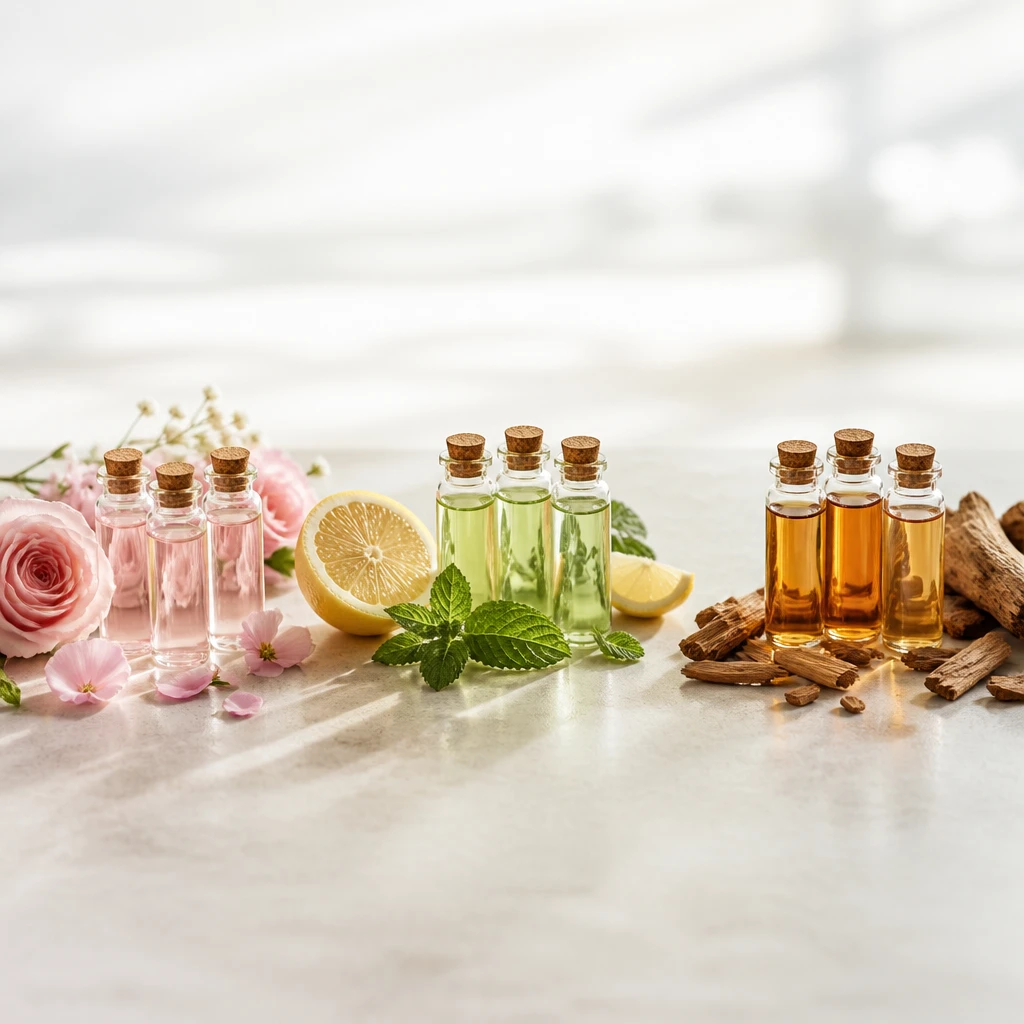
What are the mainstream fragrance types for car air fresheners?Which types are suitable for which groups of people?
Four main fragrance categories: fresh, woody, floral, and fruity
The mainstream fragrance types for car air fresheners can be classified into four categories: fresh, woody, floral, and fruity.
Fresh(Mint, ocean, and grass types) diffuse quickly and have a strong refreshing effect, suitable for daily commuting and short trips. They are also more acceptable to users sensitive to smells, but the scent retention time is relatively short.
Woody(Sandalwood, cedar, and amber types) have a steady scent, diffuse slowly but have good longevity, suitable for long-distance driving and business reception scenarios. Users who prefer an understated temperament tend to favor this type.
Floral scent(Rose, jasmine) Sweet and soft, highly recognizable, suitable for female users and family car use, but high concentration in enclosed spaces may cause discomfort; it is recommended to use with slow-release diffusion.
Fruity scent(Citrus, lemon, grapefruit) Friendly and well-accepted, effectively neutralizes odors in the car, suitable for new car deodorization and high-frequency passenger scenarios such as ride-hailing.
Correspondence between fragrance types and user profiles
| User type | Recommended fragrance type | Typical scenario |
| Young white-collar workers | Fresh and fruity notes | Daily commute |
| Business professionals | Woody | Long-distance driving, business reception |
| Female users | Floral and fruity notes | Short-distance commuting, family trips |
| Household users | Fruity, fresh | Family car, multiple passengers |
The choice of fragrance should be based on the target users' olfactory preferences and car usage habits. For daily commuting (within 1 hour), prioritize fresh or fruity scents that diffuse quickly;For long-distance driving (over 2 hours), woody or slow-release floral scents with lasting fragrance are more suitable.
Why does the same fragrance type have vastly different experiences across different products?
When choosing a fragrance type, you often see names like "Ocean," "Woody," "Citrus," and so on. But the actual scent of the same name on different products can be completely different. What truly determines the experience are two technical variables behind the fragrance name: essential oil quality and diffusion technology.
Essential Oil Quality: Pure Oil-Based Plant Extraction vs. Regular Fragrance
Regular fragrances are typically made from synthetic aroma chemicals and solvents, offering low cost and direct scent, but they have two obvious drawbacks: first, they diffuse quickly and fade quickly—strong in the first few minutes, then rapidly diminishing;second, they tend to produce a pungent "chemical smell" at high temperatures, especially in cars after being exposed to the summer sun.
Pure oil-based plant-extracted essential oils are different. They are directly extracted from plant materials, with more stable molecular structures and richer scent layers—the transition from top, middle, to base notes is more natural, and the scent lasts significantly longer. Take the SOCELI smart car diffuser as an example: it uses high-concentration plant-extracted pure oil-based essential oils, meaning that with the same "woody" note, you smell real cedar or sandalwood, not a synthetic "woody-like" scent.
Key points to judge: When purchasing, do not only look at the fragrance name; confirm whether the essential oil base is pure oil-based or solvent-diluted. The former has a higher unit price, but the experience and scent duration are completely different.
Diffusion technology: How slow-release/controlled-release affects fragrance longevity and layering
Many users complain that "the aroma is very strong at the beginning, but then fades away." The problem often lies not in the essential oil, but in the diffusion method. Ordinary diffusion devices release continuously and constantly, causing the essential oil to evaporate heavily in the initial stage, with concentration dropping rapidly, resulting in a "strong at first, weak later" experience.
Slow-release/controlled-release technology solves this problem. It controls the release rate of the essential oil, allowing the fragrance to be emitted uniformly over a longer period. Specifically, sustained-release technology regulates the contact area between the essential oil and air and the evaporation rate, so that the top note is not too strong, and the middle and base notes can be continuously presented.
This is also why, with the same bottle of essential oil, a device equipped with sustained-release technology can last longer and maintain a stable scent throughout.
Key points to judge: Pay attention to whether the product explicitly indicates "sustained-release" or "controlled-release" technology, and whether the release mechanism is supported by physical structures (such as adsorption media, microporous membranes, etc.), rather than merely relying on heating to accelerate evaporation.
Key trade-off: If you only seek to "smell a distinct fragrance the moment you get in the car," ordinary fragrance plus a strong diffusion device may be more direct;But if you care about the fragrance not being greasy, not dissipating, and not irritating during long drives, then pure oil-based essential oils plus sustained-release technology is the matching solution. Before choosing a fragrance type, confirm these two technical indicators first; this is more important than agonizing over the name.
How do brands and distributors formulate fragrance combination strategies?
The fragrance combination is not about 'picking a few pleasant scents,' but rather a product structure decision made around the target customer group, usage scenarios, and channel positioning. For brand owners and distributors, the combination strategy directly determines inventory depth, turnover efficiency, and terminal conversion rates.
Fragrance Combination Recommendations Based on Target Markets
Users in different markets have significantly different olfactory expectations for car air fresheners, so the combination strategy should be adjusted accordingly:
- Mass retail channels: Follow the principle of 'safe and foolproof.'It is recommended to prepare 4-6 scents, covering three basic fragrance families: fresh (marine/citrus), woody (cedar/sandalwood), and floral (jasmine/white tea).These users are mostly buying for personal use or as gifts, preferring widely recognized and universally appealing scents, and avoiding overly distinctive or intense options.
- High-end/Gift channels: Focus on "differentiated memory points".Recommend 3-4 scents, with 1-2 being exclusive or limited editions, paired with packaging and brand story to create a premium.These users are less price-sensitive but very sensitive to whether the scent has been encountered elsewhere.
- Corporate/Fleet procurement: Adhere to the principle of "low controversy, long-lasting scent".Recommend 2-3 scents, choosing light, non-irritating fragrances, as strong scents can cause fatigue or discomfort with prolonged use.These clients care more about diffusion stability than scent variety.
A brand's first-round recommendation is to prepare 4-6 variants。 Fewer than 4 variants leave insufficient choice for end consumers, making the brand appear unprofessional;More than 6 variants amplify the pressure of initial stocking and sell-through, and some unpopular scents may remain unsold for a long time. It is a safer path to first establish a solid foundation, then add new scents based on sales data.
OEM/ODM Custom Scent Development: Key Steps from Selection to Launch
If your brand requires exclusive scents, the process typically involves four steps:
- Define the scent direction: Instead of directly saying "I want a premium scent," describe the target user profile (age, gender, car usage scenario), the desired olfactory experience (fresh/warm/steady), and the undesired characteristics (such as overly sweet or medicinal).The more specific the direction, the more precisely the perfumer can match it.
- Sample Confirmation and Adjustment: The supplier will provide 2-3 samples based on the direction.You need to actually test them in the car environment—note that the same fragrance can perform very differently on a scent strip versus in the car's interior, so be sure to test in the car, paying attention to the top, middle, and base notes and the longevity.
- Stability and Safety Verification: After confirming the fragrance, verify the compatibility of the essential oil with the diffusion device (whether it affects the diffusion rate, whether it corrodes materials), as well as its stability in high-temperature environments.In car scenarios, the interior temperature can exceed 60°C in summer, so the fragrance must pass heat resistance tests.
- Packaging and labeling implementation: including fragrance name, ingredient labeling, brand logo printing, etc.If your brand has a specific visual identity, you need to confirm the printing process and material compatibility with the supplier in advance.
It should be noted that OEM/ODM customization usually has minimum order quantity requirements, and the development cycle ranges from 4 to 8 weeks. If your brand is still in the market testing stage, it is recommended to first use existing fragrances for private label sales, verify market traction, and then invest in custom development to avoid upfront cost sinking.
Key trade-off: Having a large number of fragrances does not necessarily mean stronger competitiveness. The core of the combination strategy is 'covering mainstream needs + retaining differentiated highlights'. If your target market is mass retail, prioritize comprehensive coverage of basic scent profiles;If it is a high-end gift channel, focus resources on polishing 1-2 exclusive fragrance types.
Specifically for your target market and initial order budget, it is recommended to explain your channel type and customer profile to the SOCELI team, and they will provide a matching solution based on the existing fragrance library and customization capabilities.
In which situations is it not advisable to blindly pursue the number of fragrance types?
The number of fragrance types is not necessarily the more the better. For categories like car diffusers, which have complex SKU management and high minimum order quantities per item, each additional fragrance type corresponds to a simultaneous increase in essential oil raw material inventory, packaging labels, inventory turnover, and expiration loss. In the following two situations, it is more prudent to control the number of fragrance types.
Management costs and inventory risks of having too many fragrance types
The more fragrance types, the greater the inventory pressure. Each SKU requires independent stocking, and the essential oils in car fragrances have a shelf life. Slow-moving scents may face expiration losses before they are even sold. For new brands with unclear target user profiles and unverified channels, launching multiple scents at once means bearing the trial-and-error costs of multiple SKUs simultaneously. Best-sellers are prone to stockouts, while slow-moving items are prone to overstock.
It is recommended to start with no more than 3 basic scents to test the market, and use actual sales data to determine the direction for future expansion.
Clarify the selection boundaries: when to choose basic models, and when to choose customization.
| Your situation | Recommendation |
| Target market unverified, channel feedback unstable, limited budget | Choose standardized basic models, no more than 3 scents. |
| Clear brand positioning, stable sales volume already achieved, and the need for differentiated competition | Develop one exclusive fragrance through OEM/ODM |
| The customer has clearly specified the fragrance and has acceptance criteria | Customization is possible, but first confirm the minimum order quantity and sampling lead time |
Conclusion: When goals are clear and channels are defined, choosing a customized solution can create differentiation;Conversely, opting for standardized basic models is more prudent. Before brand positioning and channel feedback are validated, each additional fragrance adds management costs rather than competitiveness.
Frequently Asked Questions
Q: How many standard fragrance options does the SOCELI smart car diffuser currently offer? A: SOCELI offers a variety of base fragrances, covering mainstream preferences such as fresh, woody, and fruity scents. The specific list of available fragrances and their scent descriptions are regularly adjusted based on market feedback. We recommend contacting the sales team for the latest version.
Q: For a first collaboration with limited purchase volume, how many fragrance options are appropriate? A: We recommend keeping it within 2-3 options. This allows you to test market response without spreading procurement too thin, which could lead to insufficient inventory per fragrance.
Regarding whether a single batch order can include multiple fragrance options and the minimum order quantity for each, please confirm with the sales team based on the production schedule for that batch.
Q: What is the minimum order quantity and sampling cycle for custom fragrances? A: Custom fragrance development involves essential oil blending, stability testing, and packaging updates. The MOQ and sampling cycle vary depending on the complexity of the formula. It is recommended to first clarify the target fragrance direction (odor family, concentration preference), so SOCELI can provide accurate MOQ and timeline.
Q: After customizing a fragrance, will there be batch-to-batch variations in subsequent replenishments? A: Essential oil raw materials are affected by season and origin. Slight odor fluctuations between batches are common in the industry. In custom projects, SOCELI locks in the formula and raw material suppliers, and retains reference samples for comparison, keeping batch variations within an acceptable range.
If you have strict requirements, please specify them clearly before customization.
Learn more
If you are planning a car fragrance product line, or have specific questions about fragrance combinations and OEM customization processes, feel free to contact the SOCELI team. Submit your target channels and customer profile, and we will provide a matching solution based on our existing fragrance library and customization capabilities.
Related products:Smart Car Diffuser