

Why is safety the first decision threshold for car air freshener procurement?
When procuring car air fresheners, safety is not just one of many selling points, but a 'one-vote veto item'. The reason is straightforward: the working environment of car air fresheners is a sealed cabin with significant temperature fluctuations—after summer sun exposure, the temperature inside the car can far exceed normal levels. If the air freshener releases unstable substances at high temperatures, or if the container material ages and deforms under prolonged sunlight, it directly affects the health and safety of the driver and passengers. For brand procurement and distributors, once a product has a safety issue at the point of sale, the loss is not just the order, but channel trust and brand reputation.
Three safety concerns that buyers truly worry about
1. Chemical stability under high-temperature environments. This is the core difference between car scenarios and home air fresheners. What buyers need to confirm is: will the air freshener liquid decompose into harmful substances at high temperatures?
Have the fragrance ingredients undergone safety assessments? This directly affects whether the product can be safely used in a car during summer.
2. Temperature resistance and drop resistance of the container material. Car air fresheners experience vibration, bumps, and even accidental collisions during driving. Whether the container material is sturdy enough, whether it releases harmful substances at high temperatures, and whether it can cause secondary injuries after breaking are specific issues that buyers need to verify with suppliers.
3. Safety of long-term inhalation. The car interior is small, and drivers and passengers are exposed to the fragrance environment for extended periods. Whether the fragrance ingredients have undergone long-term inhalation safety assessments, rather than just skin contact tests, is a crucial but easily overlooked point in procurement decisions.
How to Convert Safety Selling Points into Verifiable Procurement Criteria
Phrases like "safe formula" or "eco-friendly materials" carry little weight in the procurement process—because any supplier can claim them. The truly effective approach is to break down safety selling points into verifiable procurement criteria and confirm each item during the product selection phase:
- Material certification: Does the product's claimed "eco-friendly PP material" have a corresponding material test report?Does the report cover high-temperature resistance and aging resistance tests?
- Ingredient transparency: Can the supplier provide a list of ingredients for the aromatherapy liquid and specify which ingredients have undergone safety assessments?
- Scope of the test report coverage: Does the test report cover high-temperature scenarios in vehicles?Or is it only applicable to normal-temperature indoor environments?
- Applicable markets for the certification: If the product claims to be certified against international safety standards, you need to confirm whether that certification covers the market access requirements of your target sales markets—regulatory requirements for aromatherapy products vary significantly across different markets.
Taking SOCELI liquid car aromatherapy as an example, its products use environmentally friendly PP material, but as a buyer, the specific documents you need to request from the SOCELI team include: the material's temperature resistance test report, the safety assessment of the aromatherapy liquid's ingredients, and the certification coverage for the target market. These documents can directly answer the core question: "Is this product safe to use in a car during high summer temperatures?"
Next steps for confirmation: Before requesting samples for actual testing, first ask the supplier to provide the above three written documents. If the documents are complete and cover the vehicle scenario, then proceed to the sample testing stage—during testing, pay special attention to odor changes and container condition after high-temperature sun exposure.
How to verify the safety selling points of car air fresheners?From materials, certifications to formulas
 How to verify the safety selling points of car air fresheners?From materials, certifications to formulas
When evaluating the safety of car air fresheners, buyers can check from three dimensions: whether the material is high-temperature resistant and environmentally friendly, whether certification documents are complete, and whether the formula is healthy and safe. The following explains each in detail.
How does environmentally friendly PP material support high-temperature resistance and safety?
PP (polypropylene) typically has a heat deflection temperature in the range of 100–120°C, which can cope with the ambient temperature after sun exposure in a car during summer (generally not exceeding 80–90°C). However, "eco-friendly" does not directly equate to "high-temperature resistance"; it refers to the raw materials and production process meeting environmental requirements. SOCELI liquid car fragrance uses eco-friendly PP material. Buyers should confirm two points with the supplier: the actual heat deflection temperature data of this PP material, and the corresponding material test reports (such as RoHS, REACH, and other restricted substance tests).
Only when both are complete can the high-temperature resistance and eco-friendly selling points be considered well-founded.
International safety certifications and healthy formulations: What documents should buyers verify?
Buyers should not merely accept verbal assurances of "passing international safety standard certifications." It is recommended to request the following documents according to this checklist:
| Document Type | Verification Points |
| Material Safety Reports (RoHS, REACH) | Confirm that the shell and container are free of restricted substances such as lead, mercury, and cadmium. |
| Fragrance safety documents (IFRA compliance statement, MSDS) | Confirm that fragrance raw materials comply with international standards for daily-use fragrances. |
| Transport safety report (if applicable) | Confirm that liquid products comply with regulations during transportation. |
The core of a "healthy and safe formula" lies in two aspects: solvent type and fragrance concentration. Inferior products often use industrial alcohol or low-purity solvents, which easily emit irritating gases at high temperatures. Buyers should confirm whether the solvent is food-grade or cosmetic-grade raw material and whether the fragrance has passed IFRA certification.
If the supplier can only make verbal commitments, it is recommended to request copies of key test reports with the samples during the sample stage, to be attached as annexes to the bulk purchase contract.
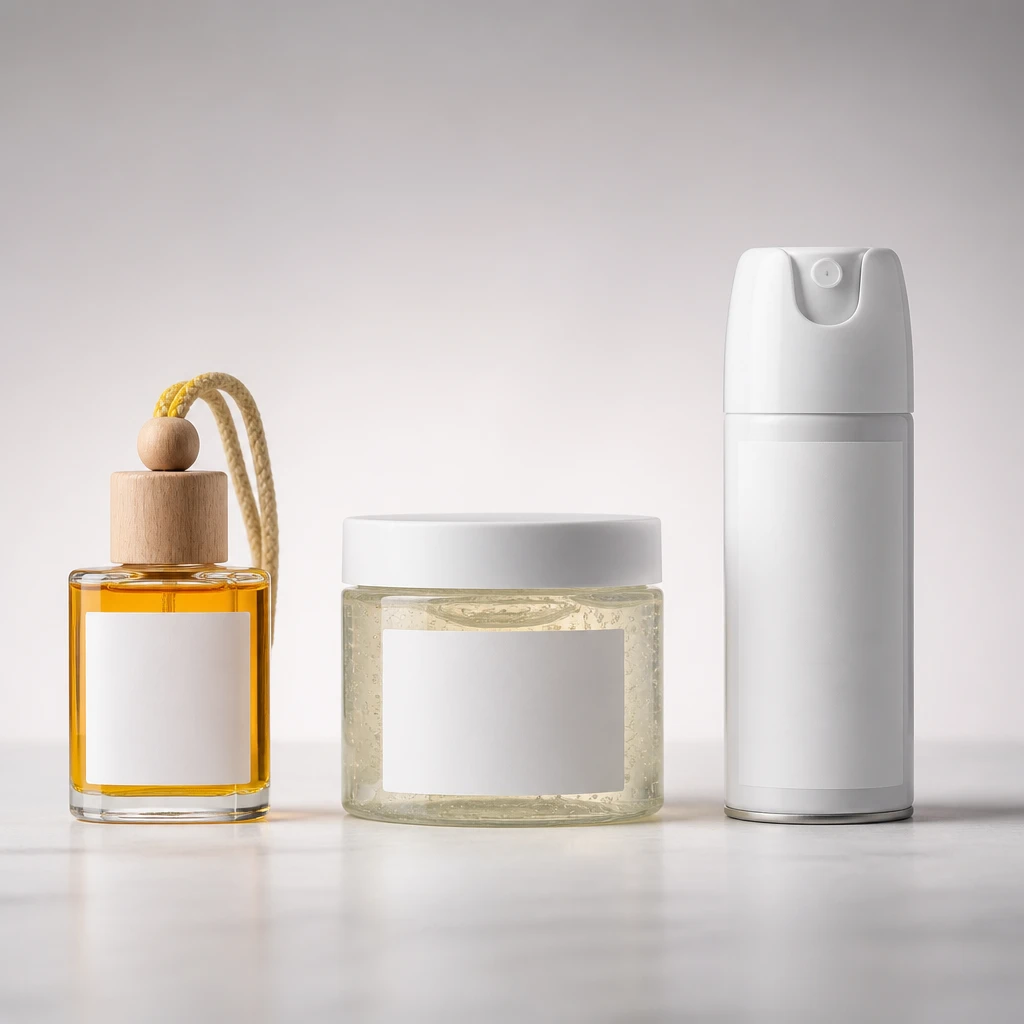
Liquid, solid, or spray?Safety and Applicability Boundaries of Different Forms
When purchasing car air fresheners, the choice of form is often dismissed as a matter of 'taste,' but it directly determines who you can sell to and who you cannot. The safety logic of the three forms—liquid, solid, and spray—is completely different, and their applicable scenarios barely overlap.
How to balance the durability and safety design of liquid air fresheners?
The durability of liquid air fresheners comes from two factors: capacity and evaporation control. Taking SOCELI liquid car air freshener as an example, with a 120g content and slow-release design, the claimed endurance is 90 days, a level that solid air fresheners (usually 10-30g, lasting 2-4 weeks) cannot match. For enterprise customers who need a 'set it and forget it' solution—such as ride-hailing fleets, 4S store test drive vehicles, and rental cars—the liquid form offers the lowest maintenance cost.
But the price of durability is the risk of leakage. If the liquid container fails under high temperature or impact, the consequences are far more severe than with solid forms. SOCELI's response is an eco-friendly PP bottle body with a visual tank design, allowing users to see the remaining amount at any time, avoiding the embarrassment of 'thinking there's still some left when it's actually empty,' and also reducing seal wear caused by excessive twisting or inversion.
When purchasing, the key questions you need to confirm with the supplier are:Whether the bottle mouth sealing structure can maintain airtightness after continuous exposure to temperatures above 60°C, and whether there is a corresponding high-temperature test report.
Which scenarios are not suitable for choosing liquid car air fresheners?
The following scenarios are recommended to directly exclude liquid forms:
- Open-air parking scenarios in extremely hot regions: In summer, the temperature inside the car can exceed 70°C, and the expansion pressure of the liquid will significantly increase the probability of leakage.If the customer's fleet does not have underground or shaded parking conditions, solid air fresheners are more reliable.
- Operating vehicles with frequent hard braking and rough road conditions: Liquid sloshing will accelerate seal wear, and under long-term vibration, the failure rate of liquid forms is higher than that of solid forms.
- Scenarios with a demand for 'instant fragrance burst': The advantage of liquid slow-release is uniform and long-lasting, but the disadvantage is that the top note is not obvious.If the customer wants an obvious fragrance the moment they get in the car, sprays or solid fragrance tablets are more suitable.
How can the leakage risk of liquid aromatherapy be avoided?
Avoidance can be addressed at two levels. At the product level, confirm the bottle material, sealing ring material, and bottle mouth structure, and require the supplier to provide high-temperature and drop test data. At the usage level, liquid aromatherapy should be fixed in positions that are not easily bumped, such as cup holders or air conditioning vents, and avoid placing it in door storage compartments where it may be repeatedly squeezed.
Customers suitable for choosing liquid: Enterprise customers seeking low maintenance costs, long-lasting performance, and stable fragrance, especially fleets, showrooms, and long-term rental vehicles. Customers not suitable for choosing liquid: Scenarios with direct high-temperature sun exposure without shade, extremely poor road conditions, or the need to frequently change fragrance types.
The next step that needs to be confirmed with the SOCELI team is: Can you provide sealing test data for this model in a 70°C environment? If the customer has extreme high-temperature scenarios, are there suitable solid or spray alternatives?
How to determine whether SOCELI liquid car fragrance is suitable for your procurement scenario?
To determine whether this product suits you, focus on three key things: whether your procurement goals are clear, whether you have strict requirements for safety compliance, and whether you need customized services. Below are clear boundaries for suitability and unsuitability.
Three typical procurement needs suitable for choosing SOCELI
1. You need a car fragrance that can pass safety audits
If your procurement process requires suppliers to provide safety certifications or test reports, SOCELI liquid car fragrance is a suitable choice. It claims to be certified against international safety standards, using environmentally friendly PP material and a health-safe formula, and this information can be directly used in your supplier qualification review. For brand procurement, this can save a lot of time and risk in self-verification.
2. You need to quickly launch custom fragrances under your own brand
SOCELI supports OEM/ODM customization, with a library of 18+ fragrance options, and offers rapid sampling services. If your business pace is 'launch new products as soon as possible, test market response first,' then the customization process of this product can match your speed. The visible tank design (120g capacity, 90-day endurance) also makes it easy for you to visually showcase the 'remaining amount visible' selling point to end users on product detail pages or packaging.
3. Your usage scenarios involve high temperatures or long-distance environments
The product design takes into account high-temperature scenarios, making it suitable for situations where the car interior has a strong odor after being exposed to the sun in summer;The 90-day battery life also covers the continuous fragrance needs of long-distance driving. If your customer base includes ride-hailing drivers, long-haul freight drivers, or users who frequently drive in hot regions, the parameters of this product can directly address these pain points.
In what situations is SOCELI not recommended?
1. Your procurement goals are still vague
If you are still in the stage of "thinking about trying out an aromatherapy product" without having determined the target channels, target price points, and end-user profiles, it is recommended that you do not place an order yet. The suitability of this product is based on the premise that "you clearly know what problem you want to solve"—for example, whether you want to replace an existing supplier, expand your product line, or enter a new market. When procurement goals are unclear, it is easy to repeatedly adjust fragrance choices, packaging specifications, and minimum order quantities, which increases communication costs.
2. You have very specific exclusive requirements for the fragrance type
Although SOCELI offers 18+ fragrance options, if you need a fragrance that is 'completely original and has no similar scent on the market,' you need to first confirm whether their fragrance blending capabilities can meet your exclusive formula needs. This cannot be confirmed from existing information. You need to provide your scent direction (such as woody, fruity, or specific raw material preferences) to the SOCELI team so they can assess whether it can be achieved.
3. Your budget logic prioritizes 'extreme low price'
SOCELI's pricing logic is built on safety-certified materials, in-house factory control, and customized services. If your procurement decisions are driven solely by unit cost and you do not require certification or customization, there may be cheaper simple aromatherapy products on the market. But you need to weigh: is the cost saved worth sacrificing safety endorsement and quality control?
How to apply for samples and evaluate suitability?
Requesting a sample is the most direct way to assess compatibility. The specific steps are as follows:
- Clarify your testing criteria: Before applying, list the indicators you want to verify—such as fragrance persistence under high temperatures, canister durability, and whether the scent matches your brand identity.
- Contact the SOCELI team to describe your scenario: Inform them of your usage scenario (e.g., high-temperature exposure, long-distance driving), target customer group, and customization needs, so they can recommend matching scents and specifications.
- Request samples and confirm shipping costs: Sample fees are usually low, but you may need to bear the shipping costs.For bulk customization, the higher the MOQ, the better the unit price; you can inquire about this during the sample stage.
- Decide after actual testing: Place the samples in a real usage environment for at least one week, focusing on the actual experience of fragrance longevity, scent diffusion uniformity, and the visual clarity of the remaining amount in the can.
Key trade-off summary: SOCELI liquid car air fresheners are suitable for buyers who have clear goals, need safety endorsements, and have customization needs;They are not suitable for scenarios where goals are vague, buyers seek more stable low prices, or completely original fragrance types are required. If you fall into the first two categories, the next step is to contact the SOCELI team to confirm customization details and the sample process.
Frequently Asked Questions
Q: Under what conditions was the 90-day endurance of the SOCELI liquid car fragrance measured? A: The available information does not specify the exact test conditions (such as frequency of use, ambient temperature, ventilation). It is recommended that you simulate your actual usage scenario during sample testing to verify whether the 90-day endurance can still be achieved in high-temperature or long-term enclosed environments.
Q: If I only purchase 100 units for a trial sale, can SOCELI accept the order? A: The available information does not specify the minimum order quantity threshold. It is recommended that you directly ask the SOCELI team about the price and lead time for small trial orders, and confirm the cooperation conditions for the trial phase before deciding whether to expand procurement.
Q: What steps are included in SOCELI's OEM customization? A: It is known that fragrance selection and rapid prototyping are supported, but the specific scope of customization such as label design, packaging specifications, and capacity adjustments needs further confirmation. We suggest you bring your customized requirements checklist (such as label size, packaging material, and number of fragrance types) to confirm each item with the team.
Q: Is this product suitable as a procurement option for the gift channel? A: If the gift channel values the "sense of quality" brought by safety certifications and visual design, SOCELI is a suitable choice. However, you need to confirm whether the packaging supports gift box formats, whether the minimum order quantity meets the batch requirements of gift procurement, and whether there are additional options such as holiday-limited fragrances.
Q: Can SOCELI's test reports be provided to the procurement party for review? A: The product claims to have passed international safety standard certifications, but the specific certification names and report types are not listed in the materials. We suggest directly requesting a copy of the test report from SOCELI during the procurement process, and confirming whether the testing items covered by the report and its validity period meet your review requirements.
Learn more
If you are unsure about the goal, target users, existing materials, or future maintenance methods, it is recommended to confirm this information first, and then determine whether the SOCELI liquid car diffuser is suitable.
Related products:SOCELI liquid car diffuser