
Where does the odor-neutralizing ability of car air fresheners come from? Principles and Misconceptions Explained
When many procurement clients choose car air fresheners, the first question is often "Can it really remove odors?" The answer to this question depends on whether you understand "masking" or "neutralizing"—these two are separated by completely different technical routes and cost structures.
Odor Neutralization ≠ Masking: How Pure Oil-Based Essential Oils Decompose Odor Molecules
The working principle of ordinary car fragrances is "masking": using a stronger scent to overpower the odor. Not smelling it doesn't mean the odor molecules are gone. Once the fragrance evaporates, the smoke, musty, and food residue odors will return as before.
The logic of pure oil-based essential oils is different. The essential oils extracted from plants contain active ingredients such as aldehydes and terpenes, which can chemically combine with or oxidize odor molecules (such as nicotine, ammonia, and sulfides), converting them into odorless or low-odor-threshold substances. In simple terms, it 'treats' the odor rather than 'masking' it.
This is also why pure oil-based essential oils are more effective in small spaces like a sealed car cabin—where the space is small and the odor concentration is high, making the neutralization reaction more efficient.
It is necessary to clarify a common misconception: pure oil-based essential oils do not mean they can 'eliminate all odors'. They are highly effective against organic odor molecules such as smoke, sweat, and food smells, but their ability to decompose inorganic gases like formaldehyde is limited. If your procurement scenario is removing formaldehyde from new cars, you need to additionally confirm whether the product is equipped with a targeted purification module, rather than relying solely on essential oils.
How does sustained/controlled release aroma diffusion technology maintain continuous purification effects?
Pure oil-based essential oils solve the problem of 'whether it can neutralize', while sustained release technology solves the problem of 'how long it can neutralize'.
The evaporation curve of ordinary aromatherapy is steep: the concentration is high just after turning on, and drops off a cliff after a few hours. Sustained/controlled release diffusion technology controls the contact area between essential oils and air and the evaporation rate, allowing essential oils to be released at a nearly constant rate over several weeks. This means two things: first, the fragrance concentration in the car is stable, without the experience of 'choking at the beginning and no smell later';second, the effective purification cycle per refill of essential oil is longer, which directly affects refill frequency and operating costs for fleets or corporate procurement.
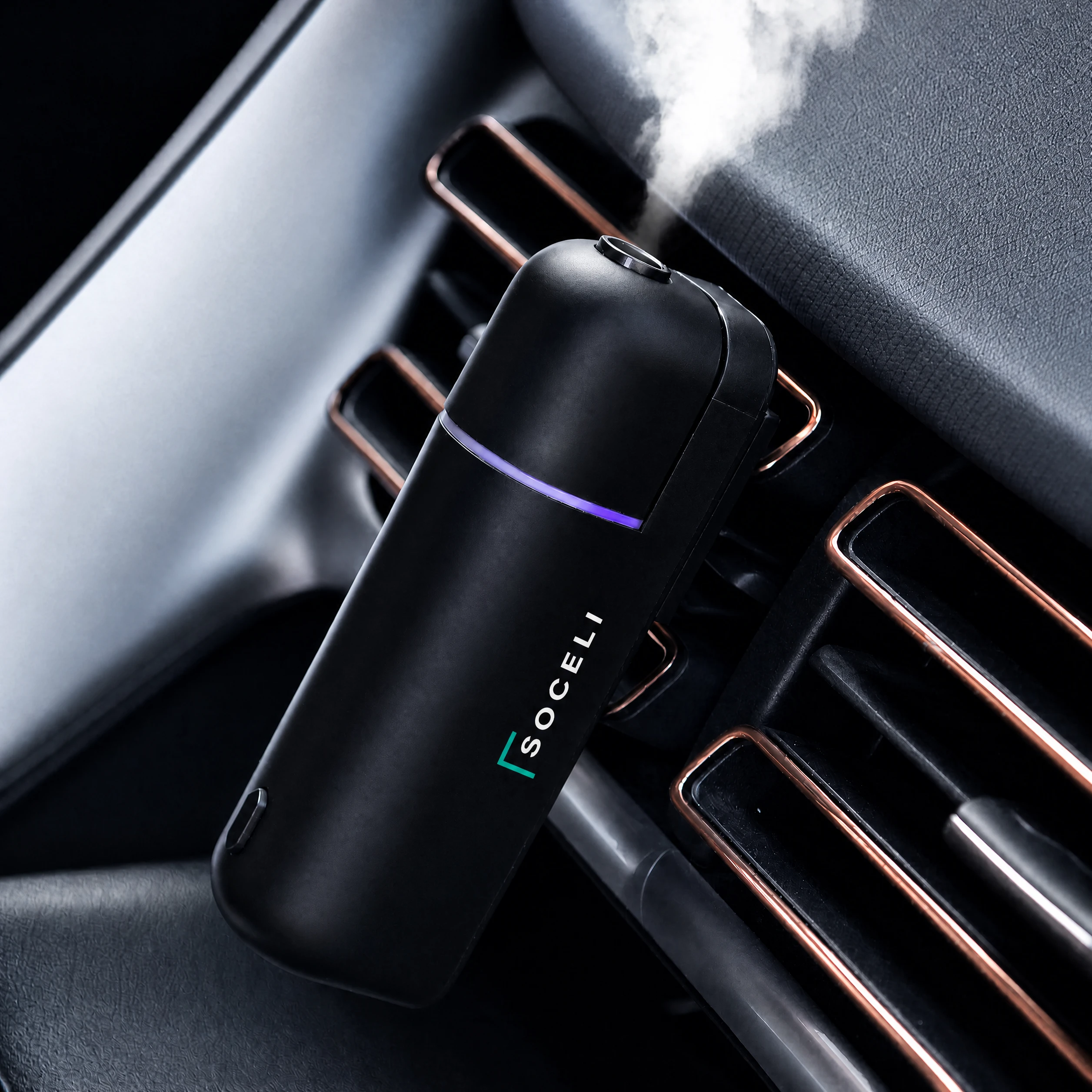
The SOCELI A125 smart car aromatherapy diffuser uses this sustained/controlled release diffusion structure, combined with high-concentration plant-extracted pure oil-based essential oils, to maintain a stable neutralization effect in both commuting and long-distance scenarios. For buyers, to determine whether a product truly has sustained release capability, you can look at two details: whether the essential oil chamber is sealed and whether there are adjustable diffusion levels—these two points determine the controllability of evaporation in actual use.
Next step to confirm: If you are concerned about neutralizing smoke or food odors, this product can directly match;If you are addressing the issue of formaldehyde in a new car, we recommend confirming with the SOCELI team whether an additional purification solution is included before deciding on the procurement configuration.
What is the difference between a car fragrance and an air purifier?How to choose between the two solutions
Many customers confuse "fragrance" with "purification" when selecting products, assuming that if a scent masks odors, the air quality has improved. In reality, these two types of products address different levels of issues, and choosing the wrong solution can lead to "spending money while the problem remains."
Comparison of working principles: chemical neutralization vs. physical filtration
Car fragrance (such as the SOCELI A125 smart car fragrance diffuser) focuses on "scent management." It uses slow-release/controlled-release fragrance diffusion technology to evenly distribute high-concentration plant-extracted essential oils into the car cabin, where fragrance molecules chemically neutralize odor molecules, thereby improving people's perception of smells. It does not change the number of particulate matter in the air, but it can significantly enhance the olfactory experience—especially for organic odors such as smoke, food residue, and mildew, where the neutralization effect is direct and fast.
Car air purifier The core of it is "particulate matter removal". It physically intercepts dust, PM2.5, pollen, and other particles through a HEPA filter or activated carbon layer, and some models have negative ion settling functionality. Its advantage lies in "invisible cleanliness," but for odors, it can only rely on activated carbon adsorption, which requires filter replacement after saturation, and its immediate improvement for stubborn odors like smoke is less noticeable than that of aromatherapy.
| Dimension | Car aromatherapy | Air Purifier |
| Target Issues | Odor perception, olfactory experience | Particulate matter, allergens |
| Mode of Action | Chemical neutralization + fragrance masking | Physical filtration + adsorption |
| Speed of Effectiveness | Immediate (odor improvement upon startup) | Requires several minutes of circulation and filtration |
| Maintenance cost | Simply replenish essential oil | Regular replacement of filter cartridge |
| Additional value | Ambiance and mood regulation | None |
Scenario-based selection: when to choose an aromatherapy diffuser and when to choose an air purifier
Prioritize a car aromatherapy diffuser when:
- The main issue is 'unpleasant odor in the car'—residual smoke, food smells, leather odor, damp musty smell
- You have requirements for the in-car atmosphere and want a pleasant olfactory experience every time you get in the car
- You seek low maintenance costs and do not want to regularly replace filter cartridges
- You mainly commute daily, with each trip lasting within 30 minutes, and need quick results
Prioritize an air purifier when:
- Passengers in the car have respiratory sensitivities or pollen allergies
- Often passing through haze areas or dusty construction site sections.
- Concern about formaldehyde in new cars (note: aromatherapy cannot remove formaldehyde, only mask the odor).
Can both be used at the same time? Yes, but it depends on the priority. If your core pain point is odor, it is recommended to use aromatherapy as the main solution;If the core pain point is dust allergies, use the purifier as the main solution, with aromatherapy as a supplement to improve the smell.
It is not recommended to use aromatherapy to cover up when the purifier filter is already saturated and the air output smells sour; that is masking the problem rather than solving it.
A common pitfall: If your goal is to 'remove formaldehyde from a new car,' aromatherapy and ordinary purifiers are not ideal solutions—the former only masks it, while the latter's formaldehyde removal efficiency depends on the amount of modified activated carbon in the filter. In this case, you need to first confirm the specific indicators of the in-car air quality, and then decide whether to upgrade the solution.
Next steps to confirm: If you are a brand purchaser or distributor, first clarify whether your end customers most often complain about 'bad smell' or 'nose discomfort/allergies.' For the former, choosing a smart aromatherapy diffuser like the SOCELI A125 is sufficient;For the latter, you need to explain the specific scenarios of your target customers to our team, and we will help you determine whether a purification solution is needed or how to adjust the product mix.
How do smart car aromatherapy diffusers adapt to different driving scenarios?
Daily commuting: the practical value of fast charging and portability
The core contradiction in commuting scenarios is 'time fragmentation'—you may only have a few minutes at a red light or while parked to recharge your devices. The practical significance of the SOCELI A125's PD 3.0 fast charging with a Type-C port is:It makes 'charging on the go' possible. The 5V/3A specification means you don't need to set aside dedicated charging time; the Type-C cable for your phone can power it directly, and the existing charging port in your car won't be monopolized.
The retractable charging cable addresses the 'storage' issue in this scenario. Commuter car interiors are small, and cables left dangling can easily tangle around the gear shift or interfere with operations. The retractable design keeps the device tidy when not in use, but you need to confirm a key condition:Whether the extended cable length is sufficient to cover the distance from your car's charging port to the air vent.。
If the two are far apart, the retractable cable can actually become a limiting factor. It is recommended to first measure the distance between these two positions in the car, and then confirm with the SOCELI team whether the maximum cable extension length matches.
Long-Distance Driving: Stability of Slow-Release Technology and Continuous Fragrance
The requirement for car fragrance during long-distance driving is not 'strong' but 'stable'. It smells fragrant in the first half hour, but you can't smell it after the next three hours—this is a common problem with many car air fresheners. SOCELI's slow-release/controlled-release fragrance diffusion technology specifically addresses this issue: it allows the essential oil to be released at a relatively constant rate, avoiding an initial surge and later decline.
For brand procurement, this meansThe refill cycle can be predictedThis facilitates calculating the subsequent consumable needs of fleet or retail customers.
Regarding "how to keep the car interior fresh during long-distance driving," two concepts need to be distinguished: the odor-neutralizing ability of aromatherapy and air purification are two different things. SOCELI's high-concentration plant-extracted pure oil-based essential oils possess odor-neutralizing ability, which can mask or neutralize odors such as smoke and food residue, but they are not HEPA filters and cannot filter PM2.5 or pollen. If your customer expects "purifier-level" air improvement, this boundary needs to be clearly communicated.
Conditions suitable for long-distance scenarios: a single drive does not exceed the duration of the essential oil's continuous release (the number of continuous hours per fill needs to be confirmed with the team);the vehicle has a cigarette lighter or USB port available for recharging. Unsuitable situations: If the customer requires 'one fill to cover the entire weekly commute' or 'physical filtration capability,' this product needs to be paired with other solutions, or expectations need to be adjusted.
Key trade-offs: when it's worth choosing, and when to double-check
| Decision point | Suitable for A125 | Needs further confirmation |
| Charging convenience | The car already has a Type-C port, or the user accepts using the built-in retractable cable | The charging port location is beyond the cable's extension range from the air vent |
| Fragrance persistence | For a single drive of 1-4 hours, periodic fragrance replenishment is acceptable. | Requires maintenance-free operation for several consecutive days. |
| Odor treatment | The goal is to neutralize common odors such as smoke and food smells. | The goal is to filter particulate matter such as dust and allergens. |
| Procurement mode | OEM/ODM customization of fragrance and logo is required. | Need third-party test reports or specific certification documents |
The most worthwhile confirmation actions for the next step:Request from the SOCELI team the sustained release duration data of the slow-release technology, the capacity of a single essential oil fill, and the maximum extension length of the retractable cable. These three parameters directly determine whether this product is 'sufficient' for your customer's actual vehicle model, and they affect the purchasing decision more than any promotional selling point.
In which situations is it not recommended to choose a car diffuser?Selection boundaries and procurement suggestions
Car diffusers are not a universal solution. Clarify its boundaries to determine whether your procurement needs fall within its capabilities.
Clearly unsuitable scenarios: particulate filtration and allergen control
If your core need isremoving PM2.5, pollen, dust, or pet dander, then no aromatherapy diffuser (including the SOCELI A125) should be your first choice. The function of an aromatherapy diffuser is odor management—neutralizing odors and improving the olfactory experience through essential oil molecules; it does not have physical filtration capabilities. Such needs should be addressed by a car HEPA air purifier, with the diffuser serving only as an additional olfactory enhancement layer.
Similarly, if passengers in the car have a clear history of respiratory sensitivity or are allergic to aromatic compounds,it is not recommendedContinuous use of any aromatherapy product in an enclosed space. Even if the formula is a pure oil-based essential oil derived from plants, individual tolerance to scents varies greatly. In such scenarios, 'no fragrance' is a more prudent procurement decision.
Additionally, if your expectation is to 'eliminate all odor sources at once'—for example, a mix of musty, smoky, and food residue odors—an aromatherapy diffuser can only mask or neutralize odor molecules, not eliminate the source of the odor. If the source is not addressed, the odor will reappear once the fragrance dissipates. This is not a product defect but a boundary determined by the mechanism of action.
Procurement Decision Framework: Budget, Customization Needs, and Long-term Maintenance
Regarding budget allocation, it is recommended to split it into three layers:
- Product procurement cost: Accounts for the main budget; focus on fast-charging specifications (Type-C / PD 3.0), scent diffusion technology (slow-release/controlled-release), and essential oil concentration (high-concentration plant-extracted pure oil base).These three factors directly determine the user experience.
- Custom development cost: If brand logo, exclusive fragrance, or packaging customization is needed, this is a separate budget item.SOCELI supports OEM/ODM, but customization means additional investment in minimum order quantity, sampling lead time, and mold/printing costs.
- Long-term maintenance cost: Essential oil refills are a recurring expense.Before purchasing, you should confirm the replacement frequency and unit cost of refills, as these have a greater impact on the total cost of ownership over time than the initial purchase price.
Regarding OEM/ODM customization: This is supported, but you need to clarify the depth of customization—whether it's just changing the logo and packaging, or if you need to adjust the fragrance formula, shell material, or charging cable length? Different levels of customization result in significantly different minimum order quantities and lead times. It is recommended to clearly state the scope of customization and expected quantity in your inquiry so that the team can assess feasibility.
When is it not worth adding complexity? If your need is simply to purchase a batch of aromatherapy diffusers as gifts or standard configurations, and you have no special requirements for brand exposure or fragrance, then choosing standard products and skipping the customization process is more efficient. Customization is only worth the investment when brand differentiation can bring clear commercial returns.
How to choose finally: If your core pain points are in-car odor management, need charging convenience (retractable cable + PD fast charging), and have clear plans for OEM/ODM, the SOCELI A125 is a matching solution. If your core pain points are particulate filtration or allergy control, please turn to the air purifier category. If your needs are still changing frequently—for example, you haven't decided on the fragrance direction or the depth of customization—it is recommended to clarify your needs before placing an order, to avoid paying customization costs for an undecided solution.
FAQ
Q1: Can car aromatherapy remove smoke odor? It can neutralize smoke odor molecules and improve the olfactory experience, but it cannot remove tar residue left on fabrics and air conditioning filters. If the source of the smoke odor is not cleaned, the odor will return after the aromatherapy is stopped.
Q2: What is the minimum order quantity for OEM/ODM customization? The MOQ depends on the depth of customization. The MOQ for logo-only packaging changes is typically lower than that for re-tooling the housing.
It is recommended to provide your customization scope and estimated quantity directly to the SOCELI team for a specific assessment.
Q3: How often should the essential oil refill be replaced? It depends on the duration of each use and the diffusion level setting. With slow-release/controlled-release technology, daily commuting scenarios typically consume less essential oil than long-duration continuous use.
For the specific replacement cycle, it is recommended to confirm the refill capacity and corresponding usage duration with the team before purchasing.
Q4: Can people who are sensitive to fragrance use it? It is not recommended for continuous use in a closed vehicle. You can try it for a short time at a low setting to ensure there is no discomfort before regular use.
If you have a known allergy history, it is recommended not to choose the aromatherapy option.
Q5: Is this aromatherapy diffuser suitable for fleet bulk procurement? Yes, provided that the fleet's core need is odor management rather than air filtration. For bulk procurement, it is recommended to first test samples in a few vehicles to confirm charging port compatibility and fragrance acceptance before placing a large order.
Learn more
If your procurement needs involve odor management, fast-charging convenience, or OEM/ODM customization, you are welcome to submit your specific scenarios, target vehicle models, and customization scope to the SOCELI team. We will assist in matching solutions based on your actual working conditions.
Related products:Smart Car Aroma Diffuser