
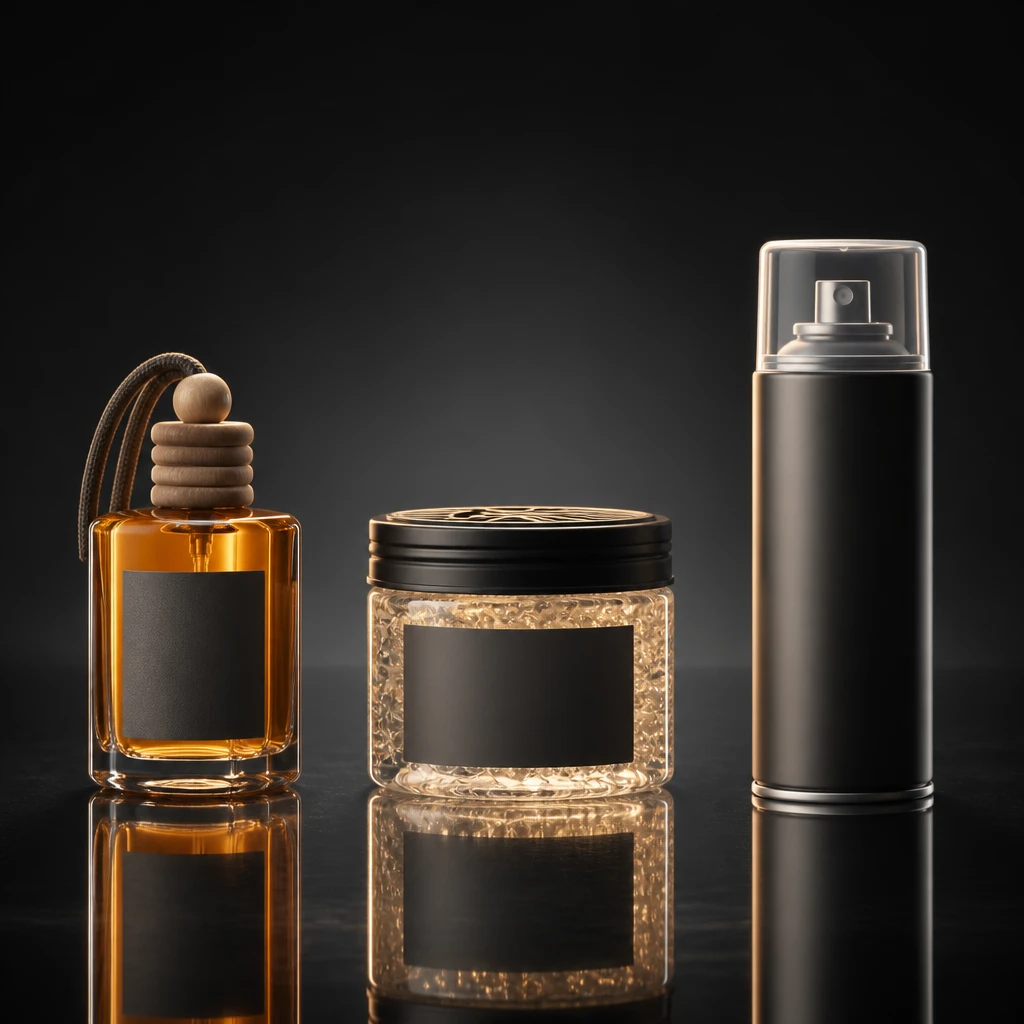
What are the core differences among the three forms of car aromatherapy?First, look at definitions and working methods.
Before determining which form suits your brand, it's important to clarify a fact that is often overlooked: liquid, solid, and spray are not three packaging options for the same product, but three completely different volatilization mechanisms. This difference in mechanism directly determines the duration of fragrance, the diffusion method, the usage scenarios, and the quality control responsibilities you bear as a brand owner.
Liquid aromatherapy: volatilization medium and persistence principle.
The core of liquid aromatherapy iscapillary adsorption + natural volatilization.。 The fragrance liquid is adsorbed through a fiber stick (volatilization stick), conducted upward from the bottle mouth, and continuously releases fragrance molecules when the liquid contacts the air. Its characteristic is that the fragrance 'seeps out slowly', with stable concentration, uniform diffusion range, and the liquid volume directly determines the duration of the cycle.
Taking the SOCELI TS101 as an example, a 120g capacity corresponds to approximately 90 days of use. This figure is not marketing talk, but a physical result determined by both the evaporation area and the total liquid volume. The natural advantage of the liquid form lies inpredictability—you know when it will run out and how much it releases each day. For brands, this means you can promise customers '90 days of continuous fragrance' without adding a bunch of qualifiers.
The cost of the liquid form is that the evaporation rate is significantly affected by temperature; high summer temperatures accelerate evaporation, while winter slows it down.Additionally, the liquid requires a sealed structure, demanding higher standards for container materials and sealing processes, and this cost is reflected in the unit price.
Solid perfume and sprays: the trade-offs behind convenience
The principle of solid perfume isthat a wax or resin base absorbs the fragrance, releasing it slowly through surface contact area.。 It has no liquid flow, is not afraid of tipping or leakage, and can be placed more freely, but the fragrance release is passive—only when air flows over the surface will it carry away fragrance molecules, so the diffusion range is small and the concentration is low, and as the surface fragrance is depleted, the scent will decay rapidly. The endurance of solid forms is usually shorter than that of liquids, and it is impossible to precisely judge the remaining time by "checking the remaining amount."
Sprays, on the other hand, usea pressurized canister with active spraying, where the fragrance reaches its highest concentration at the moment of spraying, then decays rapidly. Its advantages are strong immediacy and large coverage area, but the fragrance retention time is the shortest (usually measured in minutes), requiring repeated application, and there are more restrictions on the transportation and storage of propellants and spray cans. For brand owners, the customization threshold for sprays is the highest—involving filling lines, pressure testing, and transportation compliance.
The core differences among the three forms can be summarized as:Liquid is 'continuous supply', solid is 'passive release', and spray is 'pulsed burst'.。 This underlying logic determines all subsequent comparisons—if you want a long-term experience of 'set it and forget it', liquid naturally has the advantage;If you want the interactive feel of 'spray anytime', spray is more suitable;If you pursue ultimate placement freedom and low cost, solid is an alternative.
From safety certifications to material environmental friendliness: which form can better pass procurement audits?
The core of procurement auditing is not 'which form is safer,' but 'whether evidence can be provided to prove that the supply chain is controllable under high-temperature scenarios.' The risk points of the three forms differ, and therefore the audit focus points also differ.
High-temperature safety: material heat resistance and formula stability are key.
The high-temperature risks of liquid aromatherapy are concentrated in solvent evaporation expansion and bottle sealing. Inferior products may leak after prolonged sun exposure, and the leaked liquid may cause corrosion when in contact with the center console or leather. Solid fragrance balms are stable in form, but inferior products may soften and deform under high temperatures, and the fragrance may separate and adhere to the container surface.
Spray products rely most on canister quality and propellant stability. Inferior spray cans have a risk of bursting under high temperatures, and some transportation and storage links have additional restrictions on spray products.
PP (polypropylene) has medium-to-high heat resistance among common plastics, typically withstanding continuous temperatures above 100°C, which is sufficient for summer in-car sun exposure environments (generally not exceeding 80-90°C). However, "eco-friendly PP" does not constitute a safety promise—eco-friendliness mainly refers to recyclability and the environmental friendliness of the production process, and has no direct relationship with heat resistance. The purchaser should confirm:Whether the supplier uses virgin or recycled materials, as well as the actual test data of the container under high temperatures。
Due to varying impurity content in recycled materials, heat resistance may significantly decrease.
Certification and Testing: How Purchasers Verify Supplier Qualifications
It is recommended to check item by item according to the following checklist, rather than only looking at whether the other party has the word "certification":
| Audit Item | What Specifically Is Required | Assessing Value |
| Material Safety | Food-grade or contact-material test reports (e.g., FDA, EU 10/2011) | Confirm that the material itself does not release harmful substances |
| High-Temperature Stability | High-temperature storage test reports (e.g., continuous placement at 50-80°C) | Confirm that the container does not deform, leak, or cause fragrance decomposition |
| Fragrance Safety | IFRA compliance statement or MSDS | Confirm that the fragrance formula complies with international fragrance standards. |
| Transportation safety | Aerosol transportation safety testing (required only for spray forms) | Confirm the safety of the spray can during transportation and under high temperatures. |
If the target market is high-temperature regions such as the Middle East and Southeast Asia, it is recommended to directly request the supplier to provide continuous high-temperature test data above 50°C, rather than only looking at room-temperature reports. The verification cost for liquids and solids is lower than for sprays—the pressure vessel testing and transportation compliance involved in sprays will significantly extend the review cycle. As the next step, you can request the material test report and high-temperature storage test data for the TS101 liquid car fragrance from the SOCELI team, and also confirm whether the PP material is virgin or recycled. These two factors directly determine whether the procurement review can be passed.
Long-lasting fragrance and customization flexibility: Why is liquid aromatherapy more suitable for brand operation?
When selecting products, brands most often ask two questions that are actually two sides of the same coin:Can the product make it easy for end users, and can it make things easy for the brand? Liquid aromatherapy hits the mark on both points.
90-day endurance: How large-capacity design reduces replacement frequency
First, let's address the most direct comparison: Which lasts longer, liquid or solid aromatherapy?
The answer is that liquid clearly has the advantage. Solid aromatherapy (such as gypsum plaques and fragrance beads) has uncontrollable evaporation areas, and the scent typically diminishes noticeably within 2-4 weeks, with intensity fluctuating greatly with temperature. Liquid aromatherapy controls the release rate through cotton wicks or volatile cores. This 120g large-capacity jar design from SOCELI has a battery life of 90 days, which is more than three times that of most solid aromatherapy products.
What does this difference mean for brands? Replacement frequency directly affects users' perception of product value. A 90-day battery life means users only need to replace it 4 times a year, while solid aromatherapy may require 12-15 times.
For buyers in the gift channel or subscription-based brands, this number directly determines repurchase rhythm and complaint rate—the longer the battery life, the fewer negative reviews caused by "no scent."
Additionally, SOCELI adopts a transparent jar design, allowing users to see the remaining amount at any time. This detail is much more important in branding than it sounds: users can clearly see that the product is "still working," so they won't discard it prematurely or complain due to uncertainty.
OEM/ODM Customization: Complete Solutions from Fragrance to Packaging
Regarding customization, let's directly address three core questions:
Can fragrance and packaging be customized? Yes. SOCELI supports full-process OEM/ODM customization, covering both fragrance and packaging.
Our fragrance library currently offers 18+ options, and brands can also propose their own fragrance requirements.
What is the minimum order quantity? The minimum order quantity depends on the depth of customization. For OEM orders that only involve label changes, the minimum order quantity is relatively low;For ODM orders involving mold development and new fragrance formulation, the minimum order quantity will be correspondingly higher.
The exact figures need to be confirmed based on your packaging solution and fragrance requirements—this is also why it is recommended to contact the SOCELI team directly to obtain a quotation.
How long is the customization cycle? Rapid prototyping service is one of SOCELI's selling points, but the speed of prototyping and the production cycle for mass production are two different things. If the brand has a clear launch timeline, it is recommended to confirm both the prototyping and mass production timelines simultaneously when making an inquiry.
Here is a trade-off that brands often overlook:The higher the customization flexibility, the higher the upfront communication cost. If the brand is just starting out and has a limited budget, it is recommended to first choose mature fragrances from the existing fragrance library for label customization, and leave mold development and fragrance R&D until after sales are validated. This way, you preserve brand differentiation while controlling the initial capital risk.
Who is suitable for the liquid aromatherapy customization route? It is suitable for teams that already have a clear brand identity, know what fragrance types their target users prefer, and can accept initial stock preparation. **Who is it not suitable for?
** If you just want to test the waters and haven't even decided on the fragrance direction, it is recommended to first purchase existing products in small batches to test market response, rather than diving into deep customization from the start.
Which scenarios are suitable for liquid aromatherapy?In which situations is it recommended to choose other forms?
The core advantage of liquid aromatherapy isStable, long-lasting, and visually appealing, but its applicable boundaries are also very clear. Below, we break it down by scenario to help you decide directly.
Recommended scenarios: high-temperature exposure, long-distance driving, and brand customization
After summer high-temperature exposure, the car interior smells bad. Is liquid car fragrance safe?
SOCELI liquid car fragrance uses environmentally friendly PP material, and the canister design considers stability during use in high-temperature environments. Compared to inferior plastics that may release odors after sun exposure, PP material itself is chemically stable and does not produce additional harmful substances due to high temperatures. But one thing needs to be clarified:"Safe" does not mean "can be placed anywhere"。
Liquid aromatherapy should avoid prolonged direct exposure to the dashboard area under direct sunlight; it is recommended to place it in the cup holder or door panel storage. If you need a product that can withstand extreme sun exposure, confirm the specific temperature resistance range and test reports with the SOCELI team before ordering; this is more reliable than speculating on your own.
Long-distance driving requires lasting fragrance; can liquid aromatherapy meet that?
Yes. The 120g capacity with a 90-day endurance cycle means you don't need to frequently replace or reapply during long trips. This is a structural advantage for liquid form—solid aromatherapy will oxidize on the surface and lose fragrance over time, while sprays require repeated operation.
Liquid continuously releases through the medium, resulting in a smoother fragrance concentration curve. Additionally, the visible bottle body allows you to see the remaining amount at any time, avoiding the awkward situation of thinking there is still fragrance when it has actually run out. For scenarios such as fleet operations and rental vehicles that require long-term stable fragrance, this feature directly reduces maintenance frequency.
Why is liquid aromatherapy suitable for brand customization scenarios?
If you are a brand owner needing OEM/ODM services, liquid aromatherapy offers significantly higher customization flexibility than solid forms. SOCELI offers a library of 18+ fragrance types to choose from, supports rapid prototyping, and our in-house factory's integrated management means that from fragrance blending to label craftsmanship and packaging design, everything can be completed within the same chain. Customization of solid aromatherapy is often limited by molds and pressing processes, leading to high costs for design changes;In contrast, liquid aromatherapy has lower barriers for label and packaging customization, making it suitable for small-batch trials or rapid iteration.
Not recommended scenarios: extremely low budget, or seeking instant fragrance switching.
In which situations is liquid aromatherapy not recommended?
First, when the budget is extremely low and it is only for one-time promotional giveaways. The material cost and safety certification cost of liquid aromatherapy determine its minimum unit price. If your need is "the cheapest, just to smell something, and disposable," solid fragrance chips or sachets have a lower unit cost.
In this scenario, the durability of liquid aromatherapy is a waste—before the product is used up, the promotional period has already ended.
Second, when you seek instant fragrance switching. The slow-release characteristic of liquid aromatherapy means its scent changes gradually and cannot switch fragrance types instantly like a spray. If your usage scenario is "I want to smell citrus today and switch to woody notes tomorrow," liquid aromatherapy will feel "slow to respond."
The spray form is more suitable for this high-frequency switching need, but the trade-off is short battery life and the need for repeated operations.
Third, there are extreme requirements for fragrance concentration. The diffusion range of liquid aromatherapy is "surround-style," suitable for continuous scent release in enclosed spaces. If you need an effect of "a noticeable impact as soon as you enter the car," the initial concentration of liquid aromatherapy may not be as direct as that of a spray.
This is not a product defect but a form characteristic—you need burst power, not longevity.
Decision Boundary
| Judgment Dimension | Choose Liquid Aromatherapy | Consider other forms |
| Duration of use | Need to continuously emit fragrance for 1-3 months | Short-term events, single use |
| Maintenance frequency | Do not want to frequently replace or reapply | Willing to operate daily |
| Customization needs | Need flexible customization of fragrance, label, and packaging | Only need standard products, no brand exposure required |
| Budget positioning | Mid-range and above, emphasizing safety certifications | Extreme low price priority |
| Scent requirements | Stable gradual, enveloping | Immediate burst, frequent switching |
Final conclusion: If your core needs are "long-term stability, safety verifiability, and brand customization," liquid aromatherapy is a reasonable choice;If your core needs are "cheapest" or "change scents anytime," liquid aromatherapy will amplify your cost or experience pain points. Before confirming the purchase, clarify with the SOCELI team your usage temperature range, expected refill duration, and customization batch size; these three factors directly determine whether liquid aromatherapy matches your actual scenario.
Frequently Asked Questions
Q1: Will liquid aromatherapy solidify or fail in low-temperature winter environments? The medium of liquid aromatherapy will slow down its evaporation rate at low temperatures, resulting in a smaller diffusion range, but it will not fail. If winter temperatures in your area frequently drop below freezing, it is recommended to confirm the low-temperature adaptability of the formula with the SOCELI team in advance to avoid significant deviation between actual use effects and expectations.
Q2: Can the fragrance be fully customized for OEM orders? SOCELI offers a library of 18+ existing fragrances, and our rapid sampling service supports concentration adjustments or blending based on existing scents. Developing a completely new fragrance from scratch requires evaluation of raw material procurement lead times and minimum order quantities. For specific conditions, we recommend communicating directly with our team to confirm.
Q3: How is the risk of liquid fragrance leakage controlled? The container is made of eco-friendly PP material, ensuring a reliable seal when placed upright in normal conditions. What should be avoided is prolonged horizontal placement or inversion, such as paying attention to the orientation when stored in a car door storage compartment.
If you plan to use the product for logistics transportation or gift distribution, we recommend informing the SOCELI team of the shipping method during the packaging confirmation stage to ensure the packaging solution meets anti-leak requirements.
Q4: Under what usage conditions was the 90-day battery life measured? The endurance cycle is typically based on test conditions of 2-4 hours of in-car use per day at room temperature. Actual endurance will be affected by usage duration, in-car temperature, and ventilation frequency—high summer temperatures accelerate evaporation and may shorten endurance;In winter, it may be extended.
If you need precise endurance data for product labeling, request specific test condition descriptions from the SOCELI team.
Q5: Is the fragrance concentration of liquid and solid air fresheners comparable? The diffusion mechanisms differ: liquid provides continuous slow release with a gentle concentration curve;Solid relies on surface evaporation, with higher initial concentration but rapid decay. If you need an effect of "obvious scent in the first two weeks, gradually weakening later," solid is closer;If you need "consistent fragrance for three months," liquid is more suitable.
Learn more
If you are evaluating the selection or customization of car air fresheners, feel free to contact the SOCELI team. Submit your operating temperature range, expected battery life in days, and customization batch size, and we will match the most suitable product solution based on your actual scenario.
Related products:SOCELI Liquid Car Air Freshener