
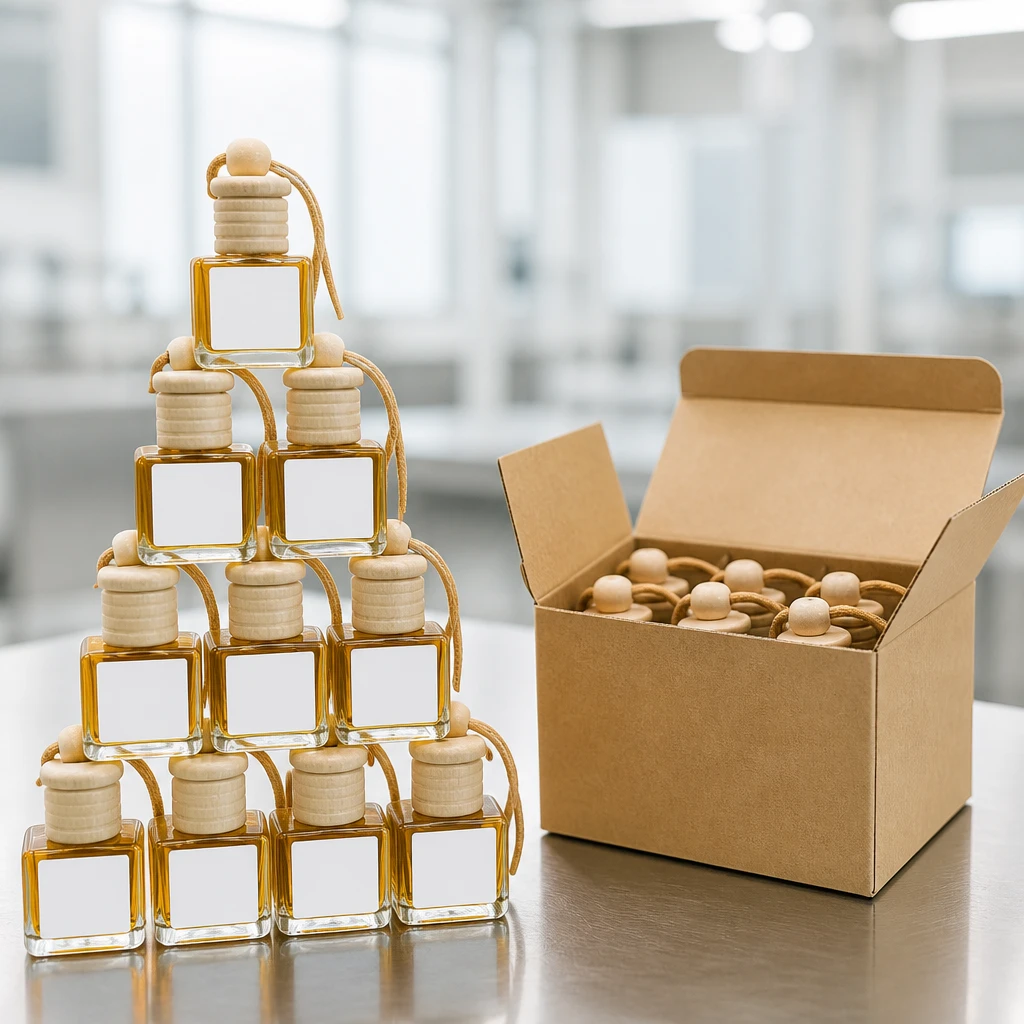
Where exactly does small-batch customization get stuck?—The minimum order quantity is just the surface
Many brand owners, when first encountering OEM, turn away upon hearing "minimum order quantity of 3,000 units." But what truly makes suppliers hesitate is often not the quantity itself, but the cost accounting behind those 3,000 units.
The real cost structure behind the minimum order quantity: molds, fragrance blending, and packaging
In OEM quotations, the minimum order quantity is the result, not the cause. Breaking it down, the cost consists of three parts:
- Molds and production line setup: The canister, lid, and inner liner of the car diffuser all require mold development.The mold cost is a one-time investment, and whether you produce 100 or 10,000 units, this expense cannot be avoided.Production line changeovers, parameter adjustments, and first-article inspection also require fixed labor hours.
- Fragrance Blending and Stability Testing: Customizing a fragrance is not as simple as pouring essential oil into a base solution.The ratio of fragrance to solvent, compatibility with PP material, and volatility stability at high temperatures all require repeated sampling and testing.The cost of this stage is time, and time does not get discounted just because the order is small.
- Minimum Order Quantities for Packaging and Labels: Label printing and outer box production both have minimum print quantities.You only make 500 units, but the label factory prints at least 2,000 sheets per run. Who bears the cost of the excess?This cost is factored into the unit price.
So, when a supplier quotes a 'minimum order quantity of 3,000', it essentially represents the point where the above fixed costs are spread thin enough to maintain a reasonable profit margin. Below this number, it's not that they can't do it, but the unit price would become so high that you might find it unacceptable.
Why are some factories hesitant to take small orders?
Besides cost, there are two other easily overlooked reasons:
First, small orders consume the same amount of management resources. An order of 500 units and an order of 5000 units require almost the same process: confirming the fragrance, sampling, signing off on the sample, scheduling production, quality inspection, and shipping. For small factories, production capacity is limited, and accepting a small order may mean squeezing out the schedule of a large order.
Second, the tolerance for error in small orders is extremely low. A 2% defect rate in a large order can be reworked or supplemented;A 2% defect rate in a small order may directly lead to delivery delays, and the supplier bears the same proportion of responsibility. This is why some factories would rather not accept such orders than take the risk.
Which factories are willing to accept small orders?
Factories willing to accept small orders usually have two characteristics:In-house production lineandstandardized modules。
An in-house production line means mold and debugging costs are controllable, with no need for outsourcing and cost-sharing;Standardized modules mean that the fragrance library, bottle types, and packaging solutions are all ready-made; you only need to combine existing options rather than develop from scratch. For example, factories like SOCELI with their own production facilities offer 18+ fragrance libraries and rapid sampling services. The logic of small-batch customization is to make fine adjustments on standard products, not to create a brand-new product.
Next step to confirm: If you are looking for a small-batch customization supplier, first ask three questions—① Are fragrances selected from the existing library or do they need new development? ② Can the tank/bottle shape only use existing molds? ③ What is the minimum print run for packaging labels?
These three answers directly determine your actual minimum order quantity threshold and per-unit cost. Send these three questions to the SOCELI team, and they will provide a matching solution based on your specific needs.
How does SOCELI support small-batch customization?—A flexible path from sampling to mass production
When many brand procurement professionals inquire about customization, their first question is often, "What is your minimum order quantity?" The underlying implication of this question is: I haven't confirmed market response yet, and I don't want to stock thousands of units right away. The customization path for SOCELI liquid car fragrance (model TS101) is designed around this concern.
Rapid sampling: the first step in small-batch customization
SOCELI's customization process is divided into four steps: requirement communication → sample confirmation → small-batch trial production → mass production delivery.
Sampling is the most critical step in the entire process because it determines what you use to validate the market. SOCELI provides rapid sampling services. Samples are typically used to confirm three things: whether the fragrance matches the target users, whether the label design aligns with the brand tone, and whether the product performs stably in real usage scenarios (such as high temperatures inside a car in summer).
The sampling cycle is generally7-15 working days, depending on the complexity of your label craftsmanship and fragrance adjustments. If you simply choose a fragrance from the existing library and only change the label design, the cycle will be shorter;If you need to adjust the fragrance concentration or scent layers, additional time is required for formulation and stability testing.
One important note: it is recommended to conduct at least two rounds of confirmation during the sampling stage. The first round confirms the fragrance type and label direction, while the second round confirms details and the final effect. Skipping the second round and going directly to mass production, if there is any deviation in label color or fragrance concentration, the rework cost will be much higher than the sampling fee.
18+ Fragrance Library and Exquisite Label Craftsmanship: Lowering the Barrier to Customization
The biggest barrier to small-batch customization often lies not in the minimum order quantity itself, but in the development and design costs required for "customization." SOCELI lowers this barrier through two mechanisms:
Fragrance library: 18+ selectable fragrance types. These fragrances have been verified for formula stability and safety. You don't need to develop a new fragrance from scratch; simply choose one or make minor adjustments. This means you save on the R&D cycle and failure risks associated with fragrance blending.
Ideal for quickly launching co-branded products, channel-exclusive items, or testing new markets.
Exquisite label craftsmanship: The canister of car air fresheners features a visual design, and the label directly determines shelf appeal. SOCELI supports label customization, including material, printing techniques, and design layout. For small-batch customization, you don't need to create a separate mold for the label or bear high plate-making fees, which significantly reduces trial-and-error costs.
Scenarios suitable for small-batch customization:
- You have a clear channel or customer and need to first produce a few hundred units to test market feedback.
- You want to add a fragrance SKU to your existing product line to verify whether it is worth expanding investment.
- You need to create a limited-time, limited-quantity customized version for an event or holiday.
Scenarios that are not very suitable:
- You are still undecided about brand positioning and fragrance direction and hope the supplier will help you "figure it out" — this is a product planning service, not something that sampling can solve.
- You need a completely new fragrance developed from scratch, rather than choosing from an existing fragrance library — this will involve a longer development cycle and higher R&D costs.
Next step to confirm
Before contacting the SOCELI team, it is recommended that you clarify three questions: what is the target channel, what is the expected price range, and how many retail points do you hope to cover in the first batch. With these three answers in hand, the team can directly tell you the sampling lead time, sample cost, and bulk unit price tiers. If your needs go beyond the existing fragrance library and label craft options, you should also clearly state this during communication so that additional development time and costs can be assessed.
Safety bottom line for small-batch customization: certification and materials cannot be compromised
Small-batch customization may raise concerns: with a small order quantity, will suppliers lower standards on materials and certification? From a product safety perspective, order quantity should not be a variable in safety standards—whether it's 500 or 50,000 units, the safety requirements should be the same for users in high-temperature car environments.
Eco-friendly PP material and health-safe formula: equally guaranteed for small batches
Eco-friendly PP material is the material used for the canister of SOCELI liquid car air fresheners. PP (polypropylene) itself has good heat resistance and can maintain structural stability within the typical temperature range of car environments (such as the cabin after summer sun exposure). But it needs to be clear:"Eco-friendly PP" refers to the base material, not the safety of the entire product.。
A car diffuser is a combination of "material + liquid formula". What truly determines the safety ceiling is whether the solvent system of the liquid fragrance remains stable under heat and whether it decomposes into harmful substances.
Therefore, when customizing, buyers should confirm two questions with the supplier:First, whether the solvent system of the customized fragrance has passed high-temperature stability testing;Second, whether the formula remains chemically stable under continuous heat exposure.SOCELI uses a health-safe formula and supports fragrance customization, but different fragrance raw materials have varying thermal stability. The safety of a specific formula needs to be confirmed item by item during the sampling stage.
International Safety Certifications: How to Verify a Supplier's Compliance Capability
Small-batch customized products can also go through the full compliance process. A common misconception needs to be clarified:Certification targets chemical composition and materials, not a specific SKU. This means:
- If customization only changes the fragrance type, and the raw materials used in the new fragrance are already covered by the existing certification, the existing certification can usually be reused;
- If customization involves changing solvents, adding new additives, or adjusting concentrations, a new ingredient assessment is required.
Before placing an order, the buyer should verify three points:
- The name of the certificate holderThe company name on the certificate must match the contracting party in the contract; otherwise, the certificate may belong to an affiliated factory, and its legal validity may not cover your order.
- Certification coverage scopeCheck whether the certificate attachments list your product category (such as "car air freshener" or "liquid fragrance").
- Batch inspection reportsCertification is a type test and does not guarantee that every batch is qualified.Reputable suppliers should be able to provide factory inspection reports for the corresponding batch, covering at least key indicators such as heavy metals and formaldehyde.
SOCELI's own factory integrates control, with a relatively complete inspection chain from raw material intake to finished product shipment. It is recommended to request the composition statement and inspection report for the sample during the sampling stage, and only proceed to mass production after confirming they are correct. Next step to confirm: Provide the SOCELI team with your custom fragrance direction, confirm whether this fragrance is within the existing certification coverage, and whether additional high-temperature stability testing is required.
Which brands are suitable for small-batch customization?—Decision boundaries and action recommendations
Small-batch customization is not a question of "can it be done," but rather "should it be done now." SOCELI supports OEM/ODM customization, but customization itself has a cost threshold. The criterion for judgment is not the size of your budget, but whether your goals are clear.
Three situations suitable for starting small-batch customization
1. You already have a clear target channel and delivery time
For example, you have already negotiated with a certain distribution channel, and the other party requires seeing samples and confirming the fragrance within 30 days;Or you plan to launch your own brand in the next quarter and need to first get the supply chain running. In this case, small-batch customization is a necessary step to validate the process, not just a trial.
2. You need to validate market response first, rather than stocking up all at once.
If you are unsure which fragrance will be more popular in the target market, customizing 2-3 fragrances in small batches and distributing them to different channels to observe repurchase data is safer than placing a large order all at once. SOCELI offers 18+ fragrance options, which is designed for a "try before you scale" approach.
3. Your brand positioning needs differentiation, but you haven't yet established stable sales.
If your product only needs a packaging change, and you can keep the existing fragrance and formula, small-batch customization can help you build brand recognition at a lower cost. SOCELI's exquisite label craftsmanship and visual can design can be directly reused during customization, without the need for additional mold development.
In which situations is it not recommended to do small-batch customization first?
When the target market is not yet determined. If you are still debating whether to make car aromatherapy or who it is for, do not customize first. Customization means you need to lock in the fragrance, packaging, and label copy. Once these decisions are made, the cost of revision is much higher than the initial sampling fee.
When there are strict safety certification requirements but the standards have not been confirmed. SOCELI products are certified to international safety standards, but different target markets (such as the EU, North America, and Southeast Asia) have different compliance requirements for aromatherapy products. If you have not confirmed which type of test report is required for the target market, do not place an order first, otherwise you may face a situation where the sample is qualified but cannot enter the country.
When expectations are likely to change frequently. If you anticipate that your brand positioning, target customer base, or price range may change within the next three months, it is recommended to hold off on customization for now. Wait until core decisions are finalized before proceeding, to avoid paying repeatedly for sampling and revision costs.
How can I apply for samples? What is the cost?
SOCELI offers rapid sampling services. The application process typically involves: confirming fragrance and packaging requirements → submitting customization intent → the factory arranges sampling → after sample approval, proceed to mass production.
Regarding sample costs, two points need to be clarified:The samples themselves are usually low-cost, but you may need to cover shipping fees and the plate-making costs for custom labels.。 The specific cost depends on the number of fragrance types you choose, whether special label processes are needed, and the destination for shipping. We recommend that you directly explain your target market and expected customization volume to the SOCELI team when applying, and they will provide corresponding sample plans and cost details.
Key trade-off: Where is the boundary of small-batch customization?
The core value of small-batch customization isvalidation, notcost reduction. It can help you verify the supplier's sampling speed, fragrance matching, and packaging processes to see if they meet expectations, but if you are pursuing the lowest unit cost, small-batch customization is not the answer—the higher the minimum order quantity, the better the unit price, which is the industry norm.
So, if your goal is to "get the process running first and validate the market," small-batch customization is the right choice;if your goal is to "get the lowest cost immediately," you need to first clarify the expected annual purchase volume, and then confirm the corresponding tiered pricing with the SOCELI team.
Frequently Asked Questions
Q: How long does sample development take? SOCELI offers rapid sampling services; the specific timeline depends on whether the fragrance is in the existing fragrance library, whether the formula needs adjustment, and the complexity of the label process. It is recommended to specify your delivery deadline when applying, and the team will assess whether it can be met.
Q: Can the sample fee be deducted from the bulk order payment? This depends on the customization volume and the cooperation method. We suggest you directly ask the SOCELI team when applying for samples, explain your expected bulk order size, and they will provide a clear fee policy.
Q: If the sample is not satisfactory, how many times can it be revised? The number of revisions is usually related to the complexity of customization. Fragrance adjustments and label redesigns are different types of modifications. We recommend clarifying your fragrance preferences, label copy, and packaging requirements as much as possible before sampling to reduce the cost of repeated communication.
Q: What is the minimum order quantity for small-batch customization? There is no fixed minimum order quantity; it depends on the fragrance, packaging specifications, and label process you choose. SOCELI's large-capacity design (120g) and eco-friendly PP material are standard configurations. The main variables in customization are the fragrance and label.
Provide the team directly with your target channels and expected sales volume, and they will give you a corresponding minimum order quantity recommendation.
Q: Can customized products retain SOCELI's safety certifications? SOCELI products themselves are certified to international safety standards, but whether the original certification can be retained after customization depends on what you change—if you only change the label and fragrance, it can usually be retained;if you change the formula or materials, re-evaluation is required. Be sure to confirm this with the team before sampling.
Learn More
If you are evaluating the feasibility of small-batch customization, it is recommended to first prepare three pieces of information: target channels, expected selling price, and the number of initial retail outlets, and then contact the SOCELI team.They will provide sampling lead time, sample fees, and minimum order quantity recommendations based on your specific needs.
Related Products:SOCELI Liquid Car Aromatherapy