
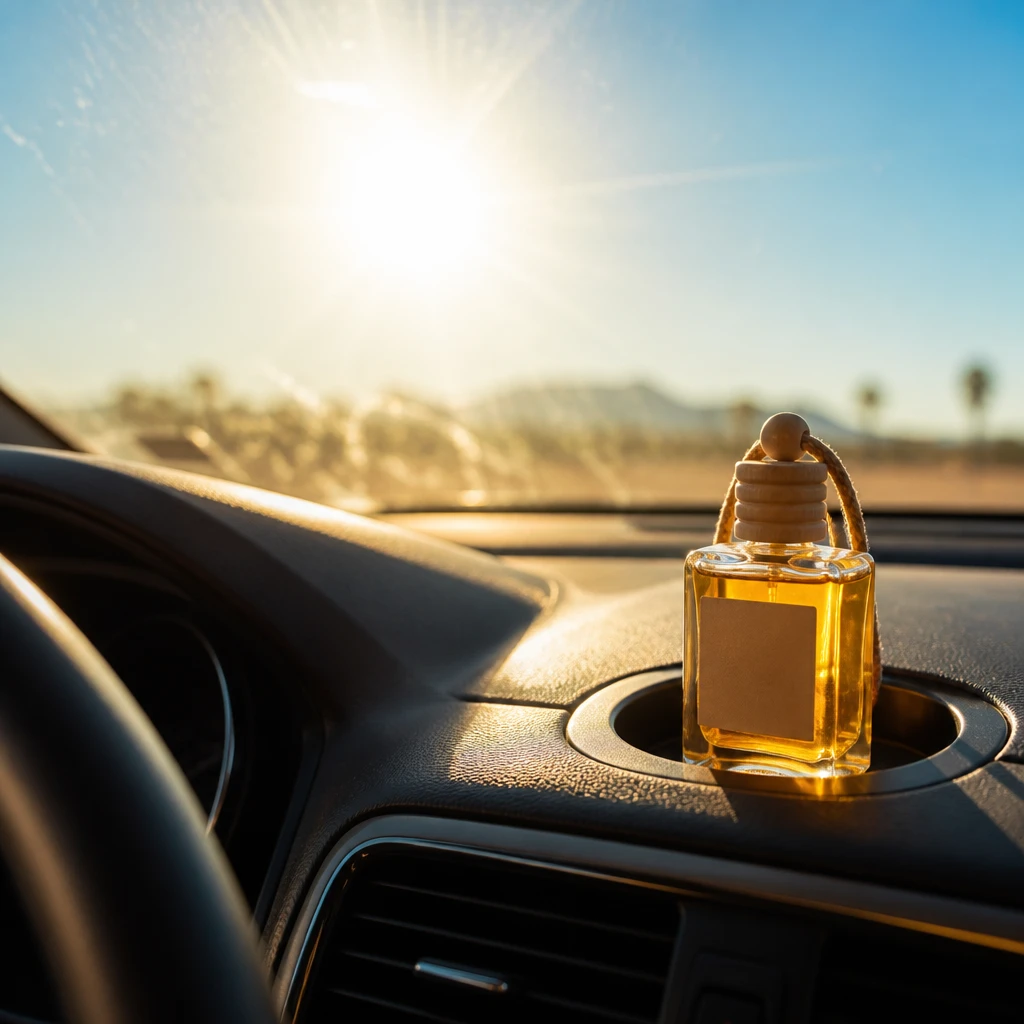
Under intense summer sun exposure, what determines the high-temperature resistance of a car diffuser?
After exposure to the sun in summer, the temperature inside a car can reach 60-70°C, which directly tests the materials and formulation of the car diffuser. High-temperature resistance is not a single indicator, but rather the result of the combined effects of materials, formulation, and sealing design. To determine whether a product is suitable for high-temperature environments, you need to verify the following two dimensions one by one.
Material Heat Resistance: Why Eco-Friendly PP Material Is the Safety Foundation
The housing of a car diffuser directly withstands high-temperature radiation. Among common plastics, PP (polypropylene) has a heat deflection temperature of approximately 100-120°C, which is far higher than the actual temperatures measured inside a car in summer, so it will not soften or deform under sun exposure. However, the term 'eco-friendly PP' itself only indicates material safety and does not automatically equate to high-temperature resistance—what you need to confirm is:
- Whether to usevirgin PPrather than recycled material (recycled material has significantly reduced heat resistance due to impurities)
- Whether the shell hasthickened or structurally reinforced designto avoid cracking of thin-walled parts after long-term thermal expansion and contraction
- Whether the sealing ring material is also high-temperature resistant (silicone is usually better than ordinary rubber)
SOCELI liquid car aromatherapy uses environmentally friendly PP material, which meets the prerequisites for use in high-temperature environments from the material basis. However, if you plan to place the product in the direct sunlight area in the center of the dashboard for a long time, it is recommended to confirm with the SOCELI team the continuous temperature resistance limit and shell wall thickness parameters of this model to match your actual usage scenario.
Formula stability: Will liquid fragrance deteriorate at high temperatures?
 Formula stability: Will liquid fragrance deteriorate at high temperatures?
The core risk of liquid fragrance is that high temperatures accelerate the evaporation and oxidation of the fragrance, causing the scent to fade or produce a rancid odor. More critically, low-quality fragrances may decompose at high temperatures, releasing irritating substances such as aldehydes. To determine whether a formula is heat-resistant, you cannot just rely on descriptions like "natural" or "healthy"; instead, pay attention to:
- Carrier solvent: Common ones are ethanol or DPG (dipropylene glycol). DPG has a higher boiling point, evaporates more slowly at high temperatures, and provides more stable fragrance retention.
- Fragrance concentration and antioxidants: High-quality formulas add antioxidants to delay oxidative deterioration at high temperatures.
- Sealing design: Even if the material and formula are both up to standard, if the bottle mouth is not tightly sealed, the liquid may expand at high temperatures and cause leakage.
SOCELI's product features a 120g large-capacity design with a 90-day endurance, indicating that the evaporation rate of its formula is controlled. However, the question of whether harmful substances are released at high temperatures needs to be answered by third-party test reports—focus on checking for volatile compound tests under high-temperature conditions (such as RoHS, REACH, or MSDS reports). If you don't have these reports on hand, you can directly request them from the SOCELI team to confirm whether the test conditions include high-temperature environment simulation.
Next confirmation steps: Ask the SOCELI team two things—① the continuous temperature resistance limit of the housing for this model and whether it has passed high-temperature aging tests;② Can you provide a volatile compound detection report for the fragrance under high-temperature conditions? Once these two points are confirmed, you can determine whether this product is suitable for your high-temperature summer usage scenario.
Liquid car air fresheners that have passed international safety certifications can be used with confidence at high temperatures.
 Liquid car air fresheners that have passed international safety certifications can be used with confidence at high temperatures.
In summer, the temperature inside a car can easily exceed 60°C, which is not only a test of the fragrance's longevity but also a bottom-line issue for safety. For purchasers and distributors, judging whether a car air freshener is safe cannot rely solely on the word "safe" on the promotional page; it must be based on verifiable certifications and test reports.
How safety certifications ensure product reliability in high-temperature scenarios
There are three main risk points for car air fresheners at high temperatures:Container deformation or rupture leading to liquid leakage, chemical changes in the fragrance at high temperatures, and the release of harmful substances from materials when heated.International safety certifications set testing thresholds precisely around these risk points.
Take SOCELI liquid car fragrance as an example; it uses environmentally friendly PP material as its container. PP (polypropylene) has a heat resistance temperature typically above 100°C, far higher than the extreme temperature after exposure to sunlight in a car, meaning the container will not soften or deform under high temperatures. But material heat resistance is only the foundation; what truly determines product safety is the overall test results—including sealing tests under high temperatures, safety assessments of fragrance ingredients, and more.
It should be noted that certification systems in different countries and regions have different focuses. Common international safety certifications include the EU's REACH regulation (Registration, Evaluation, Authorisation and Restriction of Chemicals), the US FDA food contact material standards (if involving contact packaging), as well as MSDS (Material Safety Data Sheets) and transport safety reports issued by various third-party testing agencies. The core value of these certifications is:They are not self-proclaimed by companies, but conclusions issued by independent third parties after testing according to established standards.。
Certification adaptability and verification path for SOCELI liquid car air fresheners
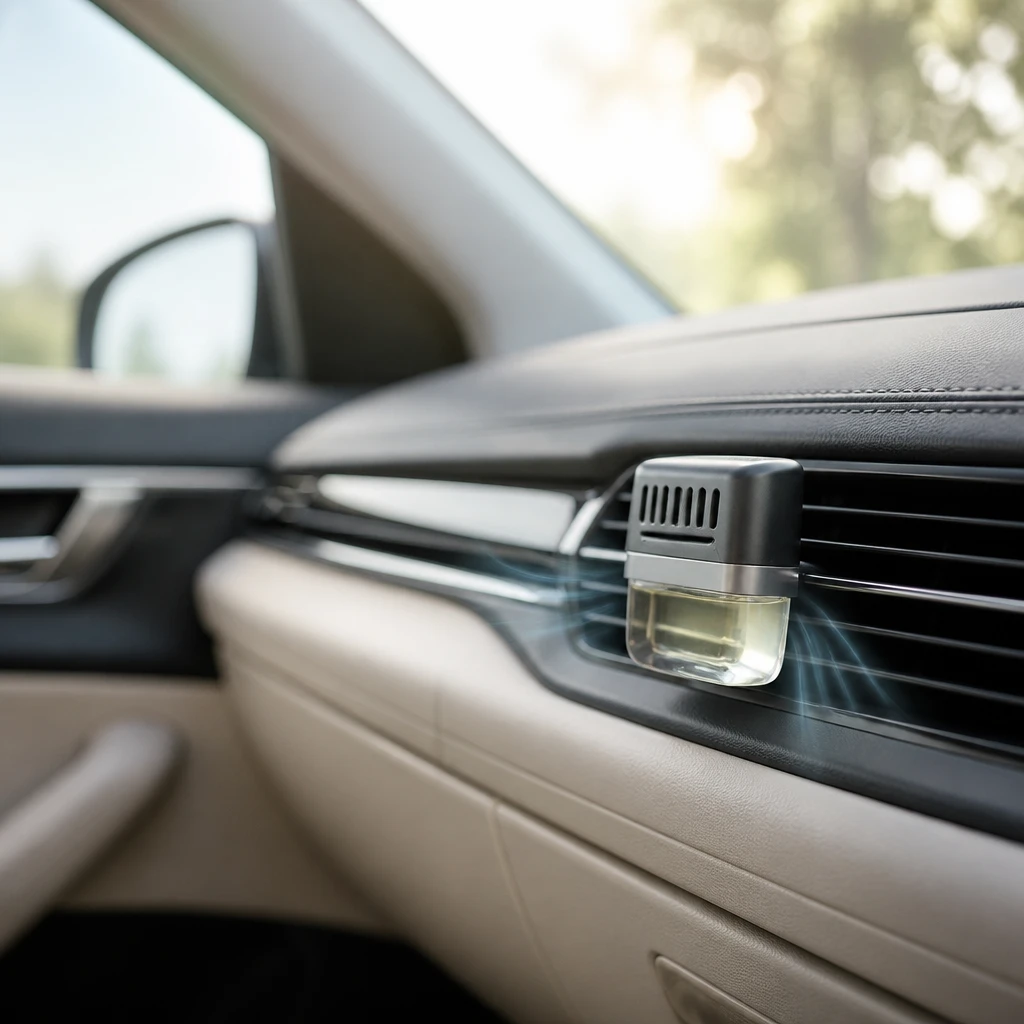 Certification adaptability and verification path for SOCELI liquid car air fresheners
For purchasers, to verify the safety of a car air freshener, it is recommended to follow the steps below:
Step 1: Request the original test report. Do not accept screenshots or verbal promises. A reputable manufacturer should be able to provide a complete third-party test report, which should include the testing institution's name, the test standard number, the sample name, and the test date.
Check that the product model on the report matches the model you are purchasing—the test report for TS101 cannot replace reports for other models.
Step 2: Verify that the test items cover high-temperature scenarios. Focus on whether the report includes tests for high-temperature storage, high-temperature leakage, and sealing performance. If the report only contains routine chemical content testing without specific tests for high-temperature environments, its reference value for in-vehicle scenarios is limited.
Step 3: Confirm the scope of the certification. Some certifications are for fragrance raw materials, while others are for finished containers; neither alone can prove the overall safety of the finished product at high temperatures. What you need isfinished-product-leveltest conclusions.
Step 4: Request the MSDS document. This document lists the product ingredients, hazard overview, and storage and transportation precautions. For distributors requiring cross-border transportation, the MSDS is also a necessary document in the logistics process.
Back to the core question:Are certified products safer and more reliable under high temperatures? The answer is no. Certification ensures safety withinthe specified test conditions and standard scope,which significantly reduces risk but cannot eliminate all uncertainties.
For example, extreme cases such as vehicle spontaneous combustion or prolonged exposure in a sealed cabin exceeding the test temperature range are not covered by conventional certification. Therefore, certification is a safety bottom line, not a way to be more stable or more certain.
Who is it suitable for: Brand owners who need to find compliant suppliers for their own brands, especially distributors targeting markets with strict chemical regulations such as the EU and North America. Certification documents are the key to entering these channels.
Who is it not suitable for: If your target market has no clear safety compliance requirements and your procurement budget is extremely sensitive, then products with complete certification may not have a price advantage. However, it should be noted that while saving on certification costs, you also bear the responsibility risk of product problems under high temperatures—once leakage or deterioration occurs, the loss far exceeds the certification fee.
Next step to confirm: Request the third-party test report and MSDS document for model TS101 from the SOCELI team, verify whether the test items include the high-temperature special test, and confirm whether the market scope covered by the report includes your target sales regions.
Which scenarios are suitable for using liquid car fragrance?Which scenarios are not recommended?
Summer high-temperature commuting and long-distance driving: the value of high-temperature resistance and long-lasting fragrance
After summer high-temperature sun exposure, the car interior has a strong odor. What fragrance is suitable?
It is suitable. The odor inside the car after sun exposure mainly comes from the smell released by interior materials when heated. The role of liquid fragrance is not to mask the odor, but to replace the olfactory perception with continuously diffused fragrance. This SOCELI product uses an eco-friendly PP material canister. The material itself will not soften, deform, or release odors under high temperatures. The transparent canister also allows you to check the remaining amount at any time, avoiding the gap period of "thinking there is still fragrance, but it has actually run out."
To be clear: it addresses the "in-car scent experience," not "removing formaldehyde or VOC" — if your procurement goal is air purification, what you need is a purification product, not a fragrance.
Long-distance driving requires long-lasting fragrance; how long can liquid aromatherapy last?
The SOCELI liquid car aromatherapy is rated to last 90 days (120g capacity), corresponding to continuous scent diffusion in daily commuting scenarios. In long-distance driving scenarios, continuous driving for several hours will steadily consume the fragrance release, but the 90 days is the overall usage cycle, not the endurance for a single long trip. If you need "a noticeable scent every time you get in the car," it meets that need;If you need "every long trip to be as intense as just opened," then no liquid aromatherapy can achieve that — fragrance concentration diminishes with usage time; this is a physical law, not a product defect.
Scenarios not suitable: extreme high-temperature enclosed environments and procurement with unclear objectives
In which scenarios is liquid car aromatherapy not recommended?
There are two types of scenarios that need to be explicitly excluded:
First, long-term sealed parking under extreme high temperatures. Although PP material is resistant to high temperatures, 'resistant to high temperatures' does not mean 'unlimited tolerance'. In extreme environments with closed windows and several days of sun exposure in summer, the evaporation rate of any aromatherapy product will significantly accelerate, and the endurance will be greatly shortened from 90 days.
If your usage scenario is 'vehicle parked in the open air for a long time and driven only once a week', the cost-effectiveness of liquid aromatherapy will significantly decrease—the fragrance is consumed even when you are not driving. This type of scenario is more suitable for taking the product with you after parking, or choosing a solid fragrance with more controllable volatility.
Second, scenarios where procurement goals are unclear. If you are a brand owner or distributor, but have not yet determined: what fragrance types the target customer group prefers, what the main price range is, and whether packaging needs customization—in this case, directly bulk purchasing liquid aromatherapy is risky. The reason is simple: the core experience difference in liquid aromatherapy lies in the fragrance, and fragrance preference is highly subjective.
SOCELI offers a library of 18+ fragrances and rapid sampling services, but being able to sample and knowing what you want are two different things. It is recommended to first request samples for small-scale testing to confirm fragrance acceptance before proceeding with bulk customization, rather than deciding on quantity first and then thinking about selling points.
One-sentence conclusion: For daily commuting, improving car odor after high-temperature exposure, and long-distance driving requiring continuous fragrance—it is suitable;For extreme sun exposure with long-term parking, or when procurement direction is not yet clear—don't rush to order; first supplement usage conditions and fragrance testing before making a decision.
Procurement decision: How to determine if SOCELI liquid car aromatherapy is suitable for your brand?
 Procurement decision: How to determine if SOCELI liquid car aromatherapy is suitable for your brand?
To determine whether a car aromatherapy product is suitable for your brand, the core is not whether it is good or not, but whether it can work within your channels, pricing, and customer expectations. SOCELI liquid car aromatherapy (TS101) suits one clear category of brands, not another. Below are four criteria to help you find your match.
Four criteria: certification, material, fragrance longevity, and customization.
Criterion 1: Do your customers care about "safety verification"?
SOCELI liquid car aromatherapy claims to pass international safety standard certifications and uses eco-friendly PP material. If your customer base consists of health-conscious families, pregnant women, or people sensitive to chemical odors, this selling point can directly translate into trust endorsement on your product page. But if your channel is low-price fast-moving consumer goods, where customers are not sensitive to safety certifications, this advantage is hard to command a premium.
Criterion 2: Does your brand tone match the "visual" design?
This product features a visible canister, so the remaining amount is clear at a glance. This is a practical feature, but it is also a design language—it leans toward rationality and function. If your brand follows a minimalist, cool style or a luxurious dark color scheme, this transparent canister may conflict with your packaging system.
It is recommended to get a sample to see the actual product and confirm whether the canister label craftsmanship (fine label craftsmanship is one of the selling points) can match your brand visuals.
Standard 3: Does the 90-day fragrance retention match your repurchase rhythm?
With a 120g capacity and 90-day duration, customers will purchase about 4 times a year. This rhythm is suitable for subscription models, quarterly promotions, or bundling with other car accessories. If your brand is accustomed to high-frequency, low-ticket items (such as monthly disposable products), this duration will actually lengthen the repurchase cycle, and you will need to redesign your cross-selling strategy.
Standard 4: What is your required depth of customization?
SOCELI supports OEM/ODM, offers a library of 18+ fragrance types, and maintains integrated control through its own factory with rapid prototyping. Here, two levels need to be distinguished:
- Light customization(selecting fragrance types, applying your own labels, and defining packaging): SOCELI's process should cover this, suitable for most brand owners.
- Heavy customization(modifying container structures, developing entirely new fragrance types, or using special materials): you need to confirm mold costs and minimum order quantity thresholds; this information is not currently provided, so you should ask the SOCELI team directly.
Budget boundaries and recommended next steps
In budget allocation, prioritize confirming whether safety certifications and material costs fall within your per-unit cost line, before considering customization and packaging expenses. Sample costs are usually low, but you may need to pay shipping fees;For bulk customization, the higher the minimum order quantity, the better the unit price—this is an industry norm, but the specific figures require SOCELI to quote based on your volume.
When to choose SOCELI directly: Your brand has a clear mid-to-high-end positioning, customers care about safety and durability, and you need to quickly launch custom fragrances without bearing factory management costs.
When to postpone the choice: Your brand is still frequently adjusting its positioning, or your expectations for fragrance, packaging, and pricing are still changing—at this point, the deeper the customization, the higher the rework costs. It is recommended to start with a small trial order to validate market feedback before scaling up.
Next steps: Contact the SOCELI team directly to request samples and test reports, and confirm three specific questions: the minimum order quantity threshold, mold costs (if applicable), and the lead time from sampling to mass production. Once you have these three numbers, you can make your final decision.
Frequently Asked Questions
Q: Can I customize only the fragrance without changing the packaging? Yes. SOCELI offers a library of 18+ fragrance options. Under the light customization path, you can choose from existing fragrances. First, confirm the fragrance library list, then decide whether you need to develop a new fragrance (the latter involves development time and costs).
Q: What are the requirements for requesting samples? Do I need to pay? Sample fees are usually low, but you may need to bear the shipping costs.
For specific policies, it is recommended to confirm directly with the SOCELI sales team, while explaining your brand background and expected purchase volume, as this will affect sample approval and subsequent quotations.
Q: Do the products have test reports? Can they be provided to end customers? The products claim to be certified to international safety standards, but specific certifications (such as REACH, MSDS, IFRA, etc.) need to be confirmed by requesting the original test reports from SOCELI.
Once obtained, you can assess whether they are suitable for direct display to end customers.
Q: Under what conditions was the 90-day fragrance retention measured? The current materials do not specify the test environment (such as temperature and ventilation conditions). In high-temperature summer exposure scenarios, whether the fragrance longevity is shortened should be confirmed with SOCELI regarding high-temperature test data before deciding on the promotional wording on the product page.
Q: What is the minimum order quantity? Can small brands place a trial order of a few hundred pieces first? The minimum order quantity figure is not listed in the public materials.
Small-batch trial orders are usually feasible, but the unit price will be higher than for large batches. It is recommended to directly ask SOCELI for tiered quotes at different volumes, and then compare them against your trial sales budget.
Learn More
If you are evaluating procurement options for liquid car fragrance for high-temperature summer scenarios, you are welcome to contact the SOCELI team to request samples, test reports, and customized solutions. We will assist in confirming product suitability and bulk cooperation details based on your target market and usage scenarios.
Related Products:SOCELI Liquid Car Fragrance