What is the SOCELI reed flameless fragrance?What does its flameless diffusion method mean for customization?
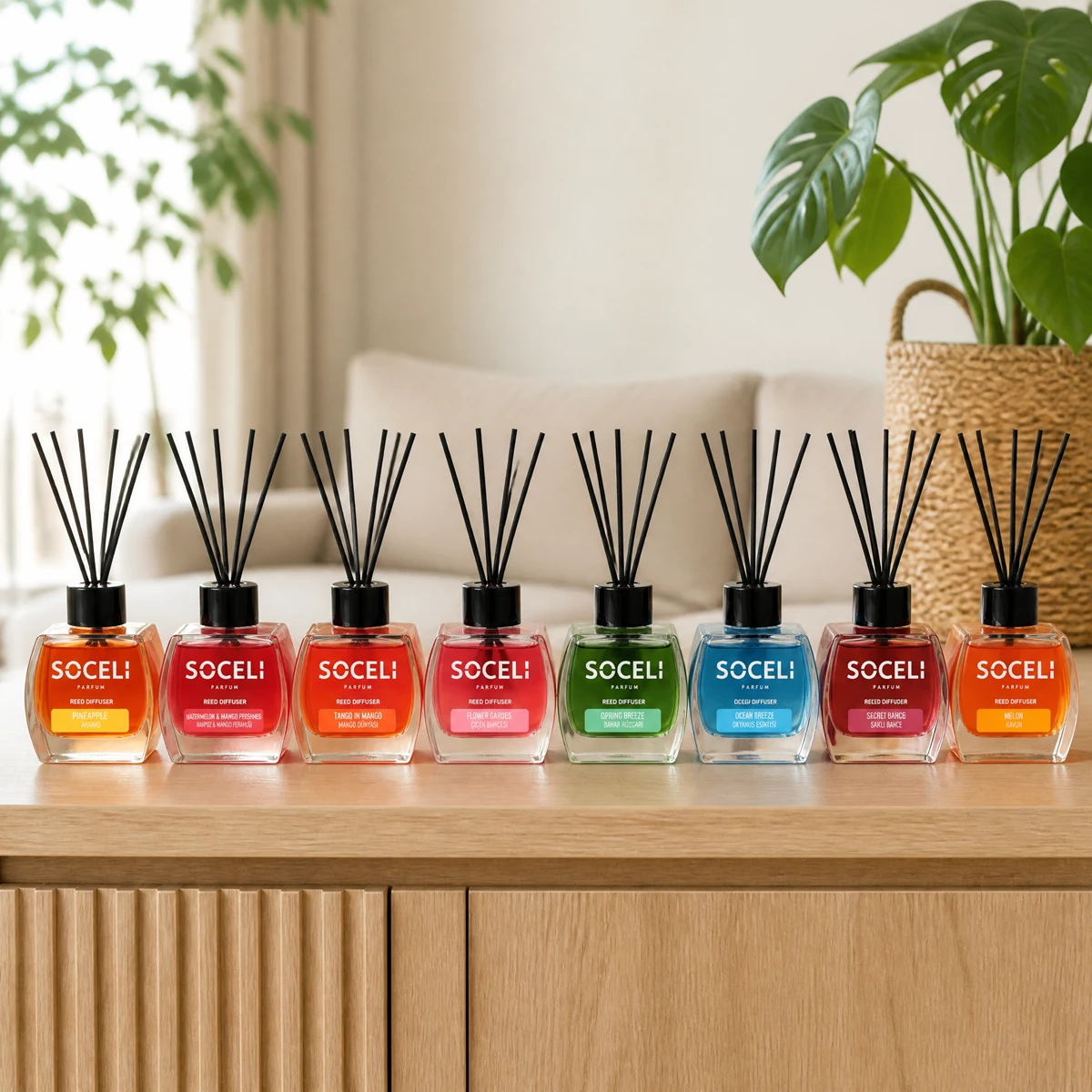
The SOCELI reed flameless fragrance consists of a glass bottle and natural reeds. After the reeds are inserted into the bottle, they naturally absorb the fragrance and continuously release it into the air. No ignition, plugging in, or heating is required, and it can be used by simply placing it on a desktop or in a home space. For brands, this is not just a product description, but a set of physical conditions that affect the feasible scope of customization.
How natural reed diffusion works, and why it does not require ignition or plugging in
The fragrance liquid is drawn up through the capillary structure of the reeds to the upper part, and then evaporates from the surface into the air. The entire process relies only on contact among the liquid, reeds, and air, with no combustion, power source, or heating involved. This brings two direct implications for customization:
- Low usage threshold: End users simply open the lid and insert the rattan sticks, with no installation steps beyond the instructions, making it suitable as a gift or retail item.
- Low maintenance frequency: Product information shows it can continuously diffuse fragrance for about 6 months with a capacity of 120ml, meaning the replenishment and replacement pace is slower than aromatherapy products that require frequent refills.For scenarios such as hotels and homestays that require unified scent management, this point will affect your procurement batch planning.
What impact does the glass bottle body and visible remaining amount have on private label packaging design?
The glass bottle body is the carrier most worth prioritizing for confirmation in customization. It simultaneously serves three functions: holding the fragrance liquid, allowing users to see the remaining amount, and serving as the focal point of the brand's visual identity.
- How the logo and pattern are applied: The glass surface is suitable for bottle printing, labeling, or outer box design, but which specific process can be used and what effect can be achieved depends on the bottle shape and your design files, and needs to be confirmed with the SOCELI team.
- Visualization of remaining amount: The transparent bottle body allows users to directly see the remaining liquid, which reduces the question of "how much longer can it be used," but it also means the bottle design cannot completely obscure the liquid level, otherwise this experience will be weakened.
- Matching of rattan sticks and bottle body: The number and length of rattan sticks and the bottle opening diameter together affect the diffusion performance and visual proportions.If you want to change the bottle shape or rattan stick specifications, this is not simply changing the packaging, but may change the diffusion effect, and must be confirmed in advance.
What It Means for OEM/ODM Customization
The structure of a flameless diffuser is simple, which instead concentrates the customization variables on a few confirmable points: bottle craftsmanship, logo presentation method, fragrance selection, outer box packaging, and whether ODM-level formula or specification adjustments are needed. You do not need to reserve space for a power supply, heating module, or ignition safety structure, which makes packaging design more flexible, but it also meansthe matching of fragrance, reeds, and bottle neck specificationsis the part that truly needs to be locked in advance during customization.
If your goal is to build your own brand, first confirm three things: what level of bottle and logo craftsmanship can be achieved, what fragrance options are available, and how to apply for samples. Once these three items are confirmed, the customization scope is basically clear.
What exactly is the difference between OEM and ODM?Which model should you choose for your own brand?
For a private-label flameless fragrance brand, the core difference between OEM and ODM is not in what they are called, but inwho holds the decision-making power over the formula and specifications。
OEM: production according to your formula or specifications, with the brand owner having more control
Under the OEM model, the fragrance direction, bottle and reed specifications, and label and packaging formats are proposed by the brand owner, and the factory organizes production according to your requirements. What you get is a finished product that meets your own definition, with greater room for differentiation and pricing.
The trade-off is: you need to complete the formula or specification definition yourself, there are more rounds of sampling, confirmation, and revision, and the upfront time investment and communication costs are higher. If the brand positioning, target fragrance, or packaging direction has not yet been decided, OEM will amplify these uncertainties into repeated sample revisions.
ODM: Using a supplier's mature solution for private labeling starts faster but offers limited differentiation.
In the ODM model, you choose one from the supplier's existing fragrance, bottle, and reed combinations, and replace it with your own logo and packaging. Solutions with an already clearly defined product form like SOCELI reed diffusers—glass bottle, natural reeds, flameless design, no power or heat required, about 6 months of continuous fragrance diffusion, 120ml capacity—are ready to enter private-label discussions.
Its advantage is fast startup and low trial-and-error cost, making it suitable for first validating channels and sell-through. The limitations are also clear: the same solution may be used by multiple brands, making it hard for you to differentiate in fragrance or bottle type, and over the long term it is easy to fall into price comparison.
How to choose: look at your brand stage and differentiation needs
- Choosing ODM is more suitable: You are just starting out and need to quickly launch and test the waters, or your channel is mainly gifts, employee benefits, or bulk procurement, with low requirements for fragrance uniqueness.
- Choosing OEM is more appropriate: You already have a clear fragrance direction or packaging specification, and are willing to bear a longer development cycle for exclusivity and brand recognition.
- The two can be phased: First use ODM to get the channel running, then use OEM to differentiate the main SKU—this is a common path.
No matter which one you choose, you must confirm three things with the SOCELI team: whether the formula or specifications you propose are within the producible range, which packaging parts Logo customization can cover, and how the sample application and proofing cycle are arranged. These conditions directly determine your launch pace and first-batch stocking plan. Confirming them clearly before deciding on the model is more convenient than choosing the model first and then filling in the conditions.
For Logo customization and fragrance selection, which details must the buyer confirm?
These two issues usually determine whether an OEM/ODM order can be successfully implemented. Clarify the following details before discussing samples and bulk orders.
Logo presentation method: bottle body, packaging, or both
First determine where the logo will be placed, because different positions correspond to different processes, minimum order quantities, and confirmation procedures:
- Bottle body logo: Glass bottle bodies can be screen-printed, hot-stamped, or labeled.It is necessary to confirm whether the bottle body has a sufficiently flat display surface, as well as the relationship between the logo color and the liquid inside the bottle and the obstruction by the reeds—after the reeds are inserted, they may block part of the bottle body area.
- Packaging logo: Outer boxes, labels, and instruction cards can all carry brand information.Packaging is usually easier to adjust than the bottle itself, making it suitable for first trial orders or solutions that require rapid visual iteration.
- Both are required: It is necessary to confirm who is responsible for the visual consistency of the logos in both places (whether the brand provides source files or the supplier assists with layout), and whether proofing requires two rounds of confirmation.
The buyer needs to confirm with the SOCELI team: which processes are supported for the bottle logo, whether there is a minimum order quantity threshold, and the proofing cycle and confirmation milestones. This information directly affects your launch schedule.
Fragrance selection: the boundary between six fragrances and custom fragrances
SOCELI offers six existing fragrances to choose from. If your brand positioning requires a unique scent, then a custom fragrance is involved. The criteria for judging the two are different:
- Choosing an existing fragrance: Confirm the specific names and scent directions of the six fragrances, and determine whether they match your brand tone and target usage scenarios (office, home, hotel).Existing fragrances usually have lower minimum order quantities and shorter lead times.
- Custom fragrance: You need to confirm whether customization is available, the minimum order quantity, the fragrance development cycle, whether a fragrance development fee is charged, and whether the custom fragrance can be used exclusively.The time from confirmation to mass production for a custom fragrance is significantly longer than for an existing fragrance, and this needs to be included in the project schedule.
Whichever you choose, you should first request samples to actually smell the fragrance, rather than judging based only on the fragrance name. The sample stage also allows you to verify the Logo presentation effect.
Next steps: Organize your Logo source files, desired presentation positions, and target fragrance direction (existing or custom), and confirm process feasibility, minimum order quantity, and delivery time with the SOCELI team all at once, then decide the structure of the first batch order.
Sample application and factory audit quality control: How to reduce risks before placing bulk orders?
For private-label reed diffusers, the risks before placing bulk orders mainly concentrate on two things: whether the fragrance is what you want, and whether mass production can stably reproduce the appearance you confirmed. Both of these can only be locked down through samples and quality control standards, not through verbal descriptions.
Sample application process: Confirm the fragrance and packaging first, then place the order
What the sample stage needs to solve is not "whether there is a sample," but "what the sample confirmed." It is recommended to proceed in the following order:
- First determine the scent direction. SOCELI reed diffusers are alcohol-free fragrance formulas. For scent selection, you need to confirm the currently available range with the team, and then filter out the directions that match the brand positioning.
- Confirm the packaging format。The product has a glass bottle paired with natural reeds, 120ml capacity.You need to confirm whether the bottle, reeds, and outer box are all within the customizable range, as well as the placement and technique for Logo customization.
- Judge after receiving the physical product。Scent is a subjective judgment; images and text descriptions cannot replace the physical product;It is recommended to place it in a real space (such as an office desk or a home living room) to experience the diffusion effect, rather than just opening the bottle and smelling it.
- Lock in writing after sample confirmation。The confirmed fragrance type, packaging, and Logo style should be documented in writing as the benchmark for comparison in subsequent bulk production.Without this benchmark, factory audits and goods inspections have no reference point.
What can be directly judged at the sample stage is: whether the fragrance type is satisfactory, whether the packaging texture matches the brand tone, and the actual performance of the rattan diffuser in your space. What needs to be confirmed with the Socelife Scent team is: whether samples are charged, the sample delivery cycle, the list of available fragrance types, and the minimum order quantity and process limitations for Logo customization.
Factory audit and quality control standards: which matters need to be confirmed with the Socelife Scent team
The core of factory audits and quality control is "whether the bulk goods are consistent with the sample you confirmed." The following matters fall within the scope of what must be clarified in advance and cannot be assumed on your own:
- Factory audit arrangements: whether customer or third-party factory audits are accepted, how audit times are scheduled, and how far in advance they must be requested.
- Quality control standards: what the respective inspection criteria are for the glass bottle body, rattan sticks, and fragrance liquid, and how the criteria for judging appearance defects are defined.
- Basis for consistency: which version of the sample the bulk goods are based on, and what the allowable range is for batch differences in fragrance type.
- Packaging and Logo acceptance: Acceptance criteria for Logo printing or craftsmanship, and handling methods for packaging damage and misprinting.
- Pre-shipment inspection: Whether pre-shipment sampling inspection is supported, the sampling ratio, and the record format.
These are not details that can be "ordered first and discussed later." If the standards for factory audits and quality control are not clearly discussed, once there is a deviation between bulk goods and samples, the boundaries of responsibility will become blurred. It is recommended that after sample confirmation and before placing a bulk order, you confirm the above matters in writing with the team one by one, and then decide whether to release the bulk goods.
Frequently Asked Questions
Can I have samples sent first to confirm the scent and packaging before placing an order? Yes, this is exactly the key step to reduce risk. It is recommended to first confirm the range of available scents and the scope of packaging customization, and then decide whether to proceed to the bulk stage after receiving the physical samples.
After sample confirmation, will there be differences in the bulk scent? Fragrance products may have slight differences between batches. The allowable range needs to be confirmed with the Socelife Scent team and written into the quality control criteria as the basis for acceptance.
What are the minimum order quantities for Logo customization and OEM/ODM? The minimum order quantity, process limitations, and customization terms need to be confirmed with the team. Requirements may differ for different customization methods, and it is not advisable to assume them on your own.
How far in advance should a factory audit be scheduled? Whether factory audits are accepted, the scheduling period, and the required documents need to be confirmed with the team. It is recommended to allow sufficient time before placing a bulk order.
Learn more
If you are evaluating a custom solution for private-label flameless fragrances, you can first organize your logo source files, target fragrance direction, desired packaging format, and initial stock-up plan, then contact the SOCELI team to confirm process feasibility, minimum order quantity, and sampling lead time.We can help you match an existing fragrance or evaluate the development path for a custom fragrance, and provide samples for physical verification.