
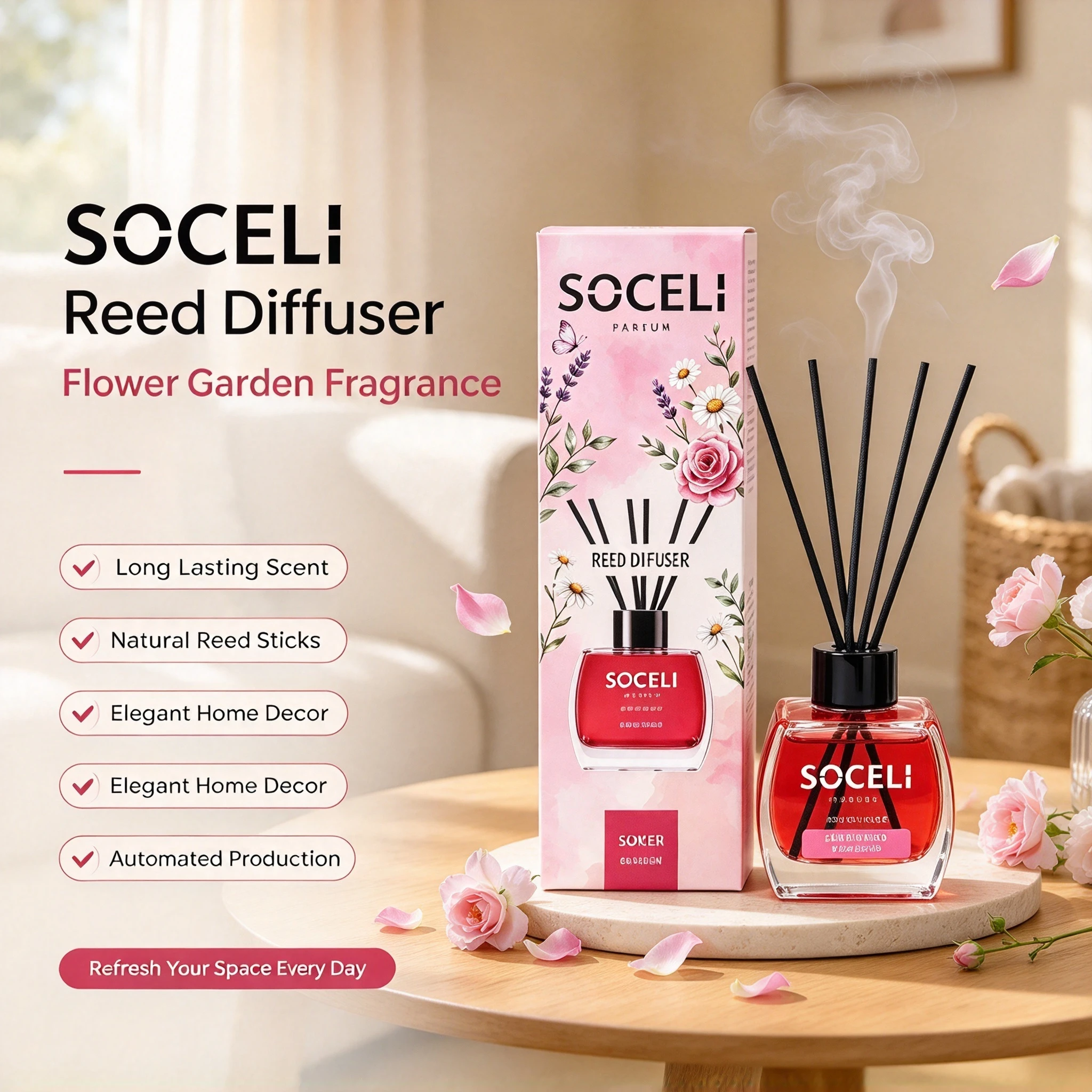
Open flames are banned in the office and there's a shortage of power outlets—so how exactly does the SOCELI rattan flameless aromatherapy diffuser disperse fragrance?
Office environments are actually quite picky about fragrance products: open flames are prohibited by fire safety regulations, and wall and workstation outlets are often insufficient, making it difficult to use scented candles and plug-in diffusers. The SOCELI rattan flameless aromatherapy diffuser can be placed on an office desktop not because of an alternative energy source, but because it uses a different fragrance dispersion logic.
What is a flameless rattan aromatherapy diffuser: a glass bottle with natural rattan sticks, no ignition and no electricity
Its structure is very simple: a glass bottle filled with fragrance liquid, with several natural rattan sticks inserted into the bottle opening. When in use, it requires no ignition, no plugging in, no heating, and has no atomizing device. The fragrance is drawn up from the bottle by the rattan sticks, then naturally evaporates from the surface of the rattan into the air.
Compared with the other two types of products, the difference lies in the "driving method":
| Type | Fragrance diffusion drive | Office suitability points |
| Scented candles | Open flame combustion | Open flames are prohibited in most office spaces |
| Plug-in diffusers | Power, heating, or atomization | Relies on power outlets, and workstations often don't have enough |
| SOCELI Rattan Reed Flameless Fragrance Diffuser | Natural evaporation through the capillary action of rattan reeds | No ignition, no electricity, just place it on the desktop |
For buyers, this difference is not a conceptual issue, but whether it can pass workplace safety requirements and whether it can be placed in locations without a power source. In places like reception areas, meeting rooms, and restrooms, where there are no open-flame conditions and power outlets may not be conveniently located, the rattan reed version is one of the few options that can be directly implemented.
Can it diffuse fragrance without alcohol: continuous evaporation through the capillary action of rattan reeds
Yes. The diffusion power of a reed diffuser comes from the capillary action of the reeds, not from the rapid evaporation of alcohol. The fragrance liquid rises through the internal channels of the reeds to the part exposed above the bottle opening, and then continuously releases fragrance into the air.
This is also why its fragrance diffusion rhythm is slower and steadier—there is no "rush at opening" brought by alcohol, and in exchange, there is a longer sustained period.
This SOCELI model has a 120ml glass bottle body, and according to the product instructions, it can continue diffusing fragrance for about 6 months. The actual duration will be affected by the environment: the larger the space, the stronger the ventilation, and the more reeds inserted, the faster the evaporation, and the corresponding cycle will be shortened; conversely, it will last longer. Therefore, "about 6 months" is more suitable as a reference baseline for restocking rhythm, rather than a promise accurate to the day.
For procurement and distribution decisions, there are two direct implications here:
- Adjustable concentration: The number of rattan sticks is one of the key on-site choices and a variable that needs adjustment.For enclosed spaces such as office desks and meeting rooms, it is recommended to insert only a few sticks at first, observe for one or two days, and then add more, to avoid overly strong scent disturbing colleagues.
- Restocking can be estimated: Estimate annual usage at about 6 months per bottle, then split it into two restocking times in the first and second half of the year, making both expenses and inventory easier to arrange.As for the specific number of spaces you need to cover and the scent types, it is recommended to confirm a matching solution with the SOCELI team.
Why can it be placed on an office desk, but only if three prerequisites are met?
Open flames are prohibited in offices, and there are often no spare power outlets near workstations. These two restrictions happen to rule out candle aromatherapy and plug-in diffusers. SOCELI rattan reed flameless aromatherapy relies on the rattan reeds to naturally absorb and diffuse the fragrance. It does not require ignition, power, or heat, so in terms of how it is used, it is indeed suitable for an office desktop. But "can be placed" does not mean "can be placed anywhere"—a workstation is a shared space, and the desktop is also a dense area for documents, cables, and cups. If the following three conditions are not met, it is not recommended to place it there.
Condition one: Avoid documents and electronic devices to prevent tipping and liquid contact.
The aromatherapy bottle has a glass body. Once it is knocked over, the fragrance liquid may seep into paper, keyboard gaps, or around outlets, and what is lost is not just documents. The placement location should meet the following:
- Place it on the inner side of the desktop, against a wall or partition, not on the edge of the desk, the aisle side, or within the area where the mouse moves widely;
- Keep distance from laptops, monitor bases, power strips, and external hard drives to avoid liquid flowing toward devices after tipping;
- Do not place it directly next to water cups or drink cups to reduce the chance of them being knocked over at the same time;
- If the workstation is right next to an aisle or people often pass by, give priority to placing it on top of a filing cabinet, a shelf, or another spot where it is not easily brushed by arms.
There is no room for "close enough" on this point. When desktop space is tight, it is better to move it to a safer location than to squeeze it next to equipment just for appearance.
Prerequisite two: control the number of rattan sticks to avoid overly strong scent that disturbs colleagues.
The number of rattan sticks directly determines the diffusion intensity. The more you place, the faster the scent diffuses per unit of time, the stronger the smell, and the faster the fragrance in the bottle is consumed—the original diffusion cycle of about 6 months will be noticeably shortened.
In office settings, it is recommended to start with a small number of rattan sticks, for example, insert 3–5 first and observe for one to two days:
- If you only smell a faint fragrance when sitting at your workstation, that is the appropriate range;
- If colleagues at adjacent workstations can clearly notice it, the scent is too strong, and you should reduce the number of reeds or temporarily remove some of them;
- If there is feedback such as dizziness, nasal irritation, or throat discomfort, the amount should be reduced immediately or the item should be moved out of the office area.
Open office areas, poorly ventilated cubicles, and shared meeting rooms should all be used more sparingly than private offices. In terms of scent selection, lighter scents are more suitable for shared spaces, while heavy sweet or spicy scents are more likely to feel oppressive in a small area.
Premise three: Confirm that the office location does not explicitly prohibit placing fragrance products.
Some office buildings, business parks, or companies have separate rules in lease contracts, fire safety management, or employee handbooks regarding placing fragrance items at workstations, regardless of whether an open flame is involved. Before placing it, it is worth confirming one thing first: whether administration or your direct supervisor allows an aromatherapy product at your workstation. If the company explicitly prohibits it, then no matter how suitable the product itself is, it should not be placed there.
When all three prerequisites are met, the SOCELI reed diffuser can serve as a low-interference option for workstation scent management;If any one of them is not met, it is advisable to address that condition first rather than forcing it by reducing the amount used. As for the specific scent type, reed configuration, and adaptation plan for bulk procurement, you can explain your office space type and number of people to the SOCELI team, and they will confirm matching recommendations.
How should they be placed at the front desk, meeting rooms, and restrooms respectively?Scenario adaptation checklist for the SOCELI reed diffuser
In the same office, different areas have different scent needs. The concentration of the SOCELI reed diffuser is mainly adjusted by the number of reeds, which determines that it is suitable for configuring each space separately rather than using one bottle throughout the entire company.
Office desktops and meeting rooms: prioritize a small number of reeds and low concentration
Office desktops and meeting rooms are spaces where people stay for long periods and are close to one another. An overly strong scent can disturb colleagues and also reduce concentration. It is recommended to start with a small number of rattan sticks in both places, keeping the fragrance at a level where it is only smelled when you get close.
Meeting rooms are used at irregular frequencies, and when no one is there the scent tends to accumulate, making it seem overpowering at the next meeting. Therefore, it is better to use fewer rattan sticks rather than adding more to make it smell stronger during meetings. Open-plan workstations also require considering nearby colleagues' acceptance of the scent. Try it out on a small scale first before deciding whether to keep it.
Reception and restrooms: balance brand tone and odor removal, but do not make it too strong
The reception area is where visitors form their first impression. The glass bottle and natural rattan sticks are decorative in themselves, so they can be placed in a visible spot that does not block sightlines and is not easily knocked over. Restrooms focus more on neutralizing odors, but the space is small and poorly ventilated, so the number of rattan sticks should also be restrained—odor removal relies on continuous scent diffusion to cover the area, not on overpowering concentration. The two locations can use a unified scent to strengthen brand consistency, then adjust the number of rattan sticks according to the size of the space.
Which scenarios are not recommended for placement?
- Completely unventilated, enclosed, and crowded small spaces, where odors easily accumulate;
- Areas with explicit fragrance-free requirements, such as certain laboratories, medical, or food handling areas;
- Passageways or tabletop edges that are easily bumped or tipped over.
As for how many rattan sticks to place in each scenario and which scent to choose, it depends on the actual area, ventilation, and personnel density. When these conditions differ, the configuration differs. It is recommended to organize the area, ventilation conditions, desired concentration, and annual usage of each zone, then confirm the scent and rattan stick configuration plan with the SOCELI team before locking in the procurement quantity.
Maintenance, restocking, and customization: Where are the decision boundaries for SOCELI rattan stick reed diffusers?
If the scent fades, flip the reeds first—it's not broken.
When a reed diffuser's scent throw weakens, the most common reason is not product failure, but that the fragrance adsorbed on the reed surface gradually becomes saturated and the volatilization channels get blocked. SOCELI uses natural reeds for natural diffusion. The fix is simple: take out the reeds, turn them upside down, and reinsert them so the end soaked in fragrance oil is exposed to the air. Usually the scent throw recovers within a few hours. If it is still weak after flipping, then consider reducing the number of reeds to concentrate the scent, or check whether the environment is too ventilated or the temperature is too low—these two factors directly affect the volatilization rate.
The real signals that it's time to replace it are: the liquid in the bottle is clearly running low, or the reeds become dry and hard or develop surface buildup after several months of use. Before that, it is not recommended to throw away the whole bottle just because 'the scent has become faint.' This is a maintenance action, not a quality issue.
120 ml provides about 6 months of scent throw. How to estimate usage for bulk purchasing
6 months is a reference value; actual consumption depends on room size, ventilation intensity, number of reeds, and placement location. When purchasing in bulk, do not directly order based on "number of bottles = number of spaces." It is recommended to estimate in the following order:
- List the points that need to be covered: office desktops, meeting rooms, reception, restrooms, etc. Count each point separately.
- Set the concentration strategy by point: enclosed small spaces (such as restrooms) use a small number of reeds, while open office areas may need more reeds or more points.
- Use six months as the replenishment cycle: Based on 120 ml lasting about 6 months, split the annual demand into two purchases in the first and second half of the year. This smooths the budget and also leaves a window to observe actual consumption.
- Leave room for adjustment in the first yearAfter the first purchase, record the actual consumption rate of each point, and then adjust accordingly in the second year.
How many bottles an office floor needs in a year depends on how many independent points the floor is divided into, not simply a conversion based on area. For this figure, it is recommended that your company first provide a list of points, and then confirm the corresponding usage recommendation with the SOCELI team.
If you want to do a private label, you need to ask these things clearly during negotiations.
The decision boundary for OEM/ODM is not "whether it can be done," but "which conditions must be locked in first." The following matters fall within the scope of what needs to be confirmed with the SOCELI team; this article does not preset specific values:
- Minimum order quantity and price tiers: The unit price structure corresponding to different quantities directly determines your pricing room.
- Customizable scope: To what extent can the logo, bottle body, packaging, and fragrance each be modified, and which are standard items versus which require separate mold making or formulation.
- Sample process: Whether samples incur a fee, the sampling lead time, and whether mass production will be consistent with the confirmed sample.
- Certification and compliance documents: Who provides and who bears the cost of the documents required by the target market; this will affect your customs clearance and listing schedule.
- Delivery time and acceptance criteria: The milestones from sample confirmation to delivery, and how the acceptance standards are agreed upon.
Situations suitable for directly purchasing standard products: The number of placement points is clear, the scent requirements are general, and brand exposure is not needed. Situations suitable for going the customization route: There are clear brand tone requirements, you can bear the extra lead time and cost of sampling and packaging, and the minimum order quantity can cover your actual sales volume. Situations where adding complexity is not worthwhile: There are very few placement points, sales have not yet been verified, or scent preferences are still changing frequently—in this case, first using standard products to establish the usage and restocking rhythm is more prudent than directly investing in customization.
Frequently Asked Questions
After flipping the rattan sticks, the scent is still faint. Is this a product problem? First rule out environmental factors: strong ventilation, low temperatures, and overly large spaces will all weaken the scent diffusion. If there is enough liquid in the bottle and the rattan sticks are not dry and hard, you can try reducing the number of sticks or changing the placement location;If there is still no improvement, report the usage environment and placement situation to the SOCELI team for confirmation.
How large an area can one 120ml bottle cover? The product information gives a reference of about 6 months of scent diffusion, and does not specify the applicable area. Area is related to ceiling height, ventilation, and fragrance concentration. It is recommended to test at specific points rather than directly converting area into the number of bottles.
When can the minimum order quantity and price for custom orders be determined? This depends on the depth of customization you choose (logo only, or involving the bottle body or fragrance type). The customization scope needs to be clarified first, and then the SOCELI team will provide the corresponding minimum order quantity and quotation. This article does not preset any values.
Are the replenishment cycles for standard products and customized products the same? They are not the same. Standard products are usually replenished according to the existing inventory rhythm;customization involves proofing, packaging, and production scheduling, so the cycle is longer.
If your locations have stable consumption, it is recommended to plan customized orders in advance to avoid supply interruptions.
Learn more
If you are selecting a flameless aromatherapy solution for an office space, you can organize the list of locations to be covered, the area and ventilation conditions of each area, the desired concentration, and the annual usage, and send them to the SOCELI team.Based on this, we will assist in confirming the fragrance type, rattan stick configuration, and bulk purchasing recommendations, helping you implement scent management in office settings more reliably.