
How is the logo printed on a car air freshener?First, understand the printing substrate and customization boundaries
When purchasing promotional items, the mockup shows the design intent, but the material on which the logo is actually printed and the process used directly determine the final appearance. SOCELI custom paper car air fresheners use a paper-based substrate, and the scent diffusion method is paper-based controlled release, both of which together influence the choice of printing process.
How the material and scent diffusion method of SOCELI custom paper car air fresheners affect the choice of printing process
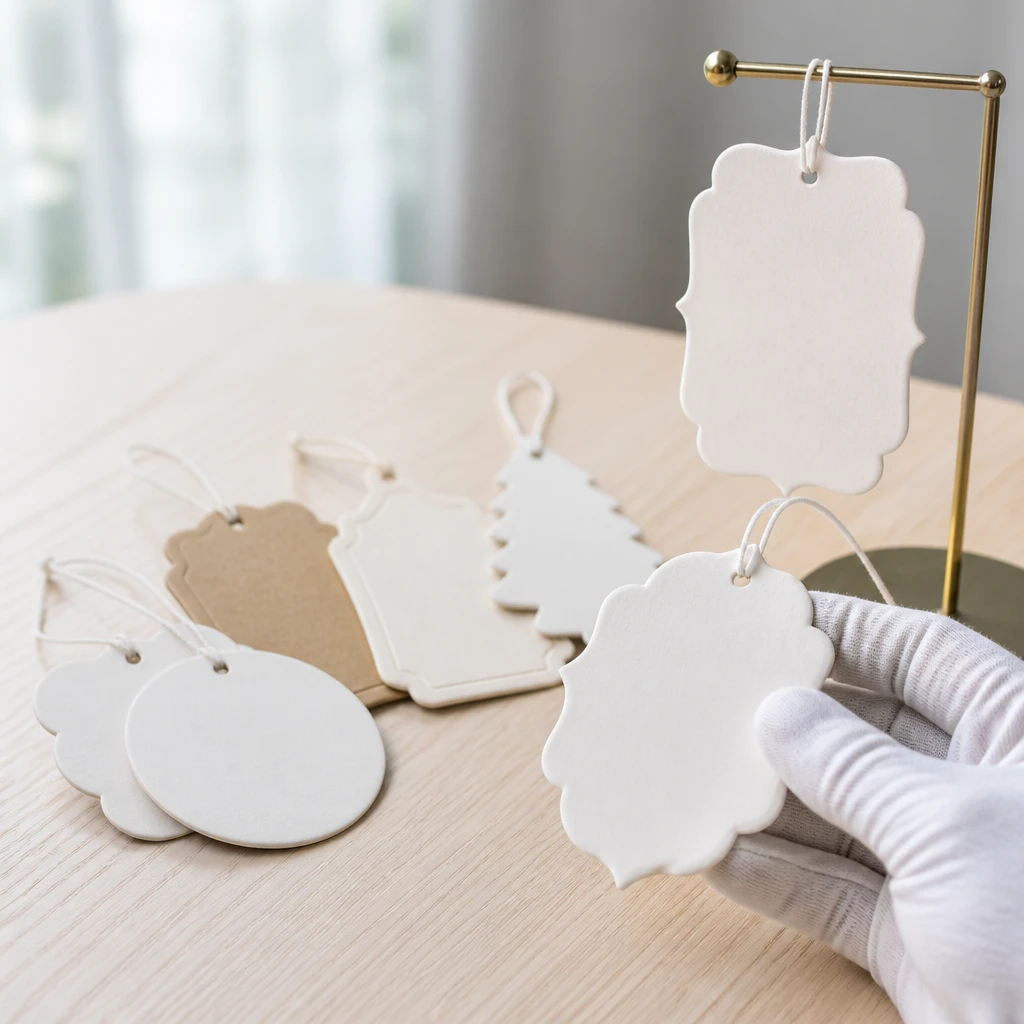
SOCELI custom paper car air fresheners use a paper-based material, and the scent diffusion method is paper-based controlled release. This means the freshener sheet itself serves as both the scent diffusion carrier and the printing substrate—the logo is directly reproduced on the surface of the freshener sheet, rather than on an attached label or plastic piece.
Paper-based materials have three characteristics that directly affect printing:
- The surface has a microporous structure: Paper-based controlled-release fragrance diffusion relies on capillary channels between fibers to slowly release the fragrance, and the surface is not completely dense or smooth.High-precision UV printing or hot stamping processes may cause edge bleeding or reduced adhesion on microporous surfaces.
- Limited thickness and softness: Fragrance sheets need to remain flexible to fit air vents or be hung; overly thick printing coatings (such as thick-film screen printing) can stiffen local areas, affecting the user experience.
- Compatibility of fragrance with ink: The continuously evaporating fragrance components in the paper base may react with certain ink solvents, causing the pattern to discolor or blur—this is difficult to judge from a mockup before sampling.
Why it is said that the printing process must be confirmed with the supplier rather than just looking at the mockup
The renderings illustrate the design intent, not the manufacturability. Specific items to confirm with the SOCELI team include:
- Whether the design includes high-precision gradients or fine lines—the paper-based surface may not achieve the same sharpness as coated paper.
- Whether the selected colors have a risk of color deviation—especially fluorescent and metallic color systems.
- The proportion of the printed area to the total area of the aroma tablet—large-area full-bleed printing may affect the breathability and fragrance diffusion efficiency of the paper base.
- Is double-sided printing required?—This involves adjustments to ink drying time and the order of fragrance filling.
The answers to these questions depend on the specific design and fragrance selection, and no unified conclusion can be given without seeing the actual materials. It is recommended that when submitting the design, you also request printing samples of the same material and process from the SOCELI team, and after actually touching, bending, and smelling them, decide whether to proceed with mass production.
What types of brand logos are suitable for screen printing, hot stamping, and UV processes respectively?
Screen printing: solid color blocks, controllable cost, suitable for simple graphic logos.
Screen printing is suitable for logos with solid color blocks, clean lines, and no gradients or fine textures. The principle is to scrape the ink directly onto the surface of the fragrance sheet, resulting in solid color coverage and clear edges, with good recognizability at small sizes. For promotional product procurement, screen printing has a short proofing cycle and is easy to change colors, making it suitable for repeatedly reproducing the same logo on different batches of gifts.
However, screen printing struggles with fine gradients; if the design contains complex color layers or extremely thin lines, the details in the finished product may appear blurry.
Hot foil stamping and UV: enhance texture and recognition, but design complexity needs to be evaluated
Hot foil stamping uses high temperature to press metal foil onto the paper surface, creating a reflective effect. It is suitable for line-based logos, text logos, or graphic outlines, and can significantly enhance the premium feel. It is commonly seen in exhibition gifts or client appreciation gifts. UV process uses light curing to make local ink protrude, creating a three-dimensional tactile effect. It is suitable for co-branded products that emphasize brand touch. It handles gradients and fine lines relatively better, but the three-dimensional effect is limited by the thickness and material of the aroma tablet.
Matching process with design:Screen printing is suitable for block-color logos, hot foil stamping for line-based logos, and UV for graphics requiring a three-dimensional tactile feel. If the logo requires both fine gradients and a metallic texture, a combination of processes may be necessary, which directly affects the proofing cycle and unit cost. The specific effect needs to be confirmed with the supplier based on the design draft.
SOCELI can accurately replicate the logo on the surface of the aroma tablet according to the customer's design draft. It is recommended to submit the AI or PDF source file to the craftsman for evaluation to determine the best reproduction solution on paper-based materials.
In scenarios of exhibition gifts and car decoration, how should the logo process be selected?
Even though both involve printing logos, the requirements for the process are actually completely different between exhibition gifts and car decoration. First clarify your core goal, then choose the process; the order cannot be reversed.
Exhibition gifts: Pursuing a balance between recognition and cost, screen printing is a stable starting point.
The core demand for exhibition gifts islow cost, large quantity, and fast deliveryThe logo should make people remember the brand name at a glance, rather than appreciate the craftsmanship details. SOCELI custom paper car air freshener sheets are made of flat paper-based material with a smooth surface, making them very suitable for screen printing—this process can accurately reproduce corporate logos, mascots, or any graphics and text on the surface of the air freshener, and offers significant cost advantages per unit in mass production.
If your design is mainly a single-color or two-color logo with clear lines, screen printing is basically the most reliable choice. It is abrasion-resistant and not prone to peeling. In scenarios where the product is repeatedly picked up at exhibitions and carried away in bags, the integrity of the logo is guaranteed. **When not to choose screen printing?
** If your logo contains gradients, photo-like patterns, or extremely fine anti-counterfeiting lines, the rendering capability of screen printing will be compromised. In this case, you need to confirm with the SOCELI team whether to switch to other printing methods.
Car decoration: Considering the lighting and usage environment inside the vehicle, hot stamping and UV printing are more memorable.
Car air fresheners placed inside the vehicle are seen by the driver and passengers every day. The lighting inside a car is complex—direct sunlight during the day and dashboard lights at night. The logo craftsmanship needs to be recognizable in both environments.
Hot stamping produces a striking reflective effect under light, especially forming a clear highlight contrast in direct sunlight, making it suitable for brands with a light luxury or business style. UV coating, on the other hand, can create a sense of depth and color saturation, remaining clearly visible under interior car lights at night, making it ideal for youthful, vibrant brand images.
It is important to note that in-car environments experience continuous temperature fluctuations and sun exposure, so when selecting a process, you should confirm the weather resistance of the ink or hot stamping layer. The key trade-off is: If you want the logo to remain clear in the car over the long term, prioritize process solutions that are resistant to yellowing and high temperatures;If it is only for short-term promotional use, cost can be the priority.
How do scenario goals influence process decisions?
A table to help you quickly align:
| Decision Dimension | Exhibition Gifts | Car Decoration |
| Core Objective | Brand exposure, low-cost distribution | Long-term visual memory, in-car texture |
| Recommended Process | Silk-screen printing (single-color/double-color logo) | Hot stamping or UV (with a memorable point under light) |
| Design complexity | Simple lines, high-contrast colors | Can accept richer colors and layers |
| Cost sensitivity | High, unit cost priority | Medium, texture priority |
| Delivery speed | Fast, for large quantities | Slightly longer sampling cycles are acceptable |
Next steps to confirm: Send your design files (in AI or PDF format) and estimated quantity to the SOCELI team, and specify whether the usage scenario is for trade show distribution or long-term in-car use. Based on the paper-based material and your design, they will determine which process—screen printing, hot stamping, or UV—can most accurately reproduce your logo, and provide the corresponding sampling cycle and cost proposal. If you have both trade show giveaways and in-car decoration scenarios, you can also ask about the dual-logo option—SOCELI supports printing different patterns on the front and back of the fragrance card, covering both scenarios with one product.
How to determine which process suits you?Three Decision Questions to Help You Lock In Your Direction
Before contacting suppliers, answer the following three questions first, as they determine your customization route and communication efficiency.
Is your design a simple graphic or a complex gradient?
This is the primary criterion for judgment. If your brand logo is a simple graphic with a single color, clear lines, and distinct color blocks, you have more options for printing processes, and costs are relatively controllable. If the design includes delicate gradients, rich color layers, or extremely small text details, you need to first confirm whether the printing process can reproduce them—the ink absorption characteristics of paper-based materials determine that they are better suited for designs with clear color blocks, and overly complex gradients may result in color differences or loss of detail on the final product.
It is recommended to provide the design to the supplier for evaluation, and then confirm the actual effect through proofing.
Do you prioritize cost control or texture presentation?
The two are not always in conflict, but you need to clarify priorities. If the core demand is bulk distribution and low-cost reach, simple craftsmanship paired with standard fragrance is a reasonable choice;If this customization carries the task of brand image upgrade or co-branding collaboration, it is worth investing more in the sampling stage to confirm color fidelity and overall texture. Texture presentation is not just about 'looking good'; it also includes the tactile feel of the fragrance sheet surface and the durability of the logo—these all need to be judged through physical samples.
Sample confirmation: Why can't this step be skipped?
Samples serve a 'verification' role rather than a 'reference' role. The effect presented by the design on screen will differ from the actual effect printed on paper-based materials due to differences in ink absorption and color presentation. Through samples, you can confirm three things: whether the logo clarity meets standards, whether the color is close to the design, and whether the printed parts are durable in a car environment.
SOCELI offers rapid prototyping services precisely to allow you to make a physical judgment before committing to bulk production.
When is it not recommended to proceed with customization immediately?
- The design draft is still in the revision stage and not yet finalized.
- The primary usage scenario has not been confirmed.
- The budget is only a vague range without a clear upper limit.
- The distribution targets and quantities have not been determined.
In such cases, the most reasonable approach is to first request samples, confirm basic compatibility, and then proceed with the customization process. Customization entails minimum order quantities, sampling fees, and time investment. The more complete your information, the higher the communication efficiency and the lower the risk of rework. Customization is suitable when the goal is clear and the materials are complete;If the design drafts change frequently or the goal is vague, it is recommended to clarify the requirements before investing in sampling.
FAQ
Q: My logo has a color gradient. Can it be printed on paper-based aroma sachets? It is possible, but the fidelity of the gradient details needs to be confirmed first. The ink absorption characteristics of paper-based materials make them more suitable for designs with clear color blocks. It is recommended to provide the design draft to the team for evaluation first, and then confirm the actual effect through sampling.
Q: How long does sample confirmation take? SOCELI offers rapid sampling services. The specific timeline depends on the complexity of the design draft and the number of confirmation rounds. It is recommended to specify the usage scenario and expected timeline when submitting the design draft, so the team can arrange sampling priority accordingly.
Q: If I am not satisfied with the sample, can it be adjusted? Yes. The purpose of a sample is to identify issues before mass production.
You can request adjustments based on the sample, such as color shade, logo size, printing position, etc., and proceed to mass production only after confirming satisfaction.
Q: Is there always a minimum order quantity for customization? The MOQ affects the unit price, but the specific threshold depends on the customization plan (e.g., number of logos, fragrance selection, packaging requirements). It is recommended to clarify the quantity and budget range first, then consult the team for a matching solution.
Learn More
If you are selecting a custom car fragrance solution for exhibition gifts or client appreciation gifts, you are welcome to submit your design files (in AI or PDF format) and estimated quantity to the SOCELI team.Based on the paper-based material and your design, we will confirm which process—screen printing, hot stamping, or UV—can best reproduce your logo, and provide the corresponding sampling cycle and cost plan.
Related Products:SOCELI Custom Paper Car Fragrance