
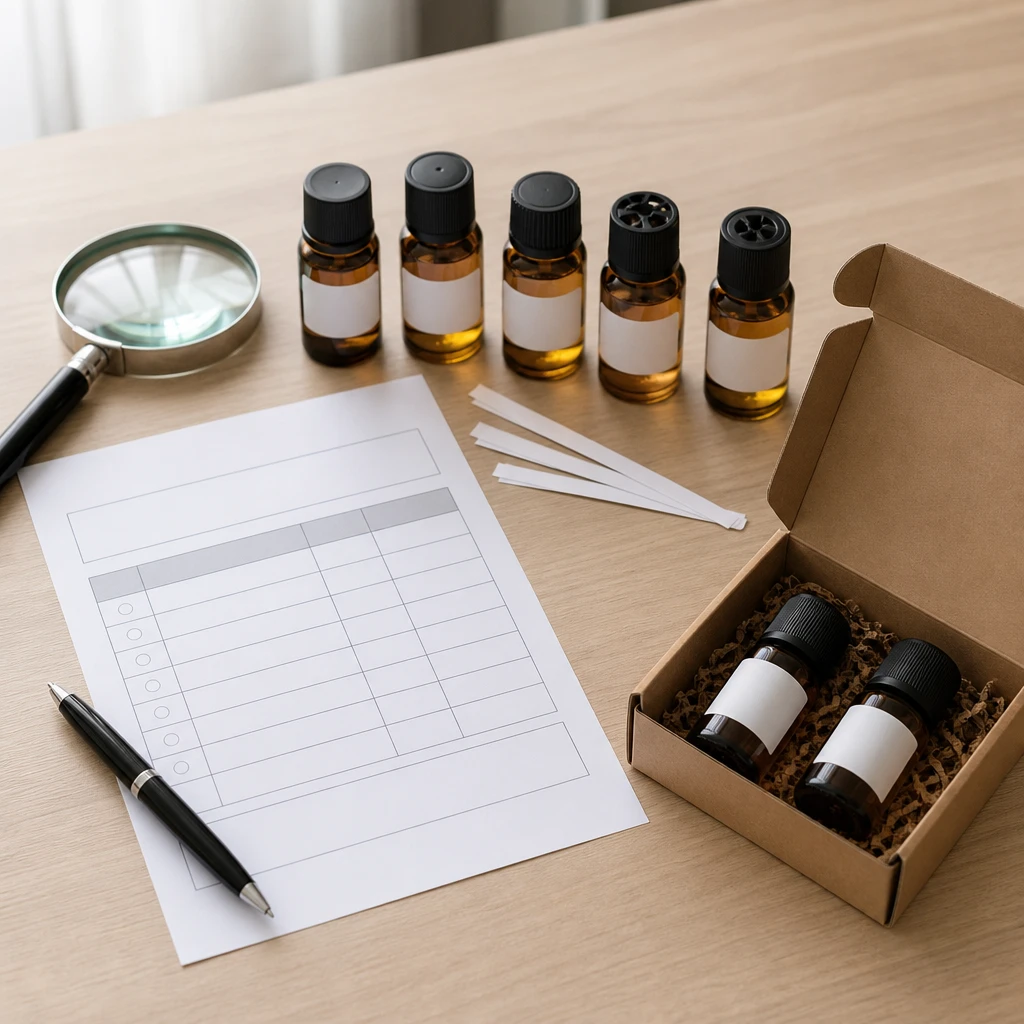
Before requesting samples, clarify these 3 questions before contacting suppliers
Requesting samples may seem simple, but many buyers only realize after receiving samples that communication costs are high and the sampling direction has gone off track. Instead of going back and forth repeatedly, it's better to think through the following three questions before sending an email or making a phone call.
Question 1: Is your target scenario for your own brand or OEM/ODM customization?
The sample logic for these two routes is completely different.
- Own brand: You directly purchase existing products and sell them under your own channel.In this case, you care about stock specifications, minimum order quantity, lead time, and price tiers.The purpose of the sample is to verify whether the product itself meets the standards—whether the fragrance lasts long enough, whether the can withstands high temperatures, and whether the scent type suits the target customers.
- OEM/ODM customization: What you need is SOCELI's R&D and production capabilities.Samples are no longer about "finished product verification" but "solution verification"—whether the fragrance can be blended according to your requirements, whether the label can be made with the process you want, and whether the can body can be printed with your brand elements.At this point, you need to confirm the sampling cycle, the minimum order quantity for customization, and the modification costs.
Next step: confirm the action: First, tell the SOCELI team which route you are taking. If it is customization, please prepare your fragrance preferences, target audience, and packaging ideas. Even rough thoughts can make the sampling more targeted.
Question 2: Do you need a standard sample or a customized sample?
This is the most ambiguous part of communication. Standard and customized samples have fundamental differences at the sample stage:
| Dimension | Standard sample | Customized sample |
|---|---|---|
| Acquisition speed | Fast, usually available as an existing sample for shipping | Slow, requires formulation and confirmation |
| Cost | Lower, possibly only shipping costs | Higher, involving sampling and fragrance adjustment costs |
| Purpose of verification | Confirm product quality, fragrance type, and battery life | Confirm whether the customization direction is feasible |
| Subsequent risks | Low, you can place an order once confirmed. | High, details need to be confirmed to avoid rework. |
Take the SOCELI liquid car fragrance (model TS101) as an example: the standard version offers 18+ fragrance options, with a content volume of 120g and a battery life of about 90 days. If you just want to verify whether the product itself suits your channel, a standard sample is sufficient. But if you need "your own fragrance + your own packaging," you must go through the custom sampling process.
Next step: confirm the action: In the application email, clearly state "apply for a standard sample" or "apply for custom sampling," and attach your intended use. If you are not sure yourself, it is recommended to apply for a standard sample first, and discuss customization after confirming the basic product quality.
Question 3: What do you need to verify after receiving the sample?
A sample is not something you just take back and sniff once and be done with it. Only by clearly defining your verification goals can you avoid the gap between 'the sample is good' and 'problems arise in mass production.' After receiving the sample, we recommend you focus on checking the following:
- Longevity of fragrance: Does actual use come close to the expected 90-day duration?How does it perform under high-temperature, sun-exposed conditions?
- Safety and compliance: The product claims to be certified to international safety standards. If you are targeting overseas markets, you need to request the corresponding test reports from the SOCELI team to confirm that they cover the compliance requirements of your target markets.
- Fragrance acceptance: Have the target users (or yourself) actually smell it to confirm it is not "good when smelling the sample, but cloying after prolonged use".
Next step: confirm the action: When requesting samples, also ask "Can you provide test reports or safety certification documents with the sample?". This helps you determine in advance whether the documentation is complete, avoiding repeated follow-ups later.
By clarifying these three questions before contacting the supplier, your sample request email will be more targeted, and the supplier can quickly assess whether your needs are feasible. If you still have questions about the specific differences between standard and customized versions, directly explain your usage scenario and expected goals to the SOCELI team, and they will provide matching prototyping suggestions.
How to apply for SOCELI liquid car fragrance samples? Process and fee explanation
Requesting a sample is the most direct way to determine whether this aromatherapy product is suitable for your sales channel. The overall process is not complicated, but the application paths for standard samples and customized samples are significantly different, which are explained separately below.
Standard Sample Application Process: From Inquiry to Shipping
If you only want to confirm the product quality, fragrance longevity, and packaging texture, you can follow the standard sample process, which typically involves the following four steps:
- Submit an Inquiry: Send a sample request through the website contact form or customer service channel, specifying the product model TS101 and the phrase "liquid car aromatherapy standard sample".
- Provide Basic Information: Include your company/brand name, country or region, estimated purchase quantity (to determine whether you are an end retailer or bulk buyer), shipping address, and contact information.
- Confirm sample and shipping costs: Standard samples usually incur a sample fee, with the cost based on actual communication, and shipping costs calculated according to the destination.In some cases, the sample fee can be deducted from a subsequent formal order; this should be clearly inquired about during the inquiry.
- Shipping and follow-up: After confirming the costs, arrange shipment. If you have fragrance preferences after receiving the sample, you can mention them when applying, and we will try to match the fragrance you are interested in.
Time expectations: Standard samples are typically shipped within 3-5 business days after confirmation, with international shipping time depending on the destination.
Special instructions for custom sample (OEM/ODM) requests
If you need products with your own brand logo, specific fragrance, or customized packaging, the application process will involve a few more steps and take longer:
- Clear requirements are a prerequisite: Before customizing samples, you need to clarify three things: the fragrance (choose from SOCELI's existing library of 18+ fragrances, or need a new blend), packaging label design (whether to use your brand visuals), and capacity specifications (whether to stick with the standard 120g capacity).If any of these three items is uncertain, it will directly affect the sampling cycle.
- Provide additional brand materials: In addition to basic information, you also need to provide the brand logo source file, label design draft (or design requirement description), and the expected customized quantity.The minimum order quantity for customization is usually higher than for standard samples; please confirm the specific threshold with the team.
- Sampling fees and cycle: Custom sample fees are higher than standard samples and are typically not deducted from bulk orders; the exact amount depends on the complexity of the customization.The sampling cycle is generally 7-15 working days, and it will take longer if new fragrance blending is involved.
Key trade-off: Standard samples are suitable for quickly validating product strength, while custom samples are suitable when you have decided to launch your own brand and need to confirm the final finished product effect. If your brand visual or fragrance direction is still being frequently adjusted, it is recommended to first obtain standard samples to confirm basic quality, and then start custom sampling to avoid repeated sampling costs.
Next step: confirm the action: Before submitting an inquiry, first clarify your role (brand owner/distributor/retail customer), estimated purchase quantity, whether customization is needed, and your region. Send these three pieces of information along with the sample request, so the team can provide accurate cost and time responses.
After receiving the sample, focus on evaluating these 4 dimensions before deciding whether to proceed with mass production.
Once you receive the sample, don't rush to smell the fragrance or look at the appearance. As the buyer, what you really need to verify is whether this product can stably meet your channel requirements during mass production. It is recommended to go through the following four dimensions one by one, each with clear pass criteria.
Safety Verification: Materials, Formula, and Certification Reports
Car air fresheners are exposed to high temperatures and sunlight for long periods, so safety verification is the top priority—don't just rely on whether the sample smells pleasant.
Step 1: Confirm the material and heat resistance. Pick up the canister and confirm whether the material is eco-friendly PP (polypropylene). PP material has good heat resistance, and it is less likely to deform or release odors under high temperatures inside a car in summer.
If the material marking on the sample canister is unclear, or if it feels thin or has burrs, mark it directly as a risk item.
Step 2: Request a safety explanation of the formula. The solvents and fragrance components in liquid aromatherapy directly affect the safety of volatile substances. Ask the current website team for information on whether the formula contains common allergens and whether environmentally friendly solvents are used.
Note that this step is not about obtaining the complete formula (which usually involves trade secrets), but rather confirming that the other party can provide an explanation at the level of ingredient safety.
Step 3: Verify the consistency between the certification report and the physical sample. If the other party provides an international safety standard certification report, check whether the product model on the report matches the sample (the sample model is TS101) and whether the certification scope covers the liquid aromatherapy category. If the report does not match the sample model, or only contains a vague 'environmental certification' statement, ask the team to explain the specific coverage.
Pass criteria: The material is PP, the formula description is clear, and the certification report model matches the sample. Only when all three conditions are met simultaneously is it considered a pass.
Long-lasting fragrance test: How to verify the 90-day endurance?
The product is labeled with an endurance period of 90 days, but 'endurance' has two meanings in the context of car air fresheners, which need to be verified separately:
- Fragrance depletion time: The number of days for the liquid fragrance to continuously volatilize until the scent noticeably weakens or is depleted.
- Fragrance perceptibility time: The number of days for the fragrance concentration to decrease to a level that is difficult for people to perceive.
Suggested testing method: Don't just rely on your nose and sniff every day. Place the sample in an environment with stable ventilation (e.g., a fixed position in the office), and record the fragrance intensity every 3 days (can be divided into four levels: "obvious/moderate/weak/almost none"). Also observe the visible can body—this product is designed with a visible can body, so the liquid level change can be directly observed, which is an objective basis for judging the remaining amount.
If the liquid level drop rate is clearly inconsistent with the 90-day label (e.g., more than half consumed in 30 days), it indicates a gap between actual endurance and the advertised claim, and you need to confirm the differences in test conditions with the team.
Key trade-off: The 90-day endurance is data under specific temperature and ventilation conditions. If your usage scenario involves high summer temperatures, direct sunlight, or long-term outdoor parking, the evaporation rate will accelerate, and the actual endurance may be shortened. This must be confirmed with the team before mass production regarding the testing environment, rather than assuming that sample test results equal the actual user experience.
Fragrance compatibility: Does the 18+ fragrance library cover your target customer base?
Samples typically only include 1-2 fragrances, but this does not mean you are limited to these options during mass production. Confirm the complete list of the fragrance library (18+ types) and focus on evaluating:
- Whether your target market has regional preferences (e.g., European and American markets prefer woody and fresh notes, while Asian markets prefer floral and fruity notes)
- Whether the fragrance names and descriptions are suitable for printing directly on the packaging, or if they need to be renamed and customized
- Whether fragrance fine-tuning (concentration, sweetness, etc.) is supported, and the sampling cycle for such adjustments
OEM customization support: Feasibility from sample to mass production
A sample alone can only prove the product's form, not the customization capability. You need to assess OEM/ODM support through the following questions:
| Customization Aspects | Questions to Confirm |
|---|---|
| Appearance Customization | Does the can label support fully customized designs? What is the minimum order quantity? |
| Fragrance Customization | Do you support exclusive fragrance development? |
| How are development cycles and sampling fees calculated? |
| | Brand logo | Can the can body be screen-printed or labeled with the brand logo? Does the process affect mass production costs? |
Next steps to confirm: Directly request an OEM customization list from the current website team, including options, minimum order quantities, and fee structures for the four aspects mentioned above. If they can provide physical samples or images of past customization cases, it is more convincing than verbal promises.
Final judgment logic: All three safety items passed + the retention test and labeling deviation are within the acceptable range (within ±20%) + the fragrance library covers the target market + customization has clear quotes and lead times. Only when all four are satisfied is it worth entering mass production negotiations. If any item has ambiguity, complete the information first before making a decision. Do not skip the verification process just because the sample smells good.
After the sample evaluation passes, which situations are suitable for direct mass production? Which ones require caution?
Passing the sample evaluation means that the product itself has met your expectations in terms of fragrance, appearance, and material. But between "sample qualified" and "ready for mass production," there is still a judgment about the clarity of your requirements.
Conditions suitable for advancing to mass production: clear requirements and sample meets standards
When the following conditions are met simultaneously, you can directly proceed to the mass production stage:
- The use case and target audience are locked in.You know exactly which type of customer this batch is for and in what scenario it will be used (for example, deodorizing a car interior after intense summer sun exposure, or providing a long-lasting fragrance for long-distance driving).Different scenarios may have completely different requirements for fragrance concentration and longevity.
- Specifications and packaging are frozen.The capacity (120g), fragrance type, label process, and packaging method have all been confirmed, and the samples were produced under these exact conditions.Any change to any of these factors means that re-validation is required before mass production.
- Safety verification documentation is available.This SOCELI product has been certified to international safety standards. If you need the test report for downstream customers or channel audits, please confirm that the report has been provided with the samples or can be retrieved at any time.
- Budget and MOQ match: The unit price for bulk customization is tied to the MOQ. You have confirmed that the unit price corresponding to the current purchase quantity is within budget.
If the above four points are met, the risks in mass production mainly lie in delivery time and batch consistency, which fall within normal supply chain management and can proceed.
Cases where immediate mass production is not recommended: unclear requirements or need for further verification
If any of the following situations occur, it is recommended to pause first, take an additional step to confirm, and then decide:
- The fragrance has not been finalized yet: SOCELI offers 18+ fragrance options. If you only tried 2-3 during the sample stage and are still in the "they're all okay" state, do not proceed to mass production with this ambiguity.The fragrance is the core experience of this product; changing the fragrance is almost equivalent to re-sampling.
- There is a conflict in usage scenarios: For example, if you want to focus on deodorizing after high-temperature sun exposure in summer, and also hope the fragrance lasts 90 days—these two demands may require trade-offs in formula concentration.The sample only validated a single scenario; for dual-scenario needs, you need to confirm whether a corresponding solution exists.
- Packaging or labels are still being adjusted: If you plan to change the label process, bottle color, or packaging structure during mass production, the reference value of the current sample evaluation is reduced.Appearance changes do not affect the fragrance type, but label processes and packaging materials will affect cost and delivery time.
- Downstream requirements have not yet been confirmed: If you are a distributor or brand owner, but feedback from end customers on fragrance type and specifications has not yet come back, mass production at this point is equivalent to making decisions on behalf of the downstream.It is recommended to place the order only after the requirements have been finalized.
How to control risks from sample to mass production
There is only one core action to control risks:Write every item confirmed during the sample stage into the specification sheet of the mass production order in black and white.。 This includes the fragrance code (not the fragrance name), capacity, material, label process, packaging method, and certification report number. Also confirm two points: whether the mass production batch and the sample are from the same production line and the same raw material batch; and if there are batch differences, what is the supplier's rework or replenishment mechanism.If there are batch differences, what is the supplier's rework or replenishment mechanism.
SOCELI's own factory integrated management provides a natural advantage in batch consistency, but the above details still need to be clarified during communication. If you are unsure about any step (such as the minimum order quantity for switching fragrance types or the cost of specific packaging), directly confirm the matching solution with the current website team, and do not place an order based on assumptions.
Frequently Asked Questions
Q: The sample passed, but I want to switch to a different fragrance for mass production. Is that possible? Yes, but switching fragrance types means that re-sampling and confirmation are required, and you cannot directly place an order based on the original sample. SOCELI offers 18+ fragrance types. It is recommended to first request a sample of the new fragrance, and after confirmation, discuss mass production.
Q: After the sample evaluation passes, will the mass production price be lower than the sample price? Usually, the unit price for bulk orders will be lower than the sample unit price, but it depends on the minimum order quantity. The sample fee mainly covers sampling and logistics. The mass production price needs to be calculated separately based on your purchase quantity. It is recommended to directly inquire with the team for a quote.
Q: What if there are differences between the mass production batch and the sample? Before mass production, confirm whether the mass production batch and the sample are from the same production line and the same raw material batch. SOCELI's own factory integrates management, making batch consistency relatively controllable, but it is recommended to specify acceptance criteria in the order and conduct random inspections upon arrival before distribution.
Q: Is the test report provided with the sample or only during mass production? This depends on your needs. If it is needed for channel review, it is recommended to request the report at the sample stage;If it is only for routine acceptance after mass production, you can agree in the order to provide it with the goods.
In both cases, it is recommended to clarify in advance to avoid affecting your downstream delivery schedule.
Learn More
If you have further questions about the sample application process, OEM/ODM customization support, or mass production details for SOCELI liquid car diffusers, please feel free to submit your requirements through the website contact form or customer service channels. Our team will provide targeted sample and quotation suggestions based on your usage scenarios and procurement plans.
Related Products:SOCELI Liquid Car Diffuser