
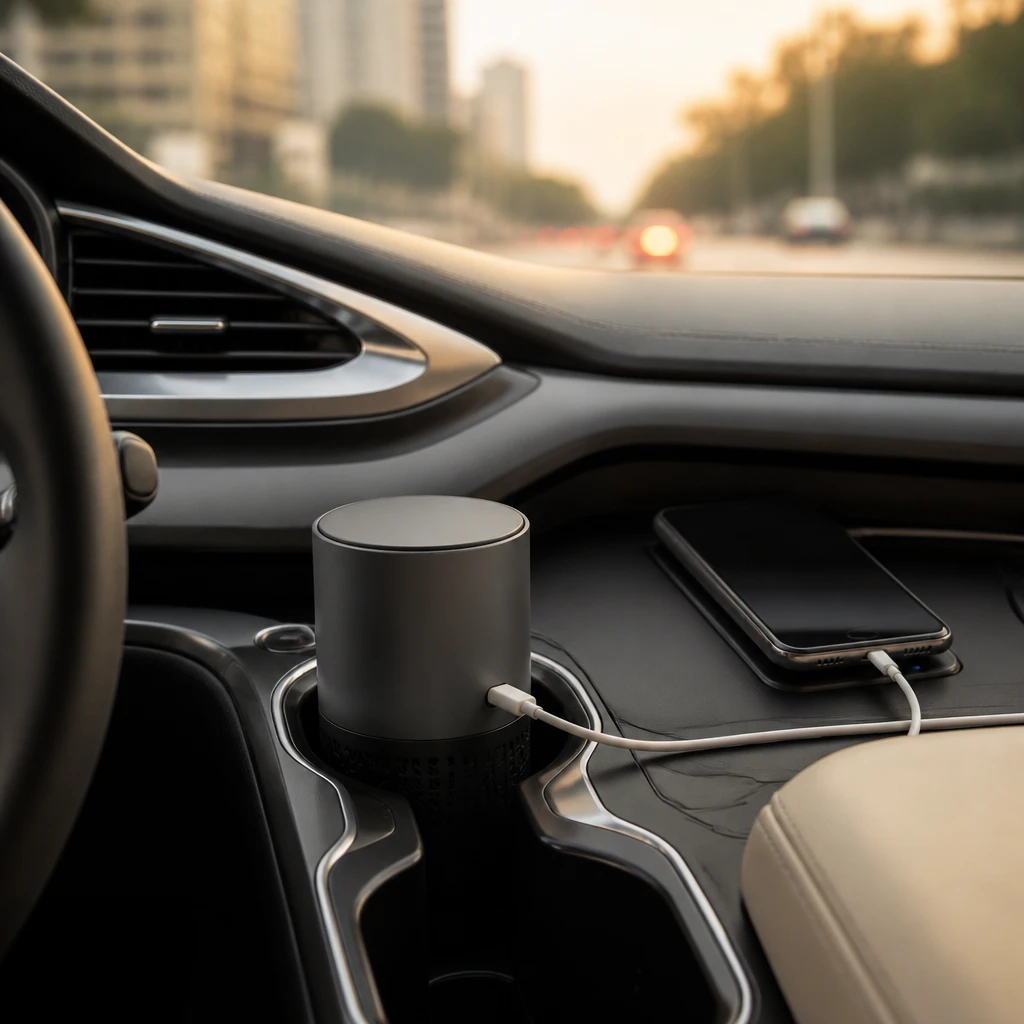
Why are the retractable cable and shell material the key to the durability of a car air freshener?
Car air fresheners, like phones and keys, are things that get 'tossed around' several times a day. Plugging and unplugging, pulling, sun exposure, and bumping—these daily actions are the real dividing line between a product lasting one year or three. For buyers, durability directly affects after-sales costs and customer reputation, so it's worth seeing clearly at the product selection stage.
In the daily use of a car air freshener, which parts are most prone to wear and tear?
Taking a car air freshener apart, the most problematic areas are actually just three:
- Charging cable: This is the most heavily worn component.With daily plugging, twisting, and being squeezed by debris, the insulation and internal copper core of ordinary cables are prone to fatigue and breakage.Especially the root of the cable—the part that connects to the device—is where most cables begin to fail.Retractable cables have an additional retraction mechanism compared to fixed cables. If the spring or latch quality is not up to par, problems such as failure to retract or jerky extension can occur within a few months of use.
- Shell material: The car environment is harsher than imagined.In summer, under direct sunlight, the dashboard temperature can easily exceed 60°C. Inferior plastic can deform, yellow, or even release odors.In winter, low temperatures can make it brittle.Additionally, car air fresheners are often placed near the cup holder or center console, and daily bumps and key scratches test the durability of the shell.
- Internal structural components: including the switch, the solder joints of the Type-C port, and the clips of the aroma cartridge.These parts are not conspicuous, but once they become loose, the whole unit will produce rattling noises or poor contact.
Why is it said that the retractable cable and the shell material determine durability?
Because these two things are components that are used every day and cannot be repaired once broken. If there are problems with the internal chip and the aroma diffusion technology, users may not perceive them;but a broken cable or a cracked shell is a visible quality issue that directly affects repurchase and brand trust.
Taking the SOCELI smart car aroma diffuser (model A125) as an example, it adopts a retractable charging cable design, with a built-in Type-C port and supports PD 3.0 fast charging (5V/3A). The advantage of this design is that the cable is stored inside the body when not in use, reducing the chance of exposed parts being pulled or tangled—the less exposed, the lower the risk of damage. But this also means that the reliability of the retractable mechanism is more important than that of a regular cable: the fatigue life of the spring, the flexibility of the cable, and the wear-resistant treatment at the outlet are all specific parameters that need to be confirmed with the supplier during procurement.
As for the shell, if the base material is not strong enough, a surface finish with a light luxury texture will show scratches or coating peeling within six months. This is especially critical for brand procurement—because your logo is often printed on the shell, and shell aging is equivalent to a discount on brand image.
How does durability affect procurement decisions and long-term usage costs?
The impact of durability on procurement is not about 'whether it will break', but 'how soon it breaks and what to do if it breaks'. Specifically:
- After-sales costs: If products experience batch cable or housing issues during the warranty period, the brand owner must bear the costs of replacement, return shipping, and customer communication.For customers purchasing in bulk, these costs scale linearly.
- Customer Lifetime Value: A product that lasts means customers will continue to choose you on their next purchase;a product that fails within six months will drive customers to competitors.Durability is essentially 'renewing' your customer relationships.
- Impact of OEM/ODM Customization: If you plan to customize your brand, the housing material directly affects the adhesion and durability of logo printing or etching.If the material is not selected properly, the custom logo may fade or peel off within a few months.
Next step: confirm the action: Request from the SOCELI team the plug-unplug cycle test data for the retractable cable (usually measured in cycles), the temperature resistance range of the housing material, and the surface treatment process description, and confirm whether cable and housing issues within the warranty period are covered by free replacement. This information will directly affect your procurement decisions and pricing strategy.
Long-term reliability of retractable cables: the practical significance of Type-C interface and PD fast charging
When sourcing or distributing car air fresheners, the retractable cable is often the first component to be overlooked, yet it is the first to fail. Once the cable fails, the entire product becomes a "scent bottle that needs manual charging," and both the experience and value are diminished. So this section directly answers three questions: Are retractable cables prone to failure?
Is the Type-C interface really more durable? What does PD 3.0 fast charging really mean for an aroma diffuser?
What determines the lifespan of a retractable cable?
The reliability of a retractable cable does not depend on whether it can retract, but on three specific aspects:
- Bending fatigue of the cable itself: The retractable structure means that each use of the cable undergoes a bending cycle of stretching and retracting.The lifespan is determined by the core material (pure copper is better than copper-clad steel) and the flexibility of the insulation layer.Ordinary PVC outer sheath hardens in low-temperature environments, and with increased bending cycles, internal wire breakage can occur—manifesting as intermittent charging.
- Spring and limit stop of the retractable mechanism: The fatigue life of the spring and the wear resistance of the limit structure determine how long the retractable feel can be maintained.If the limit catch is made of thin-walled plastic, problems such as "cannot retract" or "loosens after pulling out" may occur after long-term pulling.
- Connection point between cable and connector: This is the most vulnerable stress concentration point of the retractable cable.If the connection point is not thickened with injection molding or SR (stress relief) treatment, the force from daily plugging and pulling will directly act on the solder joint, leading to poor contact.
For the purchaser, the most direct way to confirm whether the retractable cable is reliable is to request from the suppliercable bending test report(Usually should withstand more than 5000 bends without breaking the circuit) andtelescopic life test data(The number of telescopic cycles should not be less than 3000 times). If the supplier cannot provide these two sets of data, it is recommended to first request samples for destructive testing—repeatedly stretching and bending about 100 times can give a preliminary assessment of the structural and material quality.
What practical benefits do the Type-C connector and PD 3.0 fast charging (5V/3A) offer in terms of durability?
The durability advantage of the Type-C connector is structural, not just marketing talk.
Traditional Micro-USB connectors typically have a plug/unplug lifespan of around 5000 cycles, and the internal exposed spring contacts are prone to bending or deformation when inserted incorrectly or subjected to lateral force. The Type-C connector features a double-sided symmetrical design, with a plug/unplug lifespan generally exceeding 10,000 cycles, and the connector terminals are fully enclosed by the housing, making them less susceptible to damage from lateral force. For in-vehicle scenarios—where drivers often plug in charging cables blindly under poor lighting and distracted conditions—the 'reversible plug' feature of Type-C directly reduces interface damage caused by forceful insertion in the wrong orientation.
The practical significance of PD 3.0 fast charging (5V/3A) for durability should be examined from two aspects: charging protocol and heat generation.
First, let's clarify: 5V/3A is a standard profile in the PD protocol, delivering 15W of output power. For low-power devices like a car aromatherapy diffuser, its significance lies not in 'charging faster' but in thestability and controllability of the charging process。
- Protocol negotiation mechanism: PD 3.0 is not simply 'plug in and charge'; instead, the device and charger first perform a protocol handshake to confirm the voltage and current profile before charging begins.This means the device does not experience current surges beyond its design specifications, placing less stress on the battery protection circuit.
- Heat control: At 15W power, the heat generated during charging is far lower than that of high-power fast charging.The lifespan of lithium batteries is directly related to operating temperature—for every 10°C increase in temperature, the battery aging rate approximately doubles.The 5V/3A power level keeps the charging process in a lower temperature range, which is more friendly to the battery's cycle life.
For car aromatherapy diffusers, the practical benefits of PD 3.0 can be summarized as:Faster charging (saving about 40% of charging time compared to 5V/1A), more stable charging process, and slower long-term battery degradation. This means that the pain point of "needing frequent charging" in long-term use will be weakened—and this is precisely the problem that retractable cable products fear most: the cable itself is fine, but users are unwilling to use wired charging because it is too slow, and instead frequently pull and stretch the cable, leading to premature damage.
Procurement decision recommendations:
| Judgment dimensions | Suitable to choose a retractable cable with Type-C + PD fast charging | A simpler solution can be considered |
| Frequency of use | Used multiple times daily, with frequent plugging and unplugging of the cable | Occasional use, low charging frequency |
| Usage environment | Large temperature fluctuations inside the vehicle, or frequent blind plug-in charging while driving | Fixed parking space, stable charging environment |
| Customer expectations | End users are sensitive to charging speed and convenience | End users only care about the aromatherapy effect itself |
If your customer base is ride-hailing drivers and high-frequency commuters, the Type-C + PD fast charging configuration is a selling point worth sticking to;If the product is positioned as a fixed aromatherapy that 'barely moves in the car', the retractable cable itself has limited significance, and more attention should be paid to the aromatherapy effect and shell material. The next step is to confirm with the current website team:Cable bending test data, retractable lifespan test data, and the Type-C interface plug/unplug test standardsThese three data points directly determine whether you can promise long-term reliability to your customers.
Long-term reliability of the housing material: balancing high-temperature resistance, aging resistance, and lightweight luxury design
What challenges does the high-temperature environment inside a car pose to the housing material?
On a summer day after exposure to the sun, the surface temperature of the dashboard inside a car can easily exceed 70°C, which is higher than the typical maximum operating temperature of most consumer electronic products. For the housing of a car diffuser, the real challenge is not a single high-temperature event, but thecumulative effectcaused by repeated hot-cold cycles.
Specifically, the housing material faces three types of stress inside the car:
- Heat deformation: Ordinary ABS or low-melting-point plastics may soften or warp above 70°C, especially at thin-walled structures or snap-fit connections.If your car is frequently parked for long periods in an unshaded environment, this is a point that needs priority attention.
- UV aging: UV rays in sunlight can cause the surface of some plastics to yellow, become brittle, and even develop fine cracks.Vehicles with dark interiors are relatively better off, but the area below the front windshield is still directly exposed to sunlight.
- Vibration and assembly stress: Road bumps can cause micro-wear between the housing and internal structures. If the material is brittle or the wall thickness is insufficient, over time this may lead to rattling noises or loosening of snap fits.
How can you determine whether the housing material is suitable for long-term use?
Judging the durability of the housing material cannot rely solely on feel or appearance. For buyers and distributors, there are four actionable points to confirm:
- Confirm the material type and wall thickness: Prioritize PC (polycarbonate) or PC+ABS alloy materials, as these offer better heat resistance and impact strength than ordinary ABS.Also pay attention to wall thickness design—under the same material, a wall thickness of 2mm or more typically provides significantly better resistance to deformation than one below 1.5mm.
- Ask whether temperature resistance tests have been conducted: Request the supplier to provide results from high-temperature storage (e.g., 80°C constant temperature for 24 hours) and thermal shock tests.Note that this is not about certification documents, but about confirming whether the product's interior environment was validated as a boundary condition during the design phase.
- Check the surface treatment process: For painted or plated surfaces, confirm whether the coating adhesion has undergone weathering tests.Matte or textured surfaces are generally more resistant to scratches than glossy ones and also better conceal minor wear from long-term use.
- Assess the actual weight and structural integrity: A light luxury feel does not mean being lightweight.Products that have an appropriate heft in hand, uniform seams on the housing, and no obvious elastic deformation typically use more solid materials.
Key trade-offs: Materials with good high-temperature resistance and anti-aging properties (such as PC alloy) cost more, but in return they provide appearance stability and structural reliability over a 3-5 year service life. If your brand positioning is high-end or gift channels, this cost is worth investing in;If it is a fast-moving consumer goods logic and the expected service life is within one year, there is no need to excessively pursue top-tier weather-resistant materials.
Next step: confirm the action: Ask the SOCELI team for the specific grade and wall thickness parameters of the A125 housing material, and inquire whether high-temperature storage tests above 80°C have been conducted. If your usage scenarios involve high-temperature regions (such as the Middle East or Southeast Asian markets) or long-term outdoor parking, this must be confirmed before sample approval.
Which scenarios are suitable for choosing a retractable cable design?Which scenarios require careful evaluation?
The core value of the retractable cable design is to find a balance between "needing to charge" and "not wanting to drag a long cable in the car." It does not change the charging speed, nor does it affect the diffusion effect of the aromatherapy; it only changes the way you store the cable. Therefore, determining whether it suits you essentially comes down to whether your car usage habits are willing to pay for the benefit of "neat storage."
How does the retractable cable design perform in daily commuting and long-distance driving, respectively?
Daily commuting: The retractable design is a bonus, but not a necessity.
The commuting scenario is characterized by short distances, frequent stops, and relatively fixed interior space. You may spend only half an hour to an hour in the car each day, so whether the cable is stored or not has limited impact. But the advantage of the retractable design is that when you don't need to charge, the cable retracts into the body, avoiding tangles in the armrest box or cup holder, and preventing it from swinging near the gear shift during sudden braking.
For vehicles with already compact interior space, this design can make the center console area look cleaner.
Long-distance driving: the value of the retractable design is significantly enhanced, but what truly determines the experience is fast charging.
In long-distance scenarios, using the phone for navigation, music, and charging often happens simultaneously. The benefit of a retractable cable is that you can pull the cable to a suitable length, place the phone on a mount, and the excess cable won't dangle near the gear shifter or handbrake. With PD 3.0 fast charging (5V/3A), the phone can maintain battery growth even during navigation, which is a more critical factor in long-distance driving than whether the cable is retractable.
The retractable design solves the problem of the cable being in the way, while fast charging solves the problem of having enough power; only when both are combined do you get a complete long-distance experience.
In what situations is the retractable cable design not the optimal choice?
In the following three scenarios, it is recommended to evaluate carefully:
- Fleet or corporate vehicles that are fixed installations and not disassembled for a long time: If the vehicle is used by multiple people in turns, or the diffuser is basically stationary after installation, the "storage" advantage of the retractable cable is almost useless.At this time, what deserves more attention is the high-temperature resistance of the shell material and the convenience of essential oil replacement, rather than the cable form.
- : For purchasers with extremely high requirements for cable lifespan: The retractable structure itself includes a spring and sliding mechanism. Compared with fixed cables, the long-term wear risk of moving parts is higher.If the vehicle is used in a bumpy environment with large temperature fluctuations, the durability of the retractable mechanism needs to be verified with actual samples, not just by looking at parameters.
- : For car owners who already have a fixed charging solution: If the car already has a cigarette lighter fast charger or a wireless charging pad, and the retractable cable of the diffuser is just a backup charging method, then it is not a core decision factor for you, and you don't need to pay extra budget for this design.
Key trade-offs: The retractable cable is an "experience optimization item," not a "functional necessity." It does not affect the core capabilities of the aroma diffuser—diffusion, purification, and essential oil quality. If your core needs are aroma diffusion and brand customization, the retractable design is just a bonus;If your core needs are car tidiness and charging convenience, then it is worth considering as a screening criterion.
Next step: confirm the action: Request from the current website team the test data for the number of retraction cycles of the retractable cable and the temperature resistance range of the shell material, and confirm whether the retraction mechanism's rebound is affected under high-temperature exposure. Once these two points are confirmed, you can determine whether this design matches your actual usage environment.
Learn More
If you are unsure about the target, intended users, existing materials, or future maintenance methods, it is recommended to confirm these details first, and then determine whether the Smart Car Aroma Diffuser is suitable.
Related Products:Smart Car Aromatherapy Diffuser