
Why choose hanging car air fresheners as corporate gifts?What core problems do they solve?
When purchasing gifts for corporate purposes, the most common pitfall is that the items given away end up being shelved and unused. Car air fresheners are small items that come into frequent contact, but different types of car air fresheners vary greatly in user experience. The reason hanging car air fresheners are suitable as corporate gifts lies in their ability to solve three problems at once:safety, longevity, and brand exposure effectiveness.。
Advantages of the hanging design in terms of safety and visual obstruction.
Vent-mounted air fresheners and decorative air fresheners are the other two mainstream forms, but both have obvious shortcomings:
- Vent clip air freshener: Clipped onto the blades, it blocks part of the air conditioning airflow, affecting the efficiency of warm air in winter or cool air in summer;and the gravity clip may loosen and fall off on bumpy roads.
- Dashboard air freshener: Placed on the center console or dashboard, it can become a "projectile" during sudden braking or collisions, posing a safety hazard;and it may obstruct part of the driver's view.
- Hanging air freshener: Hangs from the rearview mirror or interior hooks, does not occupy the air conditioning vents, does not obstruct the driving view, and is securely positioned to prevent slipping.
From the perspective of corporate gifts, safety is a liability issue that procurement must prioritize. If the gift itself has safety hazards, the act of giving may instead bring negative feedback. Among these three forms, the hanging design offers the most balanced choice in terms of safety and ease of use.
How does thin-film slow-release technology achieve 30 days of lasting and even fragrance diffusion?
A common pain point in gift procurement:The fragrance lasts too short a time; customers find it scentless after two weeks, making the gift effectively wasted. Many cheap car air fresheners use liquid evaporation or cotton wick absorption, resulting in a strong, pungent scent initially that rapidly fades, offering a poor experience.
This hanging car air freshener adoptsFilm sustained-release technologyThis means—
- In the first three days, the fragrance will not be too strong and cause customer aversion;
- On the thirtieth day, there is still a stable fragrance, without a 'cliff-like' disappearance;
- For corporate bulk procurement, the 30-day endurance cycle means that customers will continuously perceive the brand's presence for at least a month.
In comparison, ordinary liquid aromatherapy typically has a fragrance retention period of 7-14 days, and is greatly affected by the temperature inside the car. Thin-film slow-release technology essentiallyextends the brand exposure cycle, which is a key consideration for gift buyers in terms of cost-effectiveness.
Who is suitable for choosing a hanging car air freshener as a corporate gift?
Suitable scenarios:
- 4S store new car delivery gift—given with the vehicle, the hanging design does not interfere with the new car's interior, and it can continuously emit a "new car feel";
- Business gifts—light luxury design texture, combined with logo customization, reflects the corporate image;
- Customer rewards for daily commuting/long-distance driving scenarios—high practicality, not easily left unused.
Scenarios where it is not suitable:
- The customer base is primarily ride-hailing drivers—they care more about cost and may prefer lower-priced disposable products;
- The gift budget is extremely low (single item below 10 yuan)—the structure of the hanging diffuser and the slow-release membrane cost determine that it does not fall into the category of low-cost promotional items.
Next steps for confirmation: If you are considering bulk procurement, you need to confirm two things with the current website team: first, the process for logo customization (silk screen, hot stamping, or labeling), which directly affects the minimum order quantity and unit price;Second, the range of available fragrance options, as different industry customers have varying preferences for scents.
For car diffusers with customized logos, what processes and positions need attention?
Position selection for logo customization: on the exterior, packaging, or the diffuser itself?
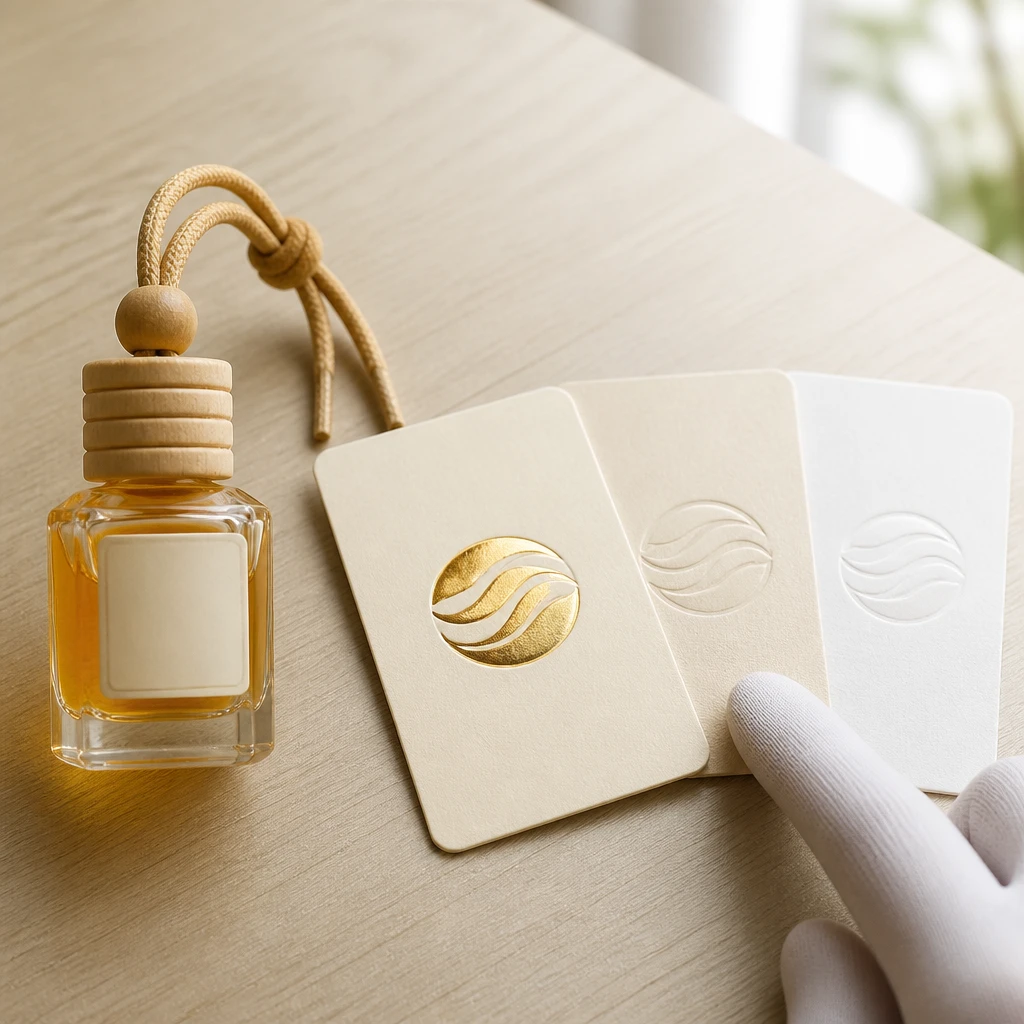
The hanging car air freshener is compact in size, and there are usually three options for the logo position:the freshener body, the outer packaging box, and the accompanying card or hang tag.。 The three serve different purposes—the logo on the body accompanies the product throughout its use, offering the longest exposure time, but is limited by size, making it suitable for simple, highly recognizable graphics;The logo on the packaging box is responsible for the 'first impression upon unboxing' and can carry more complete corporate information;The card or hang tag is suitable for detailed descriptions without affecting the product's own design. When the budget is limited, it is recommended to prioritize spending the process budget on the logo on the body.
Comparison of common customization processes: applicable scenarios for screen printing, hot stamping, and UV printing
| Process | Texture performance | Suitable logo types | Points to note |
| Silk screen printing | Matte, flat, solid colors | Simple graphics and text in single or dual colors | Limited performance for gradients and fine patterns, cost-effective, suitable for large batches |
| Hot stamping (gold/silver) | Metallic luster with a textured tactile feel | Line logos, letter abbreviations, minimalist graphics | There are requirements for line thickness; overly thin lines may not be hot-stamped clearly |
| UV printing | High color reproduction, capable of gradients | Complex patterns, colored logos | Relatively higher cost; need to confirm whether the product surface material is suitable for adhesion |
When selecting a process, attention should be paid toThe ratio of logo line thickness to product size。 The hanging diffuser body is not large; if the logo has too many details, silk-screen printing or hot stamping may become blurry after scaling down. It is recommended to first print the logo at actual size and attach it to the product for visual inspection before deciding whether to simplify the design.
Additionally, different processes have varying adhesion to product materials (such as ABS, metal, leather texture), and the curvature or texture of the diffuser surface can also affect the final result. Specific process compatibility needs to be confirmed with the supplier: Provide the logo's single-color or multi-color information, the thinnest line dimension, and the desired matte or metallic finish to receive matching process recommendations and sampling plans.
What scenarios are suitable for giving custom-logo car diffusers?What scenarios are not recommended?
Whether a custom logo car diffuser is suitable mainly depends on the clarity of the recipient, budget, and scent expectations. Clear recommendations are given below by scenario.
Suitable scenarios: business gifts, 4S store bundling, daily commuting, and long-distance driving
Business gifts: For long-term partners or corporate clients, the quality of the gift matters more than mere practicality. The hanging car diffuser features a light luxury design, with each set containing three 22.5g scent refills, lasting about 30 days, so recipients do not need frequent maintenance. After customizing the logo, every car ride becomes a brand exposure.
It is suitable for gift company product selection, corporate year-end appreciation, exhibition souvenirs, and similar scenarios.
4S Store Bundling: When 4S stores choose a fragrance as a gift, the core consideration is "no trouble"—no leakage, no deformation due to high temperatures, and no pungent smell. This product uses a leak-proof sealed design and film slow-release technology, releasing fragrance at a steady rate without an abrupt strong scent, making it suitable as a new car delivery gift or after-sales maintenance giveaway. Compared to conventional gifts like keychains, a fragrance can directly improve the smell of a new car's interior, giving customers a stronger impression.
It is recommended to test the product's performance under high-temperature sun exposure in a sample vehicle before deciding on bulk customization.
Daily Commuting and Long-Distance Driving: During commuting, the car interior is small, and the hanging design does not occupy air vents or block the view;during long-distance driving, the 30-day endurance reduces replacement frequency, and the slow-release technology ensures a uniform and long-lasting fragrance, without being strong at first and fading later. For users who spend long periods in the car, such as salespeople and drivers, it is safer than liquid perfume and more hassle-free than solid balm.
Scenarios not recommended: extremely low budget, strict taboos on fragrance, or the need to frequently change fragrance types.
Extremely low budget: Customizing a logo involves costs for mold opening, printing, minimum order quantity, etc. If the per-unit budget is squeezed to just a few yuan, both the quality of the fragrance and the customization effect will be compromised; it is better to choose ordinary printed items.
Strict taboos on fragrance: If you are unsure whether the recipient is allergic to fragrance or dislikes artificial scents (e.g., in hospitals, kindergartens, or for sensitive individuals), giving a car fragrance poses a risk; it is recommended to give unscented car accessories instead.
Need to frequently change fragrance types: This product is of the slow-release type, with a single fragrance core lasting about 30 days, and it cannot switch scents at will like liquid perfume. If the customer hopes to "change the scent every week," this product is not suitable;If the pursuit is "set it and forget it," it is actually an advantage.
Next step: confirm actions: Confirm three things with the supplier—① the minimum order quantity and sampling cycle for custom logos;② the list of existing fragrance types and whether there is an unscented version;③ the actual performance in high-temperature environments (such as exposure in a car during summer). After confirmation, you can determine whether it matches the specific scenario.
How to evaluate a custom supplier?Key checkpoints from sampling to delivery
The procurement risk of custom car air fresheners often lies not in the product itself, but in the information gap between sampling and mass production. Many buyers think the sample looks good, but after batch delivery, they find logo misalignment, inconsistent fragrance concentration, and excessive packaging damage rates. The following breaks down key checkpoints in two stages to help you front-load the risks.
Sample confirmation: final confirmation of logo effect, fragrance, and packaging
Sampling is not just 'seeing how it looks', but a rehearsal for mass production. Focus on confirming three things:
Logo effect: Confirm the adhesion of the logo printing process (silk screen, hot stamping, UV printing, etc.) on the aroma diffuser shell. Hanging car diffusers are exposed to high temperatures inside the vehicle for long periods, and poor-quality printing can easily peel off or fade. Require the supplier to provide heat resistance test results or actual performance of samples under high-temperature conditions, rather than only looking at the visual effect of new samples.
Fragrance type: Confirm whether the fragrance type is consistent between the sampling stage and the mass production stage. The same fragrance type may have odor deviations due to differences in raw material batches across different production runs. It is recommended to require the supplier to clarify the fragrance source and batch management methods. Also confirm the fragrance concentration—whether the odor intensity when the sample is first opened and the concentration after one week of use are within an acceptable range, as this directly affects the customer's first impression of the product.
Packaging: Confirm the dimensional tolerances and materials of the custom packaging. If the packaging box needs to accommodate the logo card, the product itself, and the instruction manual, be sure to conduct an assembly test using samples of the actual production dimensions to avoid the awkward situation where "the sample fits, but the batch doesn't."
Batch Delivery: Minimum Order Quantity, Lead Time, and Quality Control Process
After the sample is approved, three key points need to be clarified during the batch delivery stage:
Minimum Order Quantity: Confirm whether the supplier's minimum order quantity is "per style per color" or "multiple styles and colors can be combined in one order." If your purchase volume is not large but you need multiple fragrance types, the ability to combine orders directly affects your inventory pressure and unit cost. At the same time, confirm the tiered pricing beyond the minimum order quantity—whether the marginal cost of incremental purchases decreases, as this affects the budget planning for subsequent replenishments.
Lead time: Clarify whether the lead time is calculated from "sample confirmation" or from "receipt of deposit", and whether it includes logistics time. The customization peak season for car air fresheners usually coincides with holidays and auto show cycles. It is recommended to specify liability for delayed delivery in the contract and reserve at least one week of buffer time.
Quality control: Require the supplier to provide a sampling inspection plan after mass production—sampling ratio, inspection items (Logo position tolerance, fragrance sealing, appearance scratches, etc.), and handling of non-conforming products. Pay special attention to sealing inspection: if the car air freshener is not well sealed under high temperatures, leakage can directly damage the car interior, which is the most serious quality accident. It is recommended to require the supplier to provide the acceptance criteria for leakage testing, and arrange third-party sampling inspection or resident factory inspection during the first mass production.
Frequently Asked Questions
Q: The logo effect was good during sampling, but color deviation occurred after mass production. What should I do? A: Color deviation usually stems from batch fluctuations in the printing process. It is recommended to request the supplier to provide Pantone color numbers or color difference value ranges (e.g., ΔE≤2) during sample confirmation, and include color difference acceptance standards in the batch contract.
If the supplier cannot provide quantitative standards, it is recommended to request them to provide retained samples from different batches for comparison, using actual samples as the acceptance basis.
Q: The minimum order quantity is 500 sets, but I only need 200 sets for the first batch. Can we negotiate? A: You can try to negotiate with the supplier for a plan of 'lowering the minimum order quantity for the first batch with a unit price increase', or confirm whether there is a policy for combining multiple products to reach the minimum order quantity. However, note that lowering the minimum order quantity usually means a higher unit price, so you need to calculate whether the total cost is still within budget.
If there is a stable replenishment plan in the future, this can be used as a bargaining chip.
Q: How can you confirm the fragrance stability of a supplier? A: The most direct way is to ask the supplier to provide retained samples of the same fragrance from different batches for comparison, and to inquire about the supplier of their fragrance raw materials and their batch management methods. If conditions permit, you can request that "the fragrance of the bulk production must be consistent with the sample fragrance" be written into the contract terms, and agree on a handling plan for inconsistencies (such as return or re-production).
Q: Will car diffusers leak after being exposed to high temperatures in the summer? A: This is the most important safety issue to pay attention to in custom procurement. It is recommended to require the supplier to provide sealing performance test data under high-temperature conditions (such as leak test results after continuous placement in a 60°C-80°C environment) during the sampling stage.
If the supplier cannot provide test data, you can ask for product structure descriptions (such as sealing ring material and sealing method), and conduct high-temperature tests with actual samples before deciding whether to place a bulk order.
Q: If delivery is delayed and the supplier says it is due to 'raw material shortage', how can this be avoided in advance? A: Clearly state in the contract that 'raw material shortage' is not a force majeure event, and require the supplier to provide a raw material purchase confirmation within X working days after receiving the order. At the same time, it is recommended to set a constraint in the delivery terms that 'for each day of delayed delivery, compensation of X% of the contract amount shall be paid'.
For key materials (such as custom shells and fragrances), suppliers can be required to prepare materials in advance and confirm the material preparation status when placing the order.
Learn More
If you are looking for suitable hanging car air fresheners for fleet, gift projects, or 4S store matching, please submit your customization requirements (logo process, fragrance preference, purchase quantity), and our team will provide matching solutions and sampling suggestions based on your specific scenario.
Related Products:Hanging Car Air Freshener