
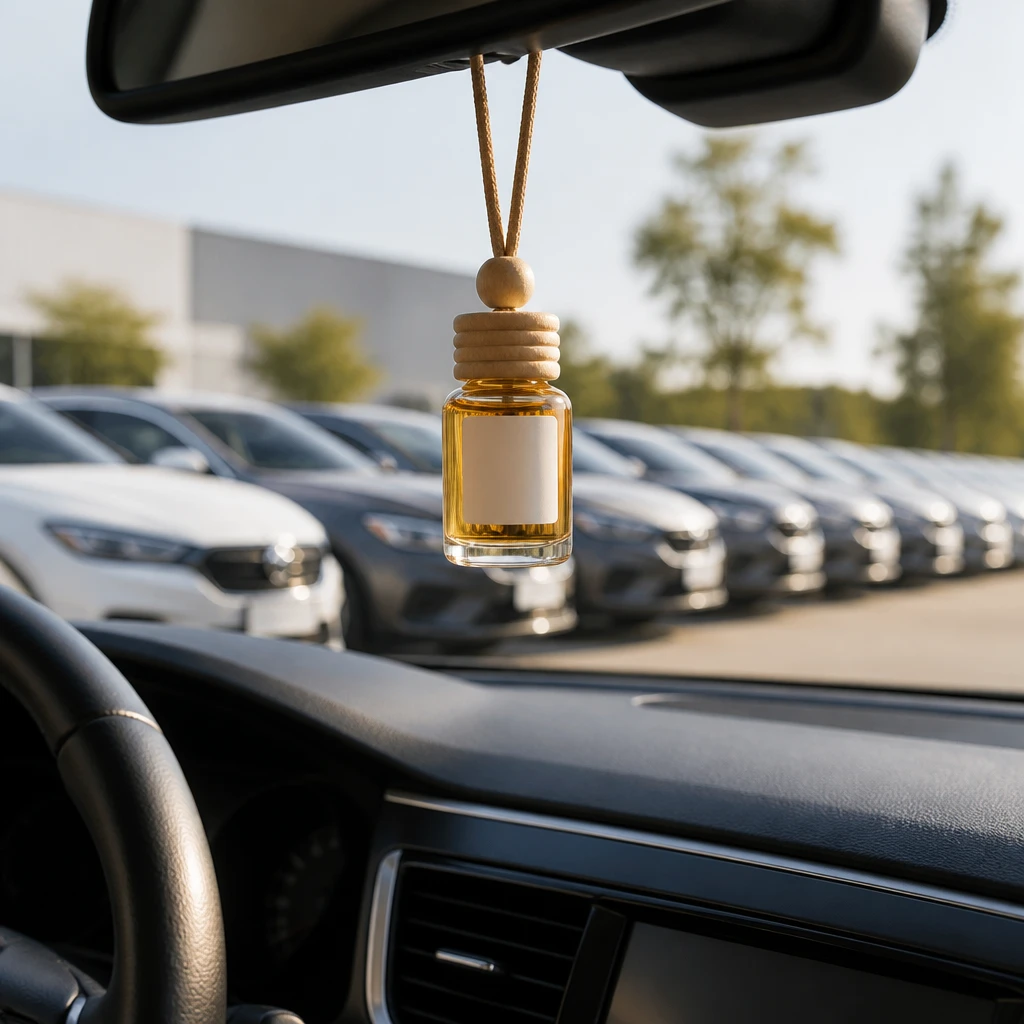
Why is a hanging car diffuser suitable for unified procurement by corporate fleets?
The core challenge in fleet fragrance procurement is maintaining consistent scent performance across multiple vehicles. Liquid perfumes are highly affected by temperature, evaporating quickly in summer and having almost no scent in winter;aerosol sprays require manual operation, making it difficult to unify the refill rhythm. Hanging car diffusers, through membrane slow-release and leak-proof sealing designs, minimize variables in fragrance management, making them suitable as a unified procurement solution for fleets.
How do hanging car diffusers address the core pain points of fleet fragrance management?
Fleet fragrance management mainly has three pain points: uncontrollable release, high maintenance costs, and inconsistent scents.
- Uncontrollable release: Liquid aromatherapy is greatly affected by temperature and shaking, and the fragrance intensity fluctuates.Hanging aromatherapy uses a thin-film sustained-release technology, where the fragrance diffuses through a semipermeable membrane at a nearly constant rate, requiring no manual operation and not fluctuating drastically with air conditioning on/off.
- High maintenance cost: Liquid aromatherapy has a risk of leakage; once it stains the interior, the cleaning cost is far higher than the aromatherapy itself.The hanging design, combined with a leak-proof sealed structure, requires no additional maintenance from the driver after installation; just replace it periodically.
- Inconsistent scent: Drivers purchase different brands of aromatherapy on their own, resulting in inconsistent scents inside vehicles.By uniformly purchasing the same hanging aromatherapy, the scent in every vehicle can be consistent, helping to establish a unified brand image.
How can thin-film sustained-release technology better ensure the consistency of fragrance quality?
The core of thin-film sustained-release technology lies in controlling the release rate of the fragrance, rather than simply increasing the amount of fragrance used. Fragrance molecules can only diffuse into the air through the semi-permeable membrane at a specific rate, resulting in two direct effects:
- Uniform release: The fragrance will not undergo a cliff-like change of "being pungent when first hung, and odorless after a week."Throughout the entire usage cycle, the concentration inside the car remains at a relatively stable level, which is a "noticeable but not intrusive" level.
- Better temperature tolerance: Compared to the dependence of liquid evaporation on temperature, the release rate of thin-film sustained-release is less affected by temperature fluctuations.Under intense summer sun and low winter temperatures, the difference in fragrance concentration is not as pronounced as with liquid air fresheners, which is especially important for fleets operating across regions.
Furthermore, the leak-proof sealed design reduces the risk of liquid leakage, minimizing potential contamination of vehicle interiors and reducing additional management costs associated with cleaning.
When uniformly equipping a fleet with car air fresheners, what selection criteria should be prioritized?
The key difference between fleet procurement and single-unit purchase is that you are making one decision for dozens or even hundreds of vehicles. Once a wrong choice is made, the costs of replacement, driver complaints, and brand image damage are all amplified. Selection criteria should not only focus on "which smells good," but rather on "which can perform stably without issues."
How to evaluate fragrance longevity and replacement cycles?
In fleet scenarios, the replacement cycle of air fresheners directly corresponds to labor costs. If the entire fleet needs to be replaced every two weeks, it means arranging dedicated personnel and time to handle it, and this hidden cost often exceeds the cost of the air fresheners themselves.
When evaluating the lasting power of a fragrance, focus on two key parameters:
- Duration per unit: Taking the soceli hanging car air freshener as an example, each unit contains 22.5g of content and uses membrane slow-release technology, lasting about 30 days.This cycle means that replacement is needed only once a month, allowing fleet managers to set a fixed date for uniform replacement, ensuring a clear management rhythm.
- Uniform release rate: What truly affects the experience is not "how long it lasts" but "whether it remains consistently fragrant."The membrane slow-release technology ensures a uniform and continuous release, avoiding the situation where the first week is overpoweringly strong and the last week has no scent at all.Uniform release means that the fragrance concentration inside all vehicles is basically consistent at any point in time, preventing drivers from removing the freshener due to an overly strong scent.
Judgment recommendation: If the supplier can only say "it lasts quite a while" without giving a specific number of days, or cannot clearly explain whether the release method is volatile liquid or a slow-release film, it is recommended to request supplementary test data. Fleet procurement has no room for "trial and error".
How to balance ease of installation and driving sight safety?
Fleet vehicles are in high-frequency use, with summer scorching heat, winter low temperatures, and bumpy roads as the norm. Two issues must be prioritized:
Leak-proof performance. Liquid air fresheners have a risk of expansion and leakage under high-temperature sun exposure. Once leakage seeps into the air conditioning vents or interior gaps, the cleaning cost is extremely high, and it may even damage the vehicle's electronic components. When selecting, prioritize solid or film slow-release products, as these structures naturally have no leakage issues.
If the supplier claims leak-proof, confirm whether it is "structurally leak-proof" or "sealed treatment"; the former is more reliable.
Installation position and line-of-sight obstruction. If a hanging air freshener is hung below the rearview mirror, it will directly enter the driver's field of vision;If hung at the air vent, it may block the air conditioning adjustment buttons. When selecting, pay attention to whether the product size and installation method support flexible position adjustment, and confirm whether the lanyard or clip is secure—falling off during high-speed driving is itself a safety hazard.
If the hanging design is installed in an appropriate position, it usually does not block the view, but a real vehicle test should still be conducted before procurement to confirm.
Conclusion boundary: If the fleet size is clear, management rhythm is well-defined, and a unified brand image is needed, the hanging film-type slow-release air freshener is a highly matching solution—the core advantage is not the fragrance itself, but the predictable management rhythm of "replacing once every 30 days." If the fleet size is fewer than 10 vehicles, or you just want to test driver acceptance, it is recommended to install a small batch first, rather than rolling it out across the entire fleet at once.
Which fleet scenarios are suitable for using hanging car air fresheners?In which situations is it not recommended?
Analysis of adaptability in daily commuting and long-distance driving scenarios
The core value of hanging car air fresheners lies in being "continuous, stable, and unobtrusive." For fleets primarily used for daily commuting—such as employee shuttles, sales field vehicles, and urban delivery vehicles—it is the most worry-free choice. These vehicles typically have a single-use duration of 30 minutes to 2 hours, and the occupants' need for fragrance is "present but not overpowering."
The membrane slow-release technology of hanging air fresheners matches this rhythm perfectly: by the time passengers get in, the fragrance has already diffused evenly, requiring no manual operation by the driver, and it does not cause an instant strong scent in enclosed spaces like spray products do.
Long-distance driving scenarios require distinguishing between two situations. For freight or passenger fleets with one-way trips exceeding 4 hours, the 30-day lifespan of a hanging air freshener means no need to replace consumables for the entire month, which is a clear maintenance cost advantage for fleet managers. However, it should be noted that drivers' sensitivity to scent decreases over time during long-distance driving. If the goal is to 'refresh and invigorate,' the steady-release characteristic of hanging air fresheners is not suitable—they cannot enhance concentration on demand.
In this case, a more reasonable positioning is 'keeping the cabin air fresh,' rather than functional fatigue intervention.
In which fleet scenarios are hanging air fresheners not the optimal choice?
In the following three situations, it is recommended not to rush into purchasing hanging air fresheners:
1. Fleets with extremely low usage frequency or long-term idle vehicles. If vehicles are only used once or twice a week, the scent of hanging air fresheners will continue to evaporate during idle periods, significantly shortening the actual effective usage cycle. In this case, the cost per use is actually higher than that of spray or solid balm products.
2. Fleets with clear time-based fragrance intensity requirements. For example, shuttle buses during peak hours in the morning and evening may want a light scent in the morning and an invigorating one in the evening, or ride-hailing drivers may want to quickly increase fragrance before accepting a ride. Hanging air fresheners cannot adjust the release rate, so they cannot meet such dynamic needs.
3. Scenarios where the vehicle interior is exposed to high temperatures and prolonged sunlight. Although this product features a leak-proof sealed design, prolonged exposure to sunlight in summer will accelerate the evaporation rate of any air freshener. If most of your fleet vehicles are parked outdoors without shade, you need to confirm with the soceli team the actual endurance performance of this product under sustained high temperatures before deciding whether to deploy it in bulk.
Characteristics of fleets that should prioritize hanging air fresheners: Vehicles have stable daily attendance and usage duration, drivers have no personalized fragrance change needs, and the purchaser wants to unify the brand image (customizable Logo). If your fleet meets all three points above, hanging air fresheners are the most cost-effective unified configuration solution;If one point is clearly not met, it is recommended to first communicate the specific usage conditions with the soceli team, and then decide whether to adjust the procurement direction.
Fleet procurement implementation: How to set a budget, test samples, and confirm supplier capabilities?
The biggest difference between fleet procurement and single purchases is that you are not buying a single air freshener, but a sustainable executable solution. Budget, samples, and supplier capabilities determine whether the solution can be consistent across dozens or even hundreds of vehicles.
Key points of budget allocation and cost control
Don't just focus on the unit price of a single item; it's more practical to calculate based on the 'landed cost'. It is recommended to divide the budget into four parts:
- The product itself: Negotiate tiered pricing based on fleet size, and confirm whether it includes tax and shipping.Taking this hanging car air freshener as an example, each set contains 3 refills of 22.5g, lasting about 30 days. When calculating, use the "cost per vehicle per month" rather than the "price per set".
- Customization fees: Brand logo customization usually involves plate-making fees or minimum order quantity thresholds.If the fleet needs to print corporate logos, this cost should be confirmed separately and not be "hidden" in the quote.
- Packaging and logistics: If it is a 4S store delivery gift or business gift, the logistics cost of packaging boxes, handbags, and split shipments to multiple stores is often higher than imagined.
- Spare and Loss: It is recommended to reserve 5%-8% of spare quantity to replace damaged, leaking, or products that customers are dissatisfied with, to avoid being passive due to insufficient minimum order quantity when replenishing.
The core trade-off in cost control is:If the fleet is large and the fragrance type is unified, prioritize negotiating a package price for product unit price and customization fees;If the fleet is scattered and vehicle models vary greatly, it is better to spend a bit more on logistics to ensure every driver receives products of the same batch and same fragrance type—mixing batches will lead to inconsistent in-car scents, which actually lowers the overall experience.
Sample Testing and Supplier Capability Confirmation Checklist
Do not skip sample testing and place a large order directly. Sample testing is not about smelling it to see if it smells good, but about verifying three things: whether the product is stable in real vehicle usage conditions, whether the customization effect meets the standards, and whether the supplier's response speed matches your procurement pace.
Sample testing is recommended to cover the following scenarios:
- High-temperature exposure test: In summer, the temperature inside the car can reach above 60°C. Focus on observing whether the fragrance leaks, whether the shell deforms, and whether the scent changes abruptly.This model adopts a leak-proof sealing design and film slow-release technology. In theory, it should be more stable under high temperatures, but different batches still need actual testing.
- Continuous fragrance retention record: Record the changes in fragrance concentration on the 1st, 7th, 20th, and 30th days in a fixed vehicle to confirm whether it releases continuously at a uniform rate as claimed, rather than being strong in the first two weeks and odorless in the last two weeks.
- Installation Compatibility: The hook-style design may seem universal, but different vehicle models have variations in air vent shapes and sun visor thickness.Test installation on 3-5 different vehicle models (sedans, SUVs, MPVs) to see if it is secure and whether it obstructs the view.
- Custom Sample Confirmation: If you are doing logo customization, ask the supplier to produce 1-2 samples first to confirm the printing process, color accuracy, and adhesion durability, to avoid issues in mass production.
Supplier Capability Confirmation, focus on four points:
- Customization Response Speed: How many days does it take from raising the requirement to receiving the sample?This directly reflects the supplier's level of cooperation.If sampling takes more than two weeks, the risk of delivery issues in subsequent bulk orders is high.
- Batch consistency: Ask the supplier to explain how they control production across different batches of the same fragrance.The biggest fear in fleet procurement is that the first and second batches have noticeably different scents.
- After-sales handling mechanism: What is the supplier's return and exchange policy if there is leakage, damage, or scent mismatch?Do they send replacements proportionally or require a full batch return?This affects your inventory risk.
- Production capacity and delivery time: Confirm the minimum order quantity, normal delivery time, and peak season delivery time.If the fleet has clear time milestones (such as new vehicle delivery season), delivery time is more important than unit price.
Suitable/unsuitable judgment:
- Suitable for direct advancement: The fleet size is clear, the fragrance is unified, there are fixed delivery time milestones, and the sample test has passed—at this point, you can negotiate a package deal based on the above budget framework.
- Need further confirmation: If the fleet has a wide range of vehicle types (e.g., both trucks and cars), drivers' sensitivity to fragrance varies greatly, or customization requirements are complex (e.g., multi-color logos, special packaging) — in these cases, it is recommended to first conduct a small batch trial installation on 20-30 vehicles, collect feedback, and then scale up.
- : Not suitable for procurement at this time: If the target fragrance type, budget ceiling, and delivery time have not yet been determined, do not discuss suppliers first; otherwise, it is easy to be led by the sales rhythm and end up buying a pile of unusable inventory.
Frequently Asked Questions
Q: How large does a fleet need to be to justify customization? A: Customization usually has a minimum order quantity threshold; the specific quantity needs to be confirmed with the supplier. If the fleet is within a few dozen vehicles, it is recommended to first evaluate the cost increase per vehicle after allocating the customization fees, and then decide whether to directly purchase standard models or opt for logo customization.
Small fleets can first use standard models, and then add customization later as the fleet expands.
Q: Is the 30-day battery life for each fragrance core or the entire product set? A: This single set contains 3 fragrance cores of 22.5g each. The 30-day endurance refers to the continuous release time of a single fragrance core under normal use. For fleet procurement, it is recommended to calculate restocking frequency based on '1 core per vehicle per month'. Actual usage duration may be affected by in-car temperature and ventilation habits.
Q: Will installation effects vary across different vehicle models? A: There will be differences. The hanging design mainly fits sun visors and air vents, but sedans, SUVs, and MPVs have different interior spaces and installation positions.
It is recommended to test one unit of each main vehicle model during the sample testing phase to confirm installation firmness and fragrance diffusion effect before finalizing the purchase quantity.
Q: What if some drivers report that the fragrance is too strong or too weak? A: This is a common question in fleet procurement. The characteristic of thin-film slow-release technology is that the fragrance release is relatively uniform, but individual differences in olfactory sensitivity are unavoidable.
It is recommended to reserve a small quantity of backup fragrance types (such as light and strong variants) during procurement, and make small-scale adjustments based on driver feedback, rather than standardizing all to one fragrance type.
Learn More
If your fleet is evaluating a unified fragrance solution, you are welcome to provide information such as fleet size, main vehicle models, and fragrance preferences. We can assist in matching suitable hanging air freshener configurations and customization solutions.
Related Products:Hanging Car Air Freshener