
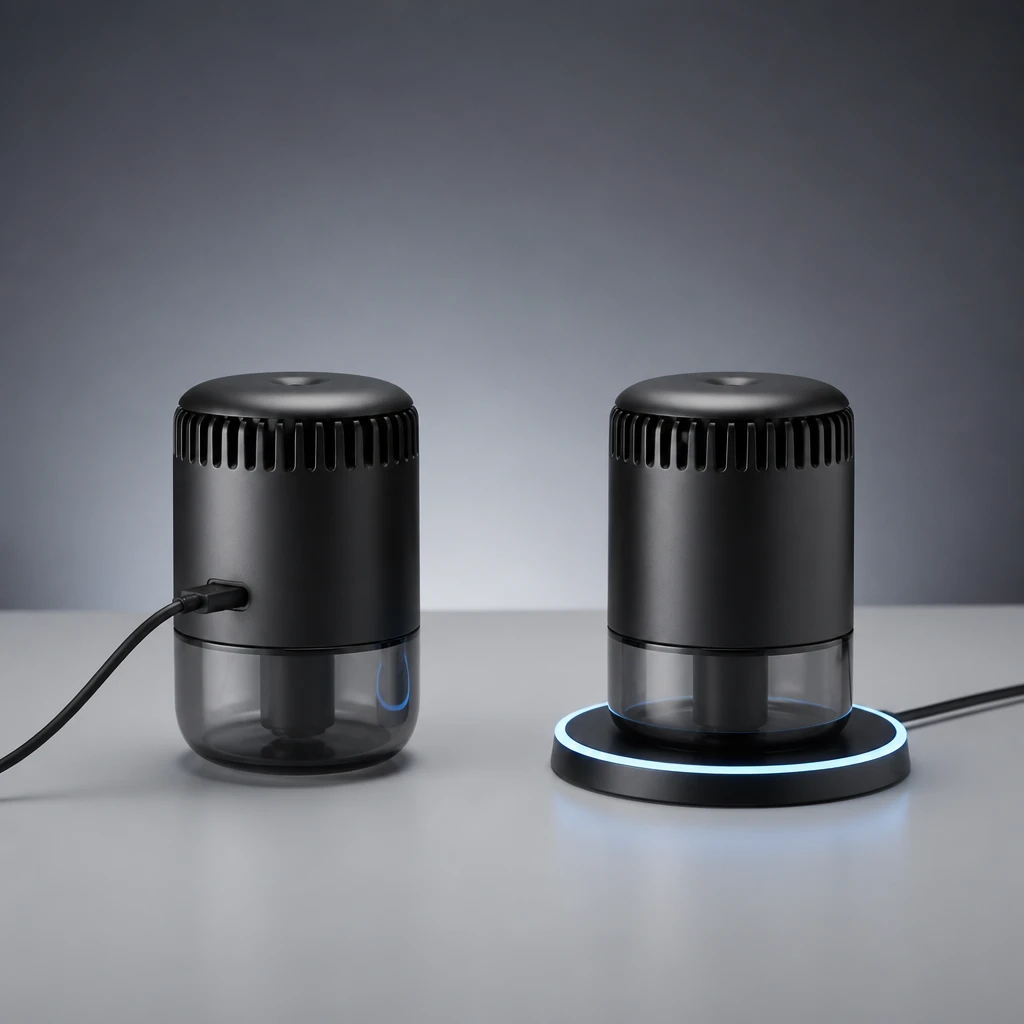
What are the charging methods for car diffusers?What is the core difference between wired and wireless charging?
The charging methods for car diffusers essentially boil down to two routes: one is wired charging with a physical connection (Type-C interface), and the other is wireless charging via electromagnetic induction. Both solve the issue of 'replenishing power for the device,' but the method, efficiency, and applicable scenarios are completely different.
Working Principles of Wired and Wireless Charging
Wired charging is easy to understand: it uses a Type-C cable to directly channel power from the vehicle's power source (cigarette lighter/USB port) into the diffuser's battery. The current travels through a solid physical path, with minimal energy loss and a short transmission distance. Take the SOCELI smart car diffuser (model A125) as an example: it features a built-in Type-C interface, supports the PD 3.0 fast charging protocol, with specifications of 5V/3A, and comes with a retractable charging cable design. When not in use, the cable is stored inside the unit, so there's no long cable trailing around the car.
Wireless charging is based on the principle of electromagnetic induction: when the charging base (transmitting coil) is powered on, it generates an alternating magnetic field, and the receiving coil inside the aroma diffuser senses the magnetic field and converts it into electric current. The entire process has no physical contact points; the device charges as soon as it is placed on the base, without any plugging or unplugging action.
From the perspectives of charging efficiency, stability, and cost, the essential differences between the two are as follows.
Charging efficiency: Wired charging is clearly superior. Wired charging involves direct electrical transmission, with energy conversion efficiency typically above 90%.Wireless charging, on the other hand, requires two conversions (electricity to magnetism to electricity), so its efficiency is generally between 70% and 80%, with the extra energy dissipated as heat. For small-capacity battery devices like car aroma diffusers, the difference in single charging time may only be a few tens of minutes, but if you need to recharge daily during commutes, the accumulated efficiency gap over time is substantial.
Stability: Wired charging is more reliable. Wireless charging is sensitive to placement—if the coils are not aligned, the charging speed will drop sharply or even stop. During driving, if the diffuser is placed in the cup holder or on the center console, vehicle vibrations may cause position shifts, affecting charging continuity.
With wired charging, as long as the cable is plugged in, there is no alignment issue. SOCELI's retractable cable design has a practical advantage here: the cable is fixedly connected and won't detach due to vibration, while the retractable structure prevents the cable from tangling inside the car.
Cost and maintenance: wired has a lower entry barrier. The Type-C interface is the universal standard for current electronic devices, with widespread accessories and low replacement costs. Wireless charging requires an additional charging base, which increases hardware costs, and if the base is damaged, replacement compatibility needs to be verified.
From a B2B procurement perspective, the wired solution offers more controllable per-unit costs in bulk purchases and simpler after-sales maintenance—if a Type-C cable breaks, just replace it; if a wireless base fails, the entire charging system may need troubleshooting.
A practical direct answer: If you value the convenience of "set and charge," wireless charging wins;if you care about charging speed, stability, and long-term maintenance costs, Type-C wired charging is more practical. For the car diffuser category, the device itself has low power consumption and a small battery capacity, so the "convenience premium" of wireless charging is not obvious—you don't need to remove the device frequently every day; one plug-in can last a long time. The SOCELI A125 adopts the Type-C + PD 3.0 fast charging solution, essentially using lower cost in exchange for faster recharging speed and less maintenance hassle.
Next steps to confirm: If you are evaluating a procurement plan, you need to confirm two matching points with the SOCELI team: first, whether the Type-C interface of this model supports the output protocol of your existing car charger (PD 3.0 is backward compatible with QC 2.0/3.0, but old 5V/1A car chargers cannot achieve fast charging);second, whether the length of the retractable cable covers the actual distance from your car's cigarette lighter/USB port to the diffuser installation location. These two points directly determine whether you can adapt the sample immediately after receiving it, rather than discovering problems only when installing it on the vehicle.
Why are PD 3.0 fast charging and Type-C interface the better solution for car diffusers?
For purchasers and distributors, the charging solution of a car diffuser is not just a checkbox on a spec sheet, but a decision point that directly affects customers' daily usage experience and after-sales feedback. The SOCELI smart car diffuser (model A125) chooses PD 3.0 fast charging and Type-C interface, which corresponds to the pain points of three real usage scenarios.
The actual value of PD 3.0 fast charging for car diffusers
First, let's be clear: a car diffuser is not a phone; it doesn't need to be charged all the time. But precisely because of this, charging efficiency is even more critical—users only think about charging when the diffuser runs out of battery, and at that moment, the waiting time directly determines whether they will give up using it.
What does the 5V/3A output (15W) under the PD 3.0 protocol mean? Based on the typical built-in battery capacity of a car diffuser, the time from low battery to full charge can be compressed to about one-third of that of traditional 5V/1A charging. In other words, if a user finds the diffuser out of battery when leaving home in the morning, plugging in the charging cable can basically restore sufficient battery life before reaching the destination.
This difference in experience is the watershed for retail customers between 'willing to continue using' and 'too troublesome, left to gather dust'.
For B-end customers, PD 3.0 also has a hidden value: it means the product solution uses a more modern power management chip, which usually has better overcurrent and overvoltage protection than older solutions, reducing the failure rate caused by voltage fluctuations in the car—this has practical significance for after-sales cost control.
What are the advantages of the Type-C interface over traditional interfaces?
The core advantage of Type-C is not 'newness', butbidirectional pluggabilityandVersatility。
The in-car usage scenario differs from that at a desk: users often operate the device from the driver's seat, leaning sideways, with insufficient light and cramped space. Traditional Micro-USB connectors require users to identify the correct orientation; forcing them in the wrong way can damage the port—this is one of the common causes of returns for car electronics. The reversible design of Type-C eliminates this problem entirely.
Another easily overlooked point iscable compatibility。 Nowadays, the vast majority of new phone charging cables are already Type-C, so users are likely to have one in their car. This means that even if the original cable is lost or damaged, users can charge with any Type-C cable they have on hand, without needing a dedicated cable for the diffuser.
For dealers, this means that after-sales scenarios where 'accessories are lost, leaving the product idle' will be significantly reduced.
How the Retractable Cable Design Solves In-Car Storage Problems
This is the most noteworthy structural design in the charging solution of the SOCELI A125. The retractable cable solves not the question of 'whether it can charge,' but rather 'where the cable goes.'
The car interior is a high-clutter space: the center console, cup holders, and armrest box are all piled with cables. Fixed-length charging cables can only be coiled up for storage when not in use, and over time they either get tangled or damaged by pulling. The retractable design allows the cable to be compactly stowed when not in use, taking up no extra space and not contributing to the 'visual chaos' of in-car cables.
For the purchaser, this design also has a practical benefit:It reduces the product's restrictions on installation location.。 Aromatherapy diffusers with fixed long cables can only be placed near the power outlet, while retractable cables allow users to place the diffuser in locations more conducive to scent diffusion, such as air vents, center consoles, or even cup holders. When charging is needed, simply pull out the cable. This directly increases placement flexibility and indirectly improves scent diffusion effectiveness.
Who is suitable for this solution, and who needs further confirmation
Scenarios suitable for choosing the wired PD fast charging solution:
- Customers have a clear perceived need for 'charging speed' and hope to quickly recharge even during short commutes.
- Procurement parties focus on long-term after-sales costs and hope to reduce returns and exchanges caused by interface damage or cable loss.
- The product needs to be compatible with various vehicle models, and the universality of Type-C reduces compatibility risks.
Situations that require further confirmation with the SOCELI team:
- If your target market has a large number of older vehicles where the cigarette lighter port is still mainstream, you need to confirm whether the product comes with a cigarette lighter to Type-C adapter, and whether that adapter supports the PD protocol.
- If the customer has a hard requirement for "wireless charging" (for example, the vehicle has already been modified for wireless charging), you need to evaluate whether the wired solution conflicts with the customer's scenario.
Next steps: Request the complete charging test data for the A125 from the SOCELI team (including the actual charging time curve and cable retraction life test), and confirm whether the Type-C connector pinout is compatible with mainstream PD chargers—these two pieces of information will help you determine whether this solution matches your target customer group.
Who is the wireless charging car diffuser suitable for?In which scenarios is it not recommended?
The core value of a wireless charging car diffuser is to eliminate the act of "charging" from the user's daily checklist as much as possible. To determine whether it suits you, it's not about whether wireless charging itself is advanced, but whether your usage scenario can truly benefit enough from "one less plug-in."
Advantages and applicable scenarios of wireless charging
The most practical benefit of wireless charging ischarge when placed, use when picked up. For the following three scenarios, this feature is a real plus:
- High-frequency short-distance commuting: For daily commutes, picking up kids, when you park in the garage, you simply place the diffuser back on the charging spot, and it's fully charged the next morning.This 'charge while parked' rhythm is much more convenient than finding, plugging in, and managing cables.
- Multi-user or fleet vehicle scenarios: Ride-hailing cars, corporate fleets, and family-shared vehicles have different drivers with different habits when it comes to using air fresheners.Wireless charging means whoever puts it back completes the charging, without relying on one person to remember to bring and plug in a cable.
- Users who pursue a clean interior look: With one less visible cable on the center console, the visual appearance is cleaner.If your procurement clients are brands that emphasize interior texture or high-end car users, this point will directly affect their first impression of the product.
Limitations and unsuitable scenarios of wireless charging
Wireless charging is not without its costs. Its limitations are concentrated in three points:The charging position is fixed, charging efficiency is lower than wired, and the cost is higher.Correspondingly, the following situations are not recommended:
- The vehicle's charging position is not ideal: Wireless charging requires the diffuser to be stably placed on the charging pad when parked.If your target vehicle's center console lacks a suitable flat surface, or the cup holder or storage compartment is irregularly shaped, the diffuser won't stay stable, causing intermittent charging, which is more troublesome than wired charging.
- Seeking fast recharging: The power of wireless charging is usually lower than wired fast charging.The SOCELI smart car diffuser (model A125) supports PD 3.0 fast charging, with a Type-C interface specification of 5V/3A, and the wired solution can replenish the battery faster.If your usage scenario involves long continuous use of the vehicle with very short charging windows, wired fast charging is more reliable.
- Cost-sensitive bulk procurement: Wireless charging modules increase the per-unit cost.For customers who purchase in bulk and have strict budget limits on per-unit price, the wired solution offers lower procurement costs and simpler maintenance while delivering the same diffusion performance and essential oil quality.
How to determine which one you should choose
A simple criterion:If the action of "placing it back on the charging dock after parking" occurs naturally in your usage scenario, wireless charging is worth choosing;If the parking location is not fixed, the charging dock is difficult to access, or the budget is tight, the wired solution is more practical.
Next, it is recommended that you confirm two specific conditions: first, whether the center console/cup holder area of the target vehicle model has a flat location suitable for placing a wireless charging aromatherapy diffuser;second, the sensitivity of your procurement budget to the unit cost. Once these two conditions are clearly confirmed, having the SOCELI team provide a matching solution based on your specific vehicle model and usage volume is more meaningful than directly comparing 'wireless vs. wired'.
How should brands and distributors choose?Selection recommendations for wired fast charging solutions
Choose a charging solution based on product positioning and user needs
When deciding on the charging solution for car aromatherapy diffusers, the core issue for brands is not comparing which is more 'advanced' between wired and wireless, but rather understanding how your target users actually use the car and charge their devices.
Wired fast charging solutions are suitable for the following product positioning:
- High-frequency short-distance commuting scenarios: Users drive 20-40 minutes daily and plug in to top up the charge after parking; the Type-C interface has almost no compatibility cost.
- Products with high requirements for "ready whenever needed": PD 3.0 fast charging (5V/3A) means a short charging session can support multiple days of use, so users don't need to develop a new habit of "placing it on a charging pad."
- Cost-sensitive procurement: The wired solution eliminates the cost of wireless charging coils and bases, offering a clear unit price advantage in bulk purchases and fewer failure points.
Product positioning unsuitable for the wired solution:
- If your brand focuses on a high-end minimalist style of "invisible presence in the car," and users explicitly expect "place it and charge, pick it up and go," wireless charging is the matching choice.
- If the product needs to cover multiple vehicle models and users are unwilling to manage any cables, a wired solution adds an extra usage step, which may affect the conversion rate.
The key trade-off is:The wired solution uses "one plug-in action" in exchange for lower procurement costs, more stable charging efficiency, and fewer after-sales risks. For distributors, this means lower explanation costs and return rates.
Analysis of the Wired Fast Charging Solution for the SOCELI Smart Car Diffuser
The SOCELI Smart Car Diffuser (Model A125) features a retractable charging cable design with a built-in Type-C interface, supporting PD 3.0 fast charging specifications (5V/3A). The core value of this solution for B2B procurement is reflected in three aspects:
1. The retractable cable solves the "cable storage" pain point. The cables of ordinary wired aromatherapy diffusers are exposed inside the car for a long time, which can easily become tangled, accumulate dust, and look messy. The retractable design allows the cable to be tucked into the unit when not charging, keeping the car interior tidy and reducing the risk of cable damage from pulling—this has a direct impact on after-sales maintenance costs.
2. Type-C + PD 3.0 reduces compatibility risks. Currently, mainstream phone chargers and car chargers use Type-C ports, so users do not need to prepare a separate charging cable for the diffuser. The PD 3.0 protocol ensures charging efficiency, avoiding the disappointing experience of "charging all night without a full battery."
3. Customization capabilities and solution stability. SOCELI supports brand logo customization, fragrance selection, and OEM/ODM cooperation. For brand owners, the charging solution is only part of the product; what truly determines the long-term value of cooperation is whether the supply chain can maintain consistent quality and stable delivery cycles under customized requirements.
Selection checklist (for item-by-item verification during procurement decisions):
| Decision question | Performance of wired fast charging solution | Items to confirm with the SOCELI team |
| Is the user's charging habit clear? | Suitable for the common habit of "plug in when parked" | Is it necessary to add a wireless charging version to cover another type of user? |
| Is the procurement budget limited? | Wired solutions are more cost-effective, with clear advantages in bulk procurement. | Unit price tiers for different procurement volumes. |
| Is after-sales maintenance controllable? | Simple structure with fewer failure points. | Lifespan test data for the cable retraction mechanism. |
| Does brand differentiation depend on the charging method? | The charging method itself does not constitute a differentiating selling point. | Customization depth in fragrance, appearance materials, packaging, etc. |
Frequently Asked Questions
Q1: Does the SOCELI smart car diffuser's wired fast charging solution support customization? Yes. The product supports brand logo customization, fragrance selection, and OEM/ODM cooperation.
The charging solution itself (Type-C + PD 3.0 + retractable cable) is the product's basic configuration; customization mainly revolves around appearance, fragrance, and packaging. The specific customization scope and minimum order quantity need to be confirmed with the SOCELI team.
Q2: Compared with wireless charging, what are the actual user experience differences of wired charging? The core differences lie in the "charging action" and "charging efficiency". Wired solutions require users to actively plug in, but they offer fast charging speeds and low costs;Wireless solutions allow charging by simply placing the device, but charging efficiency is usually lower than wired, and product costs and selling prices are higher.
If your target users are the "trouble-averse" type, wireless is more suitable;If they are the "cost-performance priority" type, wired is more suitable.
Q3: Will the retractable cable break after long use? The retractable mechanism is a mechanical structure, and long-term repeated stretching may indeed cause wear. SOCELI adopts a retractable design to solve cable storage issues, but the specific service life depends on the cable material and the craftsmanship quality of the retractable mechanism.
Before bulk procurement, it is recommended to request retractable lifespan test data or sample testing from the SOCELI team.
Q4: Is PD 3.0 fast charging necessary for a car diffuser? It has a practical impact on the user experience. Car diffusers are low-frequency charging devices. PD 3.0 gives users more confidence in quickly topping up the battery during short commutes, avoiding the embarrassment of 'running out of power every time you get in the car.'
If your product is positioned as a 'continuous operation' diffuser, fast charging capability is a feature worth keeping.
Q5: As a distributor, how should I determine the initial order quantity? It is recommended to first request samples to verify the actual user experience and quality, and then decide the initial quantity based on your channel type. If you are targeting corporate clients (fleet, corporate gifts), you can start with a small trial order and increase based on feedback;If you are targeting retail channels, it is recommended to first cover core SKUs, observe sales performance, and then expand fragrance options and customized versions.
Specific minimum order quantities and tiered pricing need to be confirmed with the SOCELI team.
Learn More
If you are evaluating charging solutions for car diffusers, you are welcome to submit your target vehicle model, usage scenario, and procurement volume to the SOCELI team. We will match you with the most suitable wired fast charging or customized solution, and provide sample testing support.
Related Products:Smart Car Diffuser