
Where exactly are the difficulties in small-batch customized car air fresheners?
Why is the traditional OEM model unfriendly to startup brands?
The profit model of traditional OEM factories is built on economies of scale—the costs of changing materials, debugging, and cleaning pipelines are fixed each time a production line is started, so most factories set minimum order quantities at several thousand or even tens of thousands of units. For startup brands, this means that the first product requires tying up tens of thousands of yuan in inventory capital, while market feedback is still unknown. A more realistic issue is that the traditional OEM model usually requires you to finalize all details—formula, bottle shape, label, packaging—before placing an order. Once the product doesn't sell and you want to change the scent or design, the remaining inventory becomes a sunk cost.
What capabilities does a supplier need for small-batch customization?
The core difficulty of small-batch customization is not whether the supplier is 'willing to do it,' but whether the supplier has the ability to redesign the production process for small orders. Specifically, three conditions are required:
First, flexible scheduling capability. Can the factory quickly switch between batches of different fragrances and labels on one production line, rather than having to shut down for half a day for each switch? This determines whether the delivery time and unit price of small-batch orders are controllable.
Second, rapid prototyping and verification. Before placing a formal order, brand owners usually need to confirm whether the fragrance is right, whether the bottle feels good in hand, and whether the label craftsmanship is exquisite. If the prototyping cycle is long and the cost is high, the trial-and-error cost of small-batch customization will be raised.
Third, modularization of formulas and packaging materials. If suppliers can break down essential oil formulas, bottles, caps, and labels into freely combinable modules, brand owners can test a few fragrances in small batches without significantly increasing costs, and then concentrate additional orders based on market feedback.
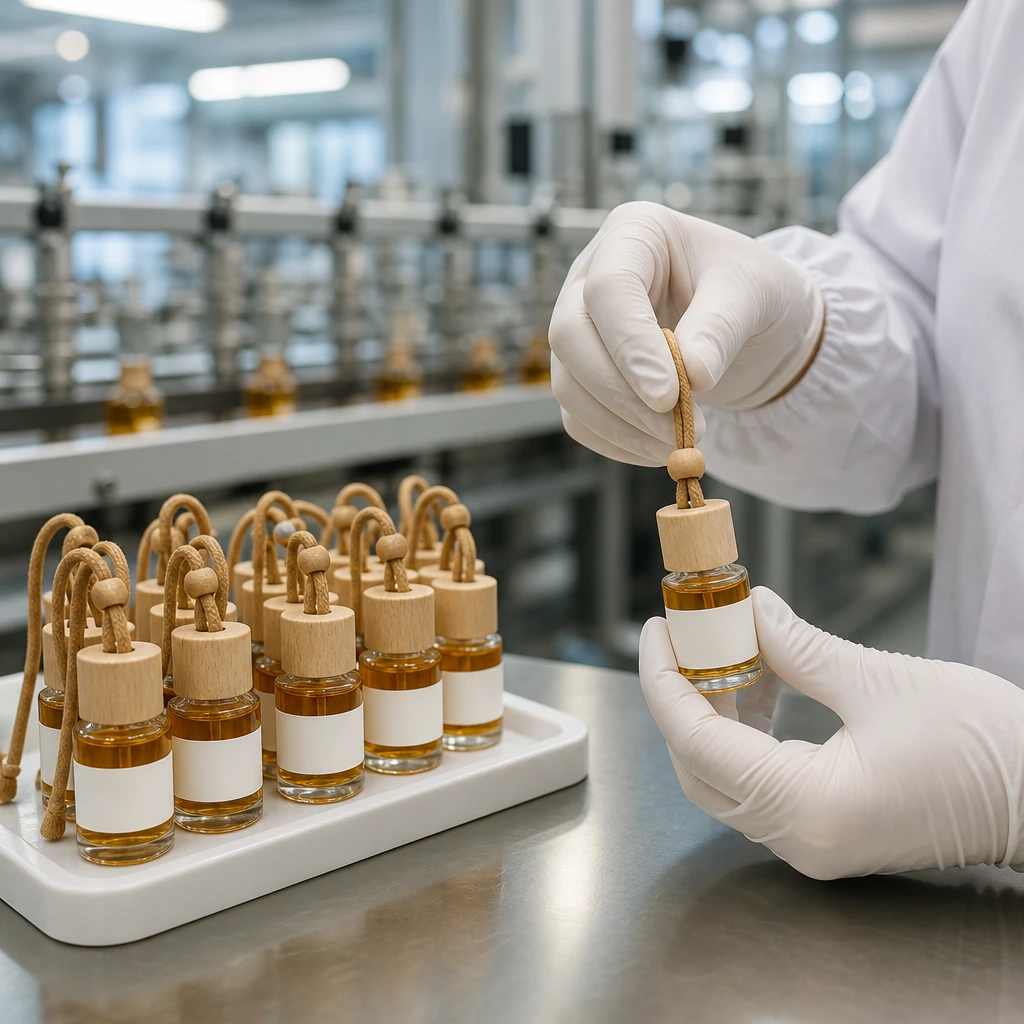
SOCELI's own factory is configured around these three points: integrated management makes production scheduling and switching more flexible, rapid sampling services allow brands to confirm the actual product effect before placing bulk orders, and the combination of glass bottles, natural wooden caps, and label craftsmanship itself offers a high degree of customization freedom. For startup brands, this means you can first use small batches to verify 'whether this fragrance will sell in the market' before deciding to scale up orders—rather than betting on a quantity you can't turn back from from the start.
How does SOCELI's flexible production line support small-batch customization?
For startup brands, the most awkward situation is often: before the product has even proven itself in the market, you have to commit a large amount of capital to the 'minimum order quantity'. SOCELI's flexible production line is designed to solve this problem—it doesn't require you to place large orders from the start, but instead makes 'small batches' and 'rapid iteration' the default options.
How does the in-house factory achieve rapid sampling for small batches?
SOCELI's confidence comes from the integrated management of its own factory. The key word here is 'own'—from essential oil blending, filling, to packaging, all steps are completed within the same system, eliminating the losses from repeated communication and scheduling delays in the outsourcing chain.
At the operational level, small-batch rapid prototyping is achieved as follows:
- Samples first: Before placing a formal order, you can request samples to confirm whether the fragrance, bottle texture, and label craftsmanship meet your expectations.The sample phase is compressed to be as short as possible because the factory does not need to schedule separate production for prototyping; instead, it utilizes gaps in the existing production line.
- Start with small orders: The initial order does not need to meet the traditional OEM factory's minimum of a thousand bottles.The flexible production line allows for starting with smaller batch sizes, enabling brands to test market feedback with real products first, then decide whether to reorder based on data.
- Flexible iteration: If initial feedback shows that a certain fragrance is more popular, or the label design needs fine-tuning, SOCELI can respond quickly in the next batch without you having to pay extra high fees for a "revision".
For the buyer, this means a more practical decision path: first validate with a small batch, then scale up, rather than betting the entire budget from the start.
How do the 10ml glass bottle and natural wooden cap balance quality and customization flexibility?
The product design itself is in service of customization. 10ml capacity, glass bottle, natural wooden cap—these three seemingly simple specifications happen to form the ideal carrier for small-batch customization.
10ml capacity: reduces trial-and-error costs. For end consumers, 10ml is a "use it up and replace it" capacity, with a short repurchase cycle;For the brand, small capacity means controllable cost per bottle, so even if the initial order quantity is small, the overall investment won't be too high. More importantly, the 10ml size allows brands to test multiple fragrance types simultaneously without worrying about inventory backlog.
Glass bottle body: a balance between quality feel and customization space. Glass material conveys a signal of 'refinement' both visually and tactilely better than plastic, which is directly related to the decorative nature of car diffusers. At the same time, the glass bottle body has strong compatibility with label processes—whether it's minimalist hot foil stamping, color printing, or custom-shaped labels, all can achieve stable results on the glass surface.
This means brands can do more visual storytelling on the bottle without being limited by the material.
Natural wooden cap: a natural differentiating element. The wooden cap itself is a customizable touchpoint—different wood species, different textures, and even laser-engraved logos on the cap. For clients looking to do brand collaborations or gift box scenarios, the texture of wooden caps naturally stands out from the many plastic cap products on the market, making it a low-cost but highly recognizable differentiating point.
Who it suits and who it doesn't:
- Suitable for: startups and distributors with a clear product positioning, who want to test the market in small batches first, or need customized logos, fragrances, or packaging.
- Not suitable for: if your need is to 'purchase the maximum quantity at once and pursue the lowest cost per bottle,' then the per-bottle cost of small-batch flexible production is likely higher than that of large-scale mass production. In this case, you need to reassess your priorities.
The key questions to confirm next are: What is your expected quantity for the first order? Which aspects need customization (fragrance, label, cap engraving, outer packaging)? Once you have organized this information, communicate it to the SOCELI team, and they will provide a specific minimum order quantity and sampling timeline plan.
Which brands are suitable for choosing SOCELI small-batch customization?In which cases is it not recommended?
To determine whether small-batch customization is right for you, the core is not "how small the quantity is," but whether your brand stage and sales rhythm are already clear. SOCELI's flexible production is suitable for two types of brands: one is startups that are just starting out and need to validate market response;the other is established brands that already have stable channels and want to test new fragrances or new packaging. The common point of these two types is that they know who this batch of goods is for and what they are using it to validate.
Typical brand profiles suitable for small-batch customization
- Startup brands that do not want to hold inventory for their first order: You don't have a stable dealer network yet and are unsure which fragrance will sell fastest.SOCELI supports custom sampling in 10ml sizes, allowing you to test packaging, fragrance, and pricing at a controlled cost before placing larger orders based on actual feedback.The approach that suits you is 'validate in small steps, then scale up.'
- Have channels but want to test new products: You already have partner stores or an online shop and want to test a new fragrance or design without disrupting your existing product line.Small-batch customization lets you use real sales data to decide whether to convert to regular orders, rather than relying on subjective judgment.
- Gift or co-branding projects with limited quantities but high quality requirements: For example, automotive accessory gift boxes or brand co-branded giveaways, where a single order may be only a few hundred pieces but with clear requirements for glass bottles, wooden caps, and label craftsmanship.SOCELI can handle this type of project because we have integrated control over our own factory, and the communication chain for sampling and production is short.
In what situations is small-batch customization not recommended?
If your needs fall into the following categories, small-batch customization may not be the best option, and it is advisable to think it through before deciding:
- You are still comparing multiple suppliers and have not even settled on basic fragrance preferences.。The value of small-batch customization lies in "rapid validation," not in "helping you make decisions."If you have not yet clarified who your target users are or what your budget ceiling is, do not place an order yet; otherwise, the customized product is likely to fall short of expectations.
- Your sales expectations fluctuate greatly—today you think you can sell 500 units, and tomorrow you think you can sell 5,000 units.。Small-batch customization suits scenarios where you are "certain you want to try, but the volume is small," not states where "expectations change repeatedly."In this case, it is recommended to first set a clear trial sales quantity (e.g., 200-300 pieces), and adjust after completing one round.
- What you need is not product customization, but a complete brand visual system.。If you want the supplier to handle everything from logo design, packaging structure, to fragrance positioning, SOCELI's customization service focuses more on adjustments based on existing products (fragrance, labels, bottle details), rather than building a brand strategy from scratch.Such needs require more comprehensive design services, which go beyond the scope of small-batch customization.
Next step to confirm:If you fit the "suitable" profile, directly explain to the SOCELI team your brand stage, expected first order quantity, and the specific issues you want to validate (e.g., fragrance acceptance or packaging texture), and they will provide corresponding sampling plans and minimum order quantity suggestions. If you are unsure which category you belong to, organize the information about "how many channel resources you currently have and in what scenarios you plan to sell this batch" and then communicate with the team, which will be more effective than directly asking "can you customize".
How to determine whether SOCELI's small-batch customization is suitable for your brand?
Three key questions to help you make a quick judgment
Question 1: Is your brand goal clear?
The value of small-batch customization lies in validating the market with controlled inventory. If your goal is to test new product reactions and build brand awareness, SOCELI's OEM/ODM model is worth considering;If you are just purchasing a batch of promotional items temporarily, standard products may be more suitable. Judgment criterion: Do you clearly know what problem this batch of products is meant to solve?
Question 2: Is your product positioning clear?
SOCELI's product features a glass bottle body and natural wooden cap, following a minimalist and refined style. If your brand tone is high-end, natural, and detail-oriented, it serves as a plus as a carrier;If you focus on low-price fast-moving consumer goods, the logistics cost and texture premium of glass bottles may become a burden. Judgment criterion: Are you willing to let this bottle directly represent your brand image?
Question 3: Do you have a plan to validate the market?
Small-batch customization is not the end point, but the starting point for testing. You need to think clearly: Which channels will the first batch be distributed to? What feedback will you collect?
Within what time frame will you decide whether to place additional orders? If you are still unsure, it is recommended to first test the market with standard products before considering customization.
Next step: How to confirm the adaptation plan with the SOCELI team?
With the answers to the above three questions, confirm the following information with the SOCELI team:
- Minimum order quantity and tiered pricing: The unit price differences corresponding to different minimum order quantities, and whether there are tiered discounts as order volume increases.
- Customization boundaries: Which aspects support customization (fragrance, label, bottle craftsmanship, packaging) and which are fixed specifications.
- Sampling process and fees: Whether samples are charged, the sampling cycle, and how to ensure consistency between samples and bulk production.
- Certifications and Compliance: The product claims to pass international safety standard certifications; the specific certification names and covered markets should be based on the certificates or test reports provided by the other party.
Conclusion Boundaries: If your brand positioning is clear, fragrance direction is defined, and you have a plan to validate the market, SOCELI's small-batch customization is worth adding to your candidate list. If your core need is extremely low prices or ultra-low minimum order quantities, you need to further confirm with the team whether it matches. It is recommended to directly consult the current website team to obtain a tailored solution for your specific needs.
Frequently Asked Questions
Q: What is the minimum order quantity for SOCELI small-batch customization? A: The specific MOQ needs to be confirmed directly with the SOCELI team, as different customization stages (fragrance, label, packaging) may have different requirements. It is recommended to first clarify your initial distribution volume, then check with the team whether the MOQ matches.
Q: What materials are needed for custom fragrance? A: If you already have a clear fragrance direction, you can communicate directly with the team;If not yet determined, you can first request the existing fragrance list for reference. SOCELI focuses on high-concentration plant-extracted pure oil-based essential oils. The fragrance choice directly affects repurchase, so it is recommended to make decisions based on the preferences of your target customer group.
Q: How is the quality consistency between samples and bulk orders ensured? Answer: SOCELI has integrated control over its own factory, but for specific quality control processes and the consistency standards between samples and bulk production, it is recommended to confirm in writing with the team before sampling to avoid deviations during mass production.
Question: If my brand is still in its early stages, is it suitable to go directly for customization? Answer: If your brand positioning and fragrance direction are not yet clear, it is recommended to first use standard products for market testing, and only after validation should you start customization. Customization is an amplifier, not a lifebuoy—before your product direction is validated, customization will only amplify inventory risks.
Learn More
If your brand is in its early stages, or if you have existing channels and want to test new products, you are welcome to organize your brand stage, estimated initial order quantity, and specific questions you want to validate, and consult the SOCELI team for sampling plans and minimum order quantity recommendations.
Related Products:SOCELI Hanging Glass Bottle Car Diffuser (10ml)