
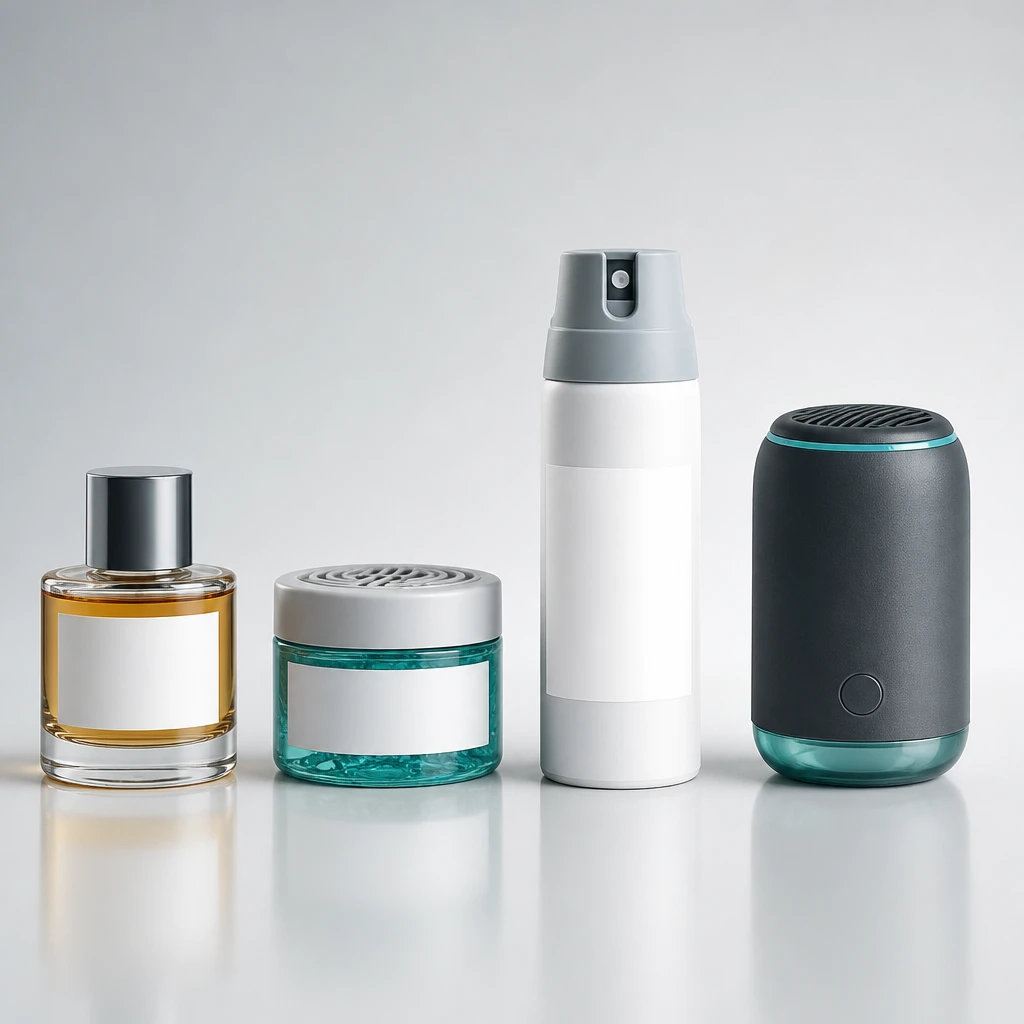
Why can't car fragrance brands rely solely on changing a scent?
If you ask a consumer, "What brand of car fragrance did you last buy?" the likely answer is silence. It's not that the scent is unpleasant, but that the vast majority of car fragrances have almost no difference in product form, appearance design, or usage method—a cylinder, a clip, a replacement pad, and the only difference is the scent name on the label.
This is exactly what brands should be most wary of:Scent is the easiest difference for consumers to perceive, but it's also the fastest thing competitors can copy. You create a "forest after rain," and your competitor can launch a "after rain forest" next month. When the product itself doesn't create recognition, consumers will always remember "that scent" rather than "that brand."
Changing scents can only bring short-term sales fluctuations, but it cannot accumulate brand equity.
The root cause of homogenization in car air fresheners: beyond the fragrance type, users perceive no difference.
The essence of homogenization is not that 'everyone is making car air fresheners', but thatthe product does not give users a reason to choose you at the physical level.。 Many car air fresheners on the market share the same mold shells, identical materials, similar vent clip designs, and even similar essential oil concentrations. When consumers glance at the shelf, they see a row of items that 'look the same but smell different', and the final decision often comes down to price.
Once caught in price competition, the brand's profit margins and bargaining power are compressed. More critically, user loyalty to such products is extremely low—next time they buy, they will switch to whoever is cheaper.
Four customizable dimensions for a differentiated product line: fragrance type, appearance, logo, and packaging.
To break away from homogenization, brands need to redefine car air fresheners from "consumables" to "brand carriers." Specifically, they can start from four dimensions simultaneously, rather than just focusing on fragrance types:
- Fragrance type: Not just choosing a scent, but defining a fragrance system.For example, layer by scenario (commuting refreshment, long-distance relaxation), by season, and by user group, forming a logical fragrance matrix rather than scattered individual products.
- Appearance: The shell material (metal, leather, soft rubber), styling language, and surface finishing process determine whether the product is a "tool" or an "accessory" in the car.This is the most direct source of brand recognition.
- Logo: From silk-screen printing and laser engraving to in-mold decoration, the way a logo is presented affects the product's texture.A logo embedded through craftsmanship conveys a completely different brand value than a sticker logo.
- Packaging: The unboxing experience, inner lining structure, and instruction manual design determine the first impression when users receive the product, and also influence the brand premium capability in gifting scenarios.
Only when these four dimensions are combined can the product be "recognized" on shelves and social media. In the next section, we will elaborate on the customization space and trade-offs of each dimension to help you judge which investments are worthwhile and which are merely self-indulgent.
Fragrance Customization: How Can High-Concentration Plant-Extracted Pure Oil-Based Essential Oils Become the Starting Point for Brand Differentiation?
The aspect of the car fragrance product line most prone to homogenization is precisely the fragrance type that consumers perceive first. When shell designs and charging methods can be quickly imitated, scent becomes one of the few brand memory points that are 'different at first sniff.' The high-concentration plant-extracted pure oil-based essential oils used in the SOCELI smart car diffuser are precisely the differentiation space reserved for brands in the fragrance dimension.
Pure oil-based essential oils vs. ordinary fragrances: differences users can smell
The difference between the two is not a qualitative 'good or bad,' but the difference between 'what it smells like' and 'what it is.'
Ordinary car fragrances are typically based on synthetic aroma chemicals, diluted with solvents, with advantages of low cost, fast scent diffusion, and good batch consistency. But their shortcomings are also obvious: fast diffusion means fast evaporation, with a sharp initial scent, noticeable attenuation in the middle and late stages, and a tendency to feel 'cloying' after prolonged exposure. For brands, this means consumers' memory of the fragrance is short-lived—after three months of use, they may only remember 'there is a scent,' not 'that scent.'
The difference of pure oil-based essential oils lies in their smoother evaporation curve. High-concentration plant extraction means more complex aroma molecules, with clearer layering of top, middle, and base notes. In the enclosed small space of a car, the diffusion rate is actually more controllable. Combined with SOCELI's slow-release/controlled-release diffusion technology, the fragrance is not released all at once but continuously and steadily.
Consumers perceive less difference in scent intensity between the 20th and 40th minutes of their commute, and this 'sense of stability' is part of the brand's texture.
It should be noted that pure oil-based essential oils do not equate to 'natural equals better.' Plant-extracted fragrances have natural batch-to-batch variations, requiring higher standards in fragrance blending and quality control. If your brand positioning is 'healthy and safe formula' or 'natural lifestyle,' pure oil-based essential oils align with this narrative;If your core selling point is 'ultimate cost-effectiveness,' the synthetic fragrance route may better match your cost structure.
How to Implement Custom Fragrance: From Scent Selection to Exclusive Formulas
Custom fragrance is not about 'picking one from a catalog and printing your logo on it,' but a process of deriving a scent solution from your brand identity. SOCELI's customization process generally consists of four steps:
- Confirming the fragrance direction: The brand provides the target user profile, usage scenarios (daily commute or long-distance driving), and brand tone keywords.This step determines the broad direction, such as 'woody or citrus notes' and 'fresh or calm feel.'
- Sampling and blind testing: Based on the direction, provide 3-5 candidate fragrance samples, and it is recommended that the brand organize small-scale user blind tests to collect real feedback rather than internal preferences.During blind testing, focus on whether the scent causes fatigue after prolonged exposure and whether it can be accurately described—only scents that users can describe have communication value.
- Formula fine-tuning and finalization: Adjust the concentration ratio based on feedback to determine the final formula.Here, a key condition needs to be clarified: the minimum order quantity for custom formulas, development cycle, and whether exclusive formula fees are involved must be confirmed based on your expected sales volume and brand strategy.If you are only testing the waters with a small batch, starting with combinations from the existing fragrance library may be a more pragmatic starting point.
- Stability verification and mass production: Confirm the fragrance stability of the essential oil under high temperatures (summer car interior temperatures can exceed 60°C) and long-term storage conditions before entering mass production.
Who is suitable for deep customization? Brand owners with a clear brand positioning, a defined target customer base, a willingness to invest in development costs for 'exclusive scents,' and reasonable expectations for subsequent sales. **Who is not suitable?
** For channel distributors still in the market testing phase, with frequent SKU planning changes, or mainly relying on low-price high-volume sales, it is more prudent to choose SOCELI's existing fragrance library for white-labeling rather than deep customization.
Key question to confirm next: Does your brand positioning allow consumers to pay a premium for 'scent uniqueness'? If the answer is generally yes, fragrance customization is a differentiation starting point worth investing in;If the answer is uncertain, first conduct a small-scale market test with existing fragrances and let the data speak.
Appearance and Logo Customization: How to Make the Product a Brand Identifier in the Car?
After receiving the SOCELI smart car aromatherapy diffuser (Model A125), the first question brand owners usually ask is: How can this device, when placed in the car, make others recognize my brand at a glance? The answer depends on whether you want to be "seen" or "remembered"—the costs and paths of these two goals are completely different.
The boundaries of appearance customization: trade-offs between light luxury design and mold costs
The soceli smart car aromatherapy diffuser itself follows a light luxury design route, and the shell material and surface treatment already have a certain texture recognition. This means that if your brand tone is close to "refined and minimalist,"you can achieve a good visual presentation without modifying the mold.。
Deep appearance customization (changing the shape, altering the structure, re-tooling) is suitable for brands in the following situations:
- Planned long-term sales: The expected life cycle of a single product is more than 2 years, and the mold cost can be amortized.
- There is a clear series planning: The same appearance derives multiple fragrance or color versions, forming a family design.
- Channels have requirements for exclusivity: Some boutique stores and high-end automotive accessory channels require the product's appearance to be clearly differentiated from common market goods.
Situations where mold opening is not recommended initially: First-time cooperation, unverified order quantities, and the brand's visual identity system is still being adjusted. At this point, mold investment may become a sunk cost—every time the brand VI changes, the appearance has to change accordingly.
A practical criterion for judgment:First, calculate the proportion of mold costs in the total cost of the initial order.If it exceeds 15%-20%, it is recommended to first validate the market with the existing appearance before deciding on deep customization.
Logo customization and packaging: the minimum viable solution for brand identity
Without modifying the mold, brand identity can be achieved through three levels, listed from low to high cost:
- Flat logo printing: Use silk-screen printing or laser engraving on the existing flat surfaces of the device.Suitable for simple graphics or text logos, with low cost and short lead time, it is the lowest-threshold solution for market validation.
- Custom packaging system: Including the outer box, inner tray, instruction manual, and fragrance label.This is the most noticeable stage for enhancing brand perception—the first impression users form within 10 seconds of opening the package often comes from the packaging rather than the device itself.
- Accessory-level customization: Such as the color of the charging cable and the packaging form of the fragrance refill.The cost is moderate, but it allows the brand to be continuously exposed during subsequent use of the product.
What are the methods for logo customization? For the soceli product, the practical paths include printing on the device body (silkscreen/laser engraving), packaging printing, and customization of the fragrance refill label. Specifically, regarding which positions on the A125 body are suitable for printing and which process to use, you need to provide your logo file format and color requirements, and the soceli team will confirm the process feasibility—the adhesion on different material surfaces varies, which affects the final effect and wear resistance.
Judgment of suitable and unsuitable
| Situation | Recommended path |
| First cooperation, order volume not verified | Flat logo + packaging customization, control initial investment |
| Existing stable sales, ready for brand upgrade | Evaluate deep appearance customization, first get design drafts to confirm mold feasibility |
| Channel requires exclusivity | Discuss deep customization directly, but only make a decision after the minimum order quantity is clearly defined. |
| The brand VI is still being adjusted frequently. | Hold off on any customization for now; ship with standard packaging first. |
Next step to confirm actions:Provide the soceli team with your brand logo files, desired placement (on the device, packaging, or both), and expected initial order quantity. These three pieces of information are sufficient to determine which customization path suits you, along with the corresponding cost range and timeline.
How to implement OEM customization: from sampling to mass production, what do brands need to confirm?
OEM customization is not as simple as 'picking a product and slapping a logo on it'. From the moment you decide to create your own branded car fragrance to the actual product launch, there are three key milestones in between: sampling, sealing, and mass production. If any of these milestones is not properly confirmed, the rest will turn into costs.
Sampling stage: confirm the three core items: fragrance, appearance, and packaging.
Sampling is the lowest-cost opportunity for error correction. At this stage, you only need to focus on three things:
Fragrance confirmation. Soceli currently offers a variety of fragrance options, but what you need to confirm is not just 'does it smell good,' but three things: who is the target user group (male and female car owners have very different preferences), whether the fragrance is stable in high-temperature car environments (car interiors can reach over 60°C in summer, and low-quality essential oils will change odor), and whether your brand positioning is fresh or woody. It is recommended that after Soceli provides the fragrance list, you select 3-5 options for actual scent testing, and do not make decisions based only on fragrance names.
Appearance confirmation. This includes product color, logo process (silk screen, UV printing, or metal patch), and whether brand color elements need to be added to the device body. Note: Appearance changes directly affect mold costs and minimum order quantity.
If only changing color, the cost is usually lower;If changing the structure, a new mold is required, and both the minimum order quantity and lead time will increase significantly. It is recommended to first confirm the scope of appearance changes supported by the existing mold, then discuss design ideals.
Packaging confirmation. Packaging involves the inner tray, outer box, instruction manual, and whether to include replacement essential oil bottles. What needs to be confirmed: the packaging material (paper or plastic), whether the dimensions fit the existing logistics boxes, and whether brand-specific packaging needs to be designed.
Packaging sampling is usually faster than product sampling, but it also requires confirming the printing color values and material texture.
Mass Production Stage: Clarify Quality Control Standards and Communication Mechanisms
After sample confirmation, the core of the mass production stage is not 'chasing delivery' but clearly defining the acceptance standards.
Quality control standards must be quantified. For example: the allowable error range for essential oil filling volume, the acceptable degree of shell scratches, the testing ratio for charging functions, and the sampling plan for each batch. These standards should be confirmed in writing before mass production, not verbally agreed upon.
Soceli's smart car aromatherapy diffuser involves a charging module and a Type-C interface. The yield rate of electronic components directly affects your after-sales costs, so be sure to confirm the testing process for electronic parts.
The communication mechanism should be fixed. Clarify who your point of contact is, how often production progress is updated, how quickly feedback is given when anomalies occur, and whether you need to send someone to inspect the goods before bulk shipment. These may seem like process issues, but they actually determine whether you can intervene before problems escalate.
Confirm the minimum order quantity and delivery time. Before mass production, you must confirm the minimum order quantity, production cycle, and whether partial shipments are supported. If your channels operate both online and offline, partial shipments can reduce inventory pressure, but you need to confirm in advance whether soceli supports this.
Frequently Asked Questions
Q: How long does the entire cycle from sampling to mass production take for OEM customization? A: It depends on the scope of changes. Color and logo changes alone are usually faster, while structural changes or new mold development take longer.
It is recommended to provide your change list directly to the soceli team before sampling to get an accurate timeline estimate.
Q: Can the fragrance be fully customized? Or can we only choose from existing fragrances? A: soceli offers an existing fragrance library and can also blend fragrances according to your needs.
However, developing a completely new fragrance from scratch requires additional fragrance development time and minimum order quantity requirements. It is recommended to first check if any existing fragrance is close to your target before deciding whether to customize.
Q: Is there a minimum order quantity for logo customization? A: Yes. Different logo processes (such as screen printing, UV printing, etc.) have different minimum order quantity requirements.
The specific numbers need to be confirmed with the soceli team based on the process you choose and the quantity of products.
Q: If problems are found with the product during mass production, who is responsible? A: This depends on the quality control standards and acceptance terms you confirmed before mass production. It is recommended to clarify the sampling inspection ratio, handling of defective products, and division of responsibilities before cooperation to avoid disputes after mass production.
Q: Can the packaging design be provided entirely by our brand? A: Yes. You can provide design files, and Soceli will assist in bringing them to production; or you can use Soceli's packaging solutions for brand customization.
The key is to confirm the format requirements of the design files and the printing color standards to avoid color difference issues.
Learn More
If your brand is planning a car diffuser product line, feel free to contact the SOCELI team with your target user profile, brand tone, and initial order expectations, and we will help you evaluate the most suitable customization path.
Related Products:Smart Car Diffuser