
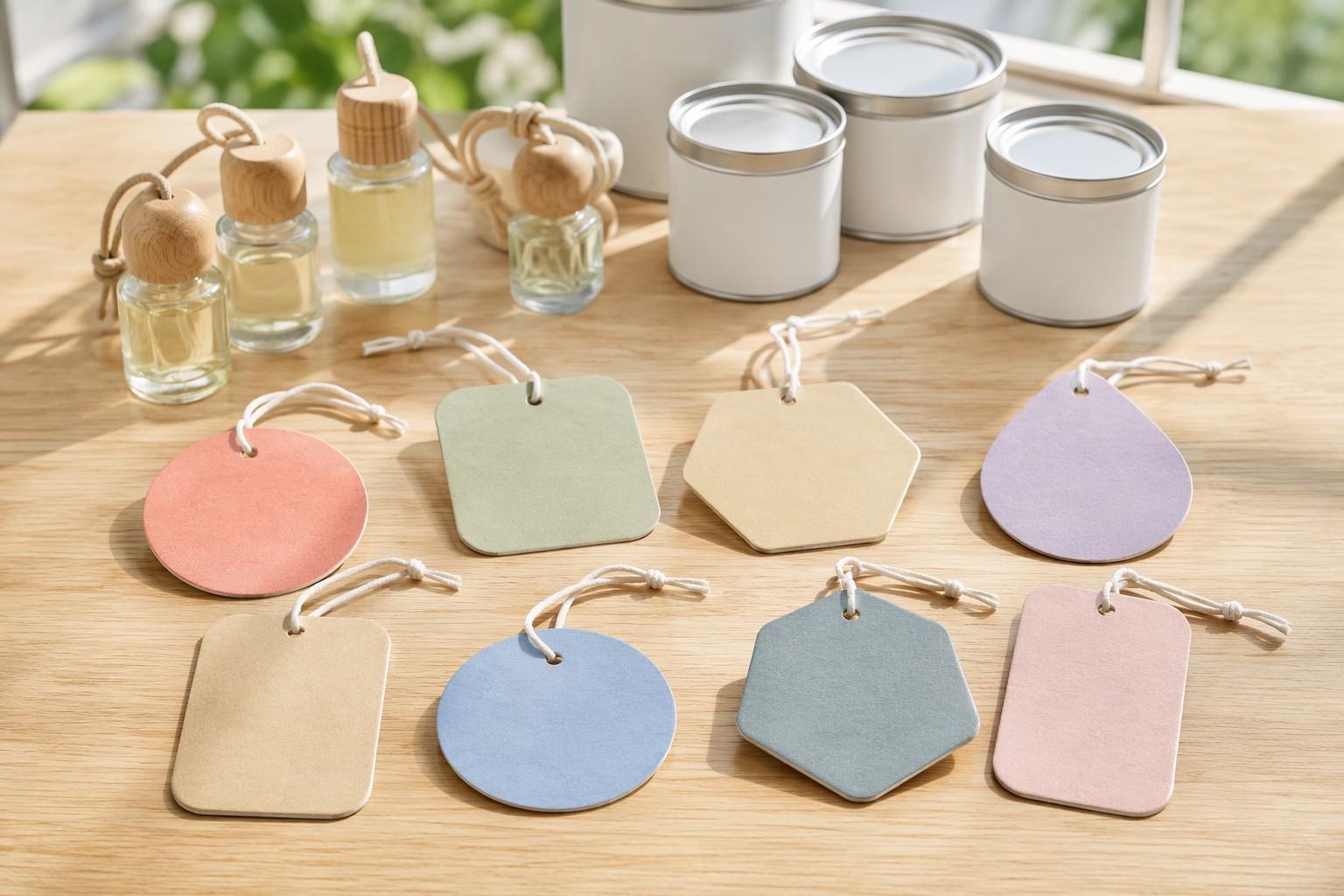
What is the essential difference between paper-based car fragrance and liquid car fragrance?
When many procurement professionals first encounter paper-based car fragrance, their initial reaction is, "It's made of paper, how can it have any scent?" This intuition is understandable, but it is precisely the fundamental difference in the diffusion mechanism between paper-based and liquid fragrances that determines they are suitable for completely different usage scenarios.
From the perspective of diffusion mechanism: the difference between controlled-release matrix and free evaporation
The diffusion method of liquid fragrance is straightforward: the fragrance oil is dissolved in a solvent and continuously released into the air through a wick or a diffuser stick. Its characteristic isstrong top notes and fast diffusion, but the fragrance intensity will noticeably decrease as the liquid level drops. Especially in the high-temperature environment inside a car, liquid aromatherapy may be pungent in the early stage and then quickly lose its scent, resulting in a very unstable fragrance release curve.
Paper-based car aromatherapy takes a different approach. Taking the controlled-release paper-based technology used by SOCELI as an example,the fragrance is not simply attached to the paper surface but is locked within the controlled-release matrix structure inside the paper base.The fragrance is released slowly and evenly through the microporous channels of the matrix, rather than evaporating in large amounts at once. This means its scent diffusion is a 'steady and continuous' process.
This means its scent diffusion is a 'steady and continuous' process.This means its scent diffusion is a 'steady and continuous' process.—the initial scent is not overpowering, but it can maintain a relatively stable fragrance concentration over a longer period.
For the buyer, this difference directly affects a judgment:Is your usage scenario 'short-term strong effect' or 'long-term stable presence'? If it's a gift for new car delivery, the customer wants the 'new car goodwill' at the moment of pickup, and the burst effect of liquid fragrance may be more intuitive;But if it's a brand gift box or promotional item, hoping the customer will repeatedly perceive the brand's presence over the next few weeks, the steady release of paper-based is more suitable.
From the material perspective: differences between paper-based materials and liquid containers
The impact of material differences is often more worth paying attention to than the fragrance itself.
The form of liquid fragrance determines that it must haveContainers, solvents, and volatile structuresThis trio. This means: there is a risk of leakage during transportation, a hidden danger of glass or plastic container expansion under high temperatures, and liquid products typically require stricter packaging protection during express delivery. For bulk purchasing and distribution scenarios, these are hidden costs and management burdens.
Paper-based materials naturally avoid these problems. Ithas no liquid, no container, no volatile sticks, and the whole is a thin and light car fragrance tablet. It is safer in transport, saves more space in storage, and is more convenient during distribution—just place it directly into a gift box or a vehicle document bag.
For promotional product buyers, this means lower logistics losses and a simpler delivery process.
But the boundaries of the paper base should also be made clear: its fragrance diffusion range is usually smaller than that of liquid aromatherapy, making it more suitable for enclosed small spaces like car interiors. If your intended use scenario is an open space or requires a strong presence that is noticeable 'as soon as you enter,' the paper base may not be the optimal solution.
Next confirmation step: When communicating with the SOCELI team, it is recommended to directly clarify two things—first, the actual fragrance retention duration of the paper-based aromatherapy at the target usage temperature (high temperatures in summer cars will accelerate release), and second, whether the fragrance concentration can be adjusted according to your brand tone. These two parameters directly determine whether the paper-based solution matches your specific use.
Why is paper-based aromatherapy superior in safety and fragrance retention stability?
When purchasing promotional items, what you really need to evaluate is not 'which scent smells good,' but 'whether this product will cause problems in the car and how long it will last.' These two points directly determine the experience customers have after receiving the product, and also determine whether your brand will suffer due to a failed giveaway.
Safety Comparison: No Liquid Leakage Risk and MSDS Certification
The core risk of liquid air fresheners lies in the 'liquid' itself. In a car environment, after summer sun exposure, the temperature inside the car can reach 60-70°C. The liquid inside glass or plastic containers expands when heated, posing a risk of leakage or even bursting. Once leakage occurs, the fragrance may corrode the car's interior, stain fabrics, and the cleaning cost far exceeds the value of the air freshener itself.
Paper-based air fresheners eliminate this risk from a physical standpoint—without a liquid container, there is no path for leakage. SOCELI's paper-based car air freshener sheets use a solid paper-based material to carry the fragrance. Even under high-temperature sun exposure, it only accelerates the release of the scent without any liquid spillage.
But "no liquid" does not mean "safer and more secure". What the purchaser really needs to confirm is safety at the chemical level. This is where the MSDS certification comes in. MSDS (Material Safety Data Sheet) is a chemical safety data sheet that lists the toxicity, flash point, handling precautions, and emergency response procedures for fragrance ingredients.
For car air fresheners, the significance of MSDS lies in:Whether the supplier knows exactly what chemical raw materials they use, and whether these materials are safe in a high-temperature enclosed space. Air freshener products without MSDS mean that the supplier cannot even clearly state the ingredient risks, and this uncertainty is unacceptable in promotional product scenarios.
SOCELI's paper-based air fresheners have passed MSDS safety certification, meaning that their fragrance formulas have undergone systematic safety assessments, allowing purchasers to explain product safety to their clients.
Fragrance Retention Stability Comparison: How Controlled-Release Technology Achieves Ultra-Long-Lasting Scent
The scent retention curve of liquid aromatherapy is typically 'high at first, low later'—when first opened, the fragrance is strong and pungent, noticeably diminishes after a week, and is essentially imperceptible after three weeks. This is because the evaporation rate of liquid fragrance is greatly affected by temperature; it evaporates quickly in direct sunlight and almost stops in cool conditions, causing dramatic fluctuations in fragrance concentration.
The scent retention logic of paper-based aromatherapy is completely different. SOCELI employs controlled-release paper-based technology, using a scientific controlled-release matrix to 'lock' fragrance molecules within the paper fiber structure, allowing the fragrance to be released continuously at a nearly constant rate. This means:
- Not overwhelming at the start: It won't be so strong that it irritates your nose right after unboxing
- Not fading later: It won't completely lose its scent in the second week
- Overall stability: Low fluctuation in scent intensity, providing a more consistent customer experience
For promotional product buyers, the practical significance of scent retention stability is:Your brand exposure duration is predictable。 Liquid aromatherapy may become a 'scentless ornament' after three weeks, while paper-based aromatherapy has a scent cycle closer to the 'long-lasting fragrance' you promise to customers. SOCELI's paper-based aromatherapy, with the same fragrance loading, has a significantly longer scent retention period than liquid aromatherapy of the same specifications, and its scent decay curve is gentler.
Procurement judgment: What you should focus on
| Decision Point | Liquid Aromatherapy | Paper-Based Aromatherapy (SOCELI) |
| High-Temperature Leakage Risk | Exists, requires additional protective design | No liquid, physically eliminates leakage |
| Ingredient safety traceable | Depends on whether supplier provides MSDS | MSDS certified |
| Fragrance release curve | Strong at first, weak later, with large fluctuations | Controlled-release matrix, stable and long-lasting |
| Customer perceived quality | May create negative impressions due to leakage/off-flavor | Novel form, stable experience |
Next confirmation step: Request a copy of the MSDS document from the SOCELI team to confirm whether the fragrance ingredients contain substances prohibited by your brand (such as specific allergens);At the same time, request test data on the duration of fragrance retention under different temperature conditions, and determine whether it matches your expected promotional campaign cycle.
In brand customization scenarios, how are the environmental friendliness and customization flexibility of paper-based aromatherapy reflected?
When selecting products for promotional items, buyers most often ask two questions: Is it environmentally friendly? Can it be printed with a logo? Paper-based aromatherapy has clear answers on both points, but the extent to which it can be achieved needs to be examined in detail.
Environmental friendliness: advantages of natural cotton fibers and naturally decomposable materials
The core materials of paper-based aromatherapy are natural cotton fibers and paper-based materials, without the plastic shells or glass bottles commonly found in liquid aromatherapy. At the end of the product's life cycle, the paper-based part can decompose under natural conditions, avoiding plastic dependence from the source of materials. SOCELI's paper-based car fragrance tablets use controlled-release paper-based technology, where the fragrance carrier itself is the paper-based material.
It should be noted that while the paper base is decomposable, the fragrance tablets contain fragrance oils, and the environmental impact of residual fragrance depends on the specific formulation. If the brand emphasizes the concept of "zero waste," it is recommended to confirm with the SOCELI team whether the fragrance ingredients are suitable for composting, rather than directly using terms like "naturally biodegradable."
Customization capabilities: from colors and patterns to flexible OEM/ODM solutions
The flexibility of paper-based materials in customization is superior to that of liquid fragrances—customization for liquid fragrances is usually limited to shell printing and fragrance selection, while paper-based fragrances allow for deeper customization:
- Patterns and printing: The surface of the paper base can be directly printed with brand logos, slogans, and patterns, with high color reproduction.
- Shape cutting: Can be die-cut into brand IP images or festive elements, while the mold cost for liquid aromatherapy shells is much higher.
- Fragrance Blending: From fresh citrus to woody notes, customizable, and exclusive fragrances can be tailored to the brand's identity.
- OEM/ODM Depth: From fragrance formulas to product structure, SOCELI's own factory provides integrated control and supports rapid prototyping.
Customization ProcessTypically four steps: requirement communication (clarify whether it's just logo printing or full ODM) → sample confirmation (verify printing effect, fragrance concentration) → production scheduling → acceptance and delivery.
Scenarios Suitable for Paper-Based Aromatherapy CustomizationThis includes brand festival gift boxes (where paper-based materials naturally harmonize with gift box packaging), new car delivery gifts for 4S dealerships (lightweight with no risk of liquid leakage), and corporate promotional items (cost-controllable with flexible customization). If the brand emphasizes a sense of luxury and heaviness, or if the product needs to maintain stable fragrance for months under high-temperature exposure, it is recommended to verify through sampling before making a decision.
How to determine whether your brand should choose paper-based or liquid aromatherapy?
Here is the conclusion first:If your brand has a clear image positioning, needs safe and compliant gifts, and does not want customers to complain about leakage or pungent fragrance after receiving them, choose paper-based aromatherapy. If your core requirement is only "cheapest and able to emit fragrance," and you are not at all concerned about liquid leakage and transportation issues, liquid aromatherapy can be considered. However, the latter is usually not the better solution in promotional item scenarios.
When to choose paper-based aromatherapy: when safety, stability, and environmental friendliness are prioritized.
Paper-based car air fresheners (such as SOCELI custom paper car air freshener sheets) are suitable for the following three typical scenarios:
- Brand holiday gift boxes or souvenirs: The paper-based material is lightweight, thin, and can be printed on flat surfaces, allowing it to fit well into the card slots of gift boxes without requiring additional fixing structures.Liquid air freshener bottles require leak-proof packaging in gift boxes, increasing both cost and volume.
- 4S dealership new car delivery gifts: New car interiors already have their own smell, and customers are sensitive to 'extra scents'.Paper-based controlled-release technology uses a scientific controlled-release matrix to achieve a steady, sustained release of fragrance, avoiding the experience gap of liquid air fresheners, which are 'too strong in the first three days and then lose their scent'.Additionally, paper-based products contain no glass or liquid, making them safer in high-temperature environments inside cars during summer.
- Enterprise bulk procurement as promotional items: If you need to print a brand logo, customize the fragrance, and quickly produce samples, the customization cycle for paper-based aromatherapy is usually shorter, and transportation and storage do not need to be treated as liquid dangerous goods, making logistics costs more controllable.
Key trade-off: The diffusion intensity of paper-based aromatherapy is usually lower than that of liquid aromatherapy. If you expect to "smell a distinct fragrance as soon as you open the car door," paper-based may not achieve this effect. Its advantage is stability, uniformity, and non-irritating—these are exactly the qualities needed for brand giveaways.
When to choose liquid aromatherapy: extremely low budget and no safety concerns
Liquid aromatherapy (such as car perfume bottles) is suitable for a very narrow range of scenarios:
- Budget is extremely sensitive, and the unit cost must be minimized.The raw materials and container costs of liquid aromatherapy can indeed be lower than those of paper-based controlled-release tablets.
- The usage scenario does not involve high temperatures or direct sunlight.For example, it is only used in spring and autumn, and the vehicle is parked in a mild environment.
- You are not worried about leakage complaints.Liquid bottles have a risk of leakage during transportation, bumping, and temperature changes. Once it occurs, the customer experience will directly lower the brand impression.
Situations where it is not suitable:If your brand targets household users, needs long-term retention (for example, customers keep it in the car for several months), or you have clear requirements for quality and safety, the leakage risk and fragrance fading issues of liquid aromatherapy will become after-sales burdens.
How to judge whether a car fragrance supplier is reliable?
Don't just look at whether the sample smells good; check the following four points one by one:
- Whether safety certification documents are provided: At least an MSDS (Material Safety Data Sheet) should be available.SOCELI's products have passed MSDS safety certification. You can directly request the documents from the other party to verify, rather than relying on verbal promises.
- Whether they have their own factory: If the other party says "we have a factory," ask clearly whether it is their own or outsourced.The integrated control of a self-owned factory means that sampling speed, quality stability, and customization response are more controllable.
- Sampling cycle and cost: A reliable supplier will clearly tell you how many days sampling takes, whether it is charged, and whether the sampling fee is deducted from bulk orders.If they are vague, subsequent cooperation is likely to be delayed.
- Fragrance library and customization capabilities: Ask how many fragrance types are available and whether the fragrance concentration can be adjusted according to your brand positioning.The core of paper-based controlled release technology lies in 'controlled release'. If the supplier cannot clearly explain the fragrance release curve, it indicates insufficient technical accumulation.
What is the minimum order quantity for custom car air fresheners?
There is no unified industry standard for MOQ; it depends on the supplier's production line and process. The minimum order quantity (MOQ) for paper-based aromatherapy is typically lower than that for liquid aromatherapy (because liquid involves filling lines and bottle procurement). You need to directly confirm the current MOQ with the SOCELI team, and also ask clearly: how many fragrance types and how many printing layouts can be offered within the MOQ.
If your brand has multiple vehicle models or series requiring different fragrances, this number directly impacts your solution design.
Frequently Asked Questions
Q: How long does the scent last for paper-based aromatherapy? A: SOCELI paper-based car aromatherapy uses controlled-release paper-based technology, achieving steady and sustained fragrance release through a scientific controlled-release matrix, with significantly longer scent duration than ordinary paper sheets. However, the specific duration is affected by in-car temperature and ventilation habits. It is recommended to request actual test data from the team and evaluate whether it meets your standards based on your usage scenarios (e.g., new car delivery vs. daily commuting).
Q: Will paper-based aromatherapy deteriorate in high summer temperatures? A: Paper-based materials are more stable than liquids at high temperatures and will not leak due to thermal expansion and contraction. However, high temperatures will accelerate the evaporation of fragrance, which is a physical characteristic of all aromatherapy products.
If you use it in the southern summer, you can ask the supplier to provide temperature resistance test data.
Q: Can multiple fragrance types be customized at the same time? A: Yes, but you need to confirm whether multiple fragrance types can be produced in batches within the minimum order quantity. It is recommended to determine 2-3 candidate fragrance types during the sampling stage to avoid frequent adjustments during mass production.
Q: Is paper-based aromatherapy suitable for printing complex patterns? A: Paper-based materials are suitable for flat printing, and logos, gradients, and fine lines can all be rendered. However, if you need special processes such as embossing or hot stamping, you need to confirm process compatibility with the team in advance to avoid the design being finalized but not achievable.
Learn more
If you are evaluating car diffuser solutions for promotional items or brand gift boxes, feel free to contact the SOCELI team, submit your usage scenarios and customization needs, and we will assist you in confirming whether paper-based diffusers are suitable and provide sampling support.
Related products:SOCELI Custom Paper Car Diffuser.